


 Francais
 Deutsch
 Italiano
Refine Your Search
Coney Island New York 1898 stock footage and images
- Showing 8479 to 8484 of 11259 results more
more Hide
Hide
U.S. troops find a child in a village, and takes it to the center for lost and orphaned children in Okinawa, Japan during WWII.
Orphaned children in Okinawa, Japan, during Battle of Okinawa of World War II. The U.S. troops advance through the roads of a rubbled village. Trees and damaged buildings along the sides of the road. A U.S. soldier, holding guns, walks along the side of a rubbled building and finds a small child. Two soldiers seated beside the child. One of the soldiers wipes the face of the child. The soldiers pick up the child and move towards the army jeep. The army jeep with soldiers and the child moves along the road. The jeep stops near a building. The soldier takes the child to the center for lost and orphaned children in Okinawa. The child is placed on a low table. A Red Cross worker and a man puts new clothes on the child and attends to the child. Views of other children in the center. The Red Cross worker feeds the child from a bowl. The workers at the center gives medical attention to a wounded child. A worker attends to a few days old baby. A child in the center looks on.
U.S. 58th Bomb Wing, 468th Bombardment Group B-29 Superfortress bombers land on West Field, Tinian during World War II.
U.S. Army Air Forces bombardment group return to West Field, Tinian after bombing missions over Nagoya, Japan during World War II. U.S. 58th Bomb Wing, 468th Bombardment Group B-29 Superfortress bombers land on runways 1 and 2, West Field. B-29s taxi after landing.
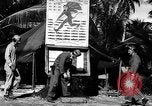
U.S. air operations at newly built airstrip on Ulithi Atoll in World War II
During World War 2, three pilots of Marine Torpedo Bombing Squadron 232 (VMTB-232) stand in front of Billboard displaying their squadron symbol of a red devil with spear and cape. It also displays silhouettes of Japanese ships they had struck. View of the newly constructed airstrip at Ulithi, as an F6F aircraft takes off. It is followed, in turn, by a C-47 (R4D),a PBY, and another F6F. Aerial view of Ulithi and the new broad runway running across the atoll.

Specialists at the Kessler Institute for Rehabilitation help the disabled and handicapped to recover.
Handicapped and disabled people at Kessler Institute for Rehabilitation, West Orange, New Jersey. A musician who met with a swimming pool accident plays an instrument with sticks. A physically handicapped boy reads a book. A man at the center is tested on Kohs block intelligence test. A woman puts on makeup after recovering from an accident. The founder, Dr. Henry Kessler talks about special training to be given to the patients to recover from disabilities. Specialists including physical therapists at Kessler Institute help the disabled recover. Disabled clients receiving therapy. A new leg is given to a woman who met with an accident and she takes her first step. Kessler specialist helps the woman to walk again properly.
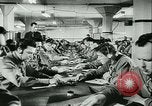
U.S. Army Signal Corps officers train at Fort Monmouth and production of signal communication items in the United States.
The role and contribution of the U.S. Army Signal Corps in combat and war. U.S. Army Signal Corps officers train at the Signal Corps Officer Candidate School (OCS) Fort Monmouth, New Jersey. Officers train at telegraph machines under the supervision of an instructor. Officers seated at desks in a classroom. Instructors take classes with the help of charts, diagrams and black boards. Officers seated atop electric poles for training. Two officers train in hand-to-hand combat at the OCS. Officers learn to use Radio Relay. Students listen to an instructor as he demonstrates the process. A U.S. soldier lays field wire across a hilly terrain to establish wire communications in the European Theater during World War II. Soldiers on the hill. Soldiers set up a sending station at the point where the wire can't go forward. A receiver is set up at the point from where the wire can go forward again. A soldier receives a photograph of a map through facsimile. Items of signal communication including radio relays, receivers, walkie-talkies, radio boxes and fuses to be produced and distributed by the USA Signal Corps to all other ground forces, navy and the Allies. New, modern, improved efficient signal communication equipment. A soldier displays two old type fuses and their counterparts.
People take precautionary measures before an impending hurricane the United States.
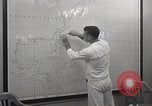
The role of Airborne Early Warning Squadron Four in the United States. A man plots the course of the hurricane on a chart. Reports are checked. The Weather Bureau issues a warning over the radio. An aircraft take off. Small boats kept ready. A toy removed from a garden. Civilians seal their doors and windows. Civilians listen to the radio to get news about the approaching hurricane. The course of the hurricane plotted on a chart. People listen to a news broadcast about the hurricane's change of course.
CRITICALPAST.COM: About Us | Contact Us | FAQs - How to Order | License Agreement | My Account | My Lightboxes | Shopping Cart | Advanced Search | Featured Collections | Website Terms & Conditions | Privacy Policy ©2026 CriticalPast LLC.
License Agreement |
Terms & Conditions |
Privacy Policy
©2026 CriticalPast LLC.