


 Francais
 Deutsch
 Italiano

Refine Your Search
Coney Island New York 1898 stock footage and images
- Showing 8491 to 8496 of 11285 results more
 Hide
Color Sound

Specialists at the Kessler Institute for Rehabilitation help the disabled and handicapped to recover.
Handicapped and disabled people at Kessler Institute for Rehabilitation, West Orange, New Jersey. A musician who met with a swimming pool accident plays an instrument with sticks. A physically handicapped boy reads a book. A man at the center is tested on Kohs block intelligence test. A woman puts on makeup after recovering from an accident. The founder, Dr. Henry Kessler talks about special training to be given to the patients to recover from disabilities. Specialists including physical therapists at Kessler Institute help the disabled recover. Disabled clients receiving therapy. A new leg is given to a woman who met with an accident and she takes her first step. Kessler specialist helps the woman to walk again properly.
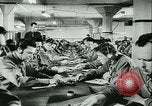
U.S. Army Signal Corps officers train at Fort Monmouth and production of signal communication items in the United States.
The role and contribution of the U.S. Army Signal Corps in combat and war. U.S. Army Signal Corps officers train at the Signal Corps Officer Candidate School (OCS) Fort Monmouth, New Jersey. Officers train at telegraph machines under the supervision of an instructor. Officers seated at desks in a classroom. Instructors take classes with the help of charts, diagrams and black boards. Officers seated atop electric poles for training. Two officers train in hand-to-hand combat at the OCS. Officers learn to use Radio Relay. Students listen to an instructor as he demonstrates the process. A U.S. soldier lays field wire across a hilly terrain to establish wire communications in the European Theater during World War II. Soldiers on the hill. Soldiers set up a sending station at the point where the wire can't go forward. A receiver is set up at the point from where the wire can go forward again. A soldier receives a photograph of a map through facsimile. Items of signal communication including radio relays, receivers, walkie-talkies, radio boxes and fuses to be produced and distributed by the USA Signal Corps to all other ground forces, navy and the Allies. New, modern, improved efficient signal communication equipment. A soldier displays two old type fuses and their counterparts.
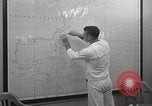
People take precautionary measures before an impending hurricane the United States.
The role of Airborne Early Warning Squadron Four in the United States. A man plots the course of the hurricane on a chart. Reports are checked. The Weather Bureau issues a warning over the radio. An aircraft take off. Small boats kept ready. A toy removed from a garden. Civilians seal their doors and windows. Civilians listen to the radio to get news about the approaching hurricane. The course of the hurricane plotted on a chart. People listen to a news broadcast about the hurricane's change of course.

Quaker college students participate in a Penn-Craft work camp, building homes at a Pennsylvania mining community
College student volunteers of the American Friends Service Committee (Quakers) work together at a Penn-Craft work camp, building homes and facilities for a coal-mining community in Pennsylvania (possibly Norvelt?). Opening image shows the book "The Plight of the Bituminous Coal Miner" by Homer Lawrence Morris and Joseph H. Willits. View of farmland and a new mining community from a high hill. Craft work Camp in Pennsylvania. View of a community mining area. Coal elevator building and rows of miner's homes close together in the background. Students help miners build new homes. They work on scaffolding, building walls of homes with stone and mortar. View of lumber piled high and a worker sawing a board. Workers move building materials in wheelbarrows. A stone home with a partially framed roof. An African American student volunteer breaks up rock with a sledge hammer. Volunteers load stone from a nearby quarry onto waiting trucks. Workers slide rocks from a quarry to a waiting team below, who loads rock pieces into a mill that pulverizes the rock and turns it into stone dust that is then carried away for use in the building projects. View of Miners simple, temporary houses. A mining family relaxes on a bench swing in front of a house and children of miners play with a dog. Men framing a temporary home. A woman volunteer paints the exterior of a house.

United States B-29 Superfortress bombers at Boeing Aircraft Plant No. 2, in Seattle, Washington
New United States B-29 Superfortress bombers on the tarmac and taxiing, landing and taking off at the Boeing Aircraft Plant Number 2, in Seattle, Washington. New B-29, tail number 46-1808 is seen. Employee stands fire guard as a B-29 starts engines. Activity on the field.
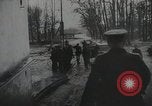
Spanish General is decorated and German and Italian military leaders coordinate defense of Italy during World War 2
Commander of the German 18th Army, Colonel General Georg Lindemann, arrives to personally recognize Spanish Army General Emilio Esteban Infantes, commanding officer of the Spanish "Blue Division" (German 250th Infantry Division) for successfully repelling attack by the Russian 55th Army, in the Battle of Krasny Bor on the Eastern Front in February, 1943. Other officers help General Esteban Infantes to place an Iron Cross decoration around his neck. Scenes of German General Field Marshal Albert Kesselring reviewing Italian and German troops in Italy at an airfield and presenting award to some of the soldiers. In next scene, Benito Mussolini enters a room and then is seated in the first meeting of the leaders of the new Fascist Republican Party, including Alessandro Pavolini and Italian Minister of War Rodolfo Graziani. Next segment covers arrival of German Field Marshal Erwin Rommel to Italy, touring fortifications and inspecting defenses in Italy. He is seen reviewing port lookouts and defense points with German artillery. In once scene he passes an elderly Italian civilian and gives him the Nazi salute, which is returned weakly by the Italian. Next segment covers further expansion of Italian defenses, with the laying of barb wire by troops, including one soldier cutting his pants knee on the barbed wire. Also shows demolition of trees using dynamite. Explosions as trees are blown up. Then shows placement of new artillery guns and positions. German soldier reviewing a map while on phone receiving enemy position information. German soldiers in hills fire artillery at enemy position in a valley.
CRITICALPAST.COM: About Us | Contact Us | FAQs - How to Order | License Agreement | My Account | My Lightboxes | Shopping Cart | Advanced Search | Featured Collections | Website Terms & Conditions | Privacy Policy ©2026 CriticalPast LLC.
License Agreement |
Terms & Conditions |
Privacy Policy
©2026 CriticalPast LLC.