


 Francais
 Deutsch
 Italiano
Refine Your Search
Coney Island New York 1898 stock footage and images
- Showing 8677 to 8682 of 11259 results more
more Hide
Hide
U.S. Air Force helicopters and DC-8 land at Le Bourget Airport in Paris after successful first non stop transatlantic flight.
New records completed at Le Bourget Airport in Paris, France. Two U.S. Air Force helicopters land at the Le Bourget airport in Paris. The captains make the first non stop transatlantic flight aboard the helicopters. Men greet and welcome the captains for setting a new record. Captains and crew pose with the helicopter. In final scene, a Douglas DC 8-61, the world's largest jet airplane, lands at the airport after its first flight. Passengers get off the DC-8 aircraft.
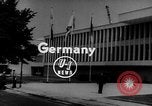
U.S. Commander General Frank Howley receives an honorary degree during the inauguration of a library and a auditorium in Germany.
Inauguration of a library and an auditorium in Germany. View of the new library and the auditorium building dedicated by the Free University of Berlin. U.S. City Commander General Frank Howley and his wife arrive at the new library. Howley receives an honorary degree during the ceremony.
A soldier arrives at the U.S. Military District of Washington DC and reports to Fort Myer to join the U.S. Army.
A soldier (PFC Ed Griffiths) arrives in new assignment with the U.S. Army in Washington DC, United States. U.S. Army Sergeant Stuart Queen in his office. Military MATS C-131 (Convair 240) airliner in flight over Washington DC area with PFC Griffiths and other personnel aboard. Army personnel seated in the aircraft. The captain makes arrival announcements. Aerial view of the Washington Monument , the National Mall, Lincoln Memorial, and Potomac River and the Capitol. Military Air Transport Command C-131 parked and passengers descending stairs upon arrival in Washington, DC. They exit the Operations building and look for ground transportation to their destinations. Soldier gets into a taxi cab. He looks at the Washington Monument and the Lincoln Monument, across the Potomac River, as the cab drives, along the George Washington Parkway, past them. He arrives at the U.S. Army Military District of Washington Headquarters, at Fort Myer, and reports for his new assignment in Headquarters Company, U.S. Army. The Sergeant in charge introduces Sergeant Stuart Queen to the soldier. He is warmly welcomed.
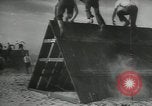
Training of American draftees before World War II; also Japanese attack on Pearl Harbor and Roosevelt's request for declaration of war.
United States soldiers and new recruits at a camp in the U.S. before outbreak of World War II. New recruits and U.S. Army soldiers in training run obstacle course. Soldiers in their uniforms march through the camp area. Tents in the background. Newly drafted U.S Army soldiers learn to fire weapons on firing range using artificial wooden rifles. U.S. soldiers seen training with wooden replica machine guns and using empty Adelphi beer cans as substitute artillery ammunition for training purposes. Teams of soldiers compete in moving a giant ball. They compete in blindfolded boxing on their knees. Lacking adequate war materiel for training, they make do by pretending that trucks are tanks and labeling them with such signs. They pretend with wooden guns and throw flour sacks instead of grenades. Scenes of the Pearl Harbor raid by the Empire of Japan on December 7, 1941. Views of the USS Arizona being hit and various ships on fire soon after the attack. United States President Franklin D. Roosevelt is seen addressing Congress, where he asks for a declaration of war against Japan.
U.S. President Lyndon B Johnson presents the Medal of Honor to American servicemen in Virginia, United States.
The Hall of Heroes at the Pentagon in Virginia, United States. Footsteps echo in Pentagon hall as camera moves along corridor toward the Hall of Heroes. John Charles Daly stands next to a giant replica of the U.S. Medal of Honor and speaks about medal recipients. He steps in front of a display listing names of Medal of Honor recipients and explains the medal's significance. Scene shifts back in time , to May, 1968 when President Lyndon Baines Johnson is seen speaking at the dedication of the Hall of Heroes, where he confers the Medal on recipients from each of the four military services. He calls out the names of : Charles C. Hagemeister (Army); James E. Williams (Navy); Gerald O. Young (Air Force) and Richard A. Pittman (Marine Corps). President Johnson says their names will be placed with others in the new Hall of Heroes. The President places the medals around the necks of the respective recipients as citations accompanying their awards are read. Next, Mr. Daly is seen again in front of the list of recipients. He notes that these four new additions brought the total of names to 3,210.
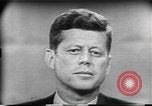
John F Kennedy talks about the importance of welfare programs during a presidential election debate in Chicago, Illinois.
The first Kennedy-Nixon Presidential Debate in Chicago, Illinois. Stuart Novins from CBS News asks Democratic candidate Senator John F Kennedy about welfare programs for education system, medical care and reduction in the federal debt. Kennedy argues that he has not mentioned about the federal debt reduction in his speeches. He states the advantages of his program for providing medical care for the aged and an effective education system. He tells that the development of natural resources will generate revenues to finance new projects. He states about the importance of a balanced budget. Republican candidate U.S. Vice President Richard M. Nixon presents his views and states that the reduction of federal debt was mentioned on the Democratic platform and not in Kennedy's speech. He presents his views on Senator Kennedy's proposal for medical care for the aged and the development of the natural resources. He states that Kennedy's proposals will result in rise in taxes and unbalancing of the budget which will lead to inflation. He favors the aid for school construction.
CRITICALPAST.COM: About Us | Contact Us | FAQs - How to Order | License Agreement | My Account | My Lightboxes | Shopping Cart | Advanced Search | Featured Collections | Website Terms & Conditions | Privacy Policy ©2026 CriticalPast LLC.
License Agreement |
Terms & Conditions |
Privacy Policy
©2026 CriticalPast LLC.