


 Francais
 Deutsch
 Italiano
Refine Your Search
Coney Island New York 1898 stock footage and images
- Showing 10177 to 10182 of 11281 results more
more Hide
Hide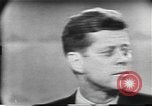
During a presidential election debate in Chicago Kennedy talks about the threats of Communism to the national security.
The first Kennedy-Nixon Presidential Debate in Chicago, Illinois. Charles Warren from Mutual News asks Democratic candidate Senator John F Kennedy about the threats of Communism to the national security of the United States. Kennedy states that matter of Communism should be given great care and attention. He states that the citizens should support the laws passed by the United States and they should sustain the Department of Justice and the Federal Bureau of Investigation (FBI) in its efforts. He further states that the Americans can meet any internal threat but the major threat is external. Republican candidate U.S. Vice President Richard M. Nixon presents his views and states that he agrees with Senator Kennedy's appraisal generally in this respect. He talks about the Cold War. He states that they could also fight Communism at home by moving against those various injustices which exist in their society which the Communists feed upon.
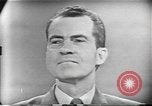
During a presidential election debate in Chicago Richard M. Nixon talks about the reasons for the financing of schools.
The first Kennedy-Nixon Presidential Debate in Chicago, Illinois. Sander Vanocur from NBC News asks Republican candidate U.S. Vice President Richard M. Nixon whether the financing of the schools and hospitals was provided by the Eisenhower Administration or by the local school districts. Nixon answers and states that they only think about the work of the federal government. Instead they should consider the joint effort by the federal, state, local government and individual enterprise. The reason the Eisenhower Administration has supported the funds to build schools, hospitals and highways is because this administration has encouraged individual enterprise. Another reason is the greatest expansion of the private sector of the economy and the overall growth of our country. Democratic candidate Senator John F Kennedy presents his views and states that the reason for the construction of schools is because of the willingness of the local school districts to increase property taxes. And also because the United States is a powerful country. He compares the country's progress with that of their adversaries and hopes an overall progress in the field of education, in health, in buildings, in homes and in economic strength.
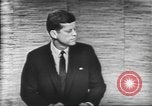
During a presidential election debate in Washington DC, Kennedy comments that its proper to express regrets to nations.
The second Kennedy-Nixon Presidential Debate in Washington DC, United States . Edward P. Morgan of ABC News asks Democratic candidate Senator John F Kennedy about sending apologies or regrets to General Secretary of the Communist Party of the Soviet Union Nikita S Khrushchev over the U-2 reconnaissance aircraft incident. Kennedy answers that if it could save the summit conference it would have been proper to express regrets. He speaks that the U-2 flights were proper from the point of view of protecting their security. But they were not in accordance with the international law. He speaks about the regrets expressed to Castro, to Southern Russia and to Eastern Germany under the Eisenhower Administration during the past years. He mentions the regrets expressed by the Soviet Union and the Chinese Communists to the U.S. over incidents. He states about they should have a stronger military force and should increase their strength all over the world. Republican candidate U.S. Vice President Richard M. Nixon presents his views and states that Senator Kennedy is wrong in thinking that Khrushchev might have continued with the summit conference if the U.S. had expressed regrets. He disagrees with Kennedy's analogies that the U.S. is a strong country and can express regrets for any wrong doings. He also disagrees in expressing regrets to anybody for doing things which has the support of the Congress and which is right from point of view to protect the security of the U.S. (This 4 part debate is sometimes called the Great Debate)
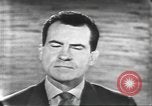
Nixon and Kennedy comment on the Cold War and Communist prestige during a presidential election debate in Washington DC.
The second Kennedy-Nixon Presidential Debate in Washington DC, United States. Edward P. Morgan of ABC News asks Republican candidate U.S. Vice President Richard M. Nixon to comment on whether the United States was doing well in the Cold War. Nixon states that they were not doing as well as they should have in the Cold War because of the presence of the Communists on the international scene. He says that the Communist prestige in the world is lower than the American prestige. He comments on cost cuttings on programs like mutual security and defense by the Democratic Congresses. Democratic candidate Senator John F Kennedy disagrees with Nixon's statement that the Congress has not provided funds for national defense. He also disagrees on the question of U.S. position in the United Nations. He mentions that various reports of Congressional committees indicate that the relative strength of the U.S. compared to that of the Soviet Union and the Chinese Communists together has deteriorated in the past years. Alvin Spivak of United Press International asks Kennedy how the losing prestige can be regained, and programs accomplished without damaging economy. Kennedy talks about the breaking off of the sugar quota with Cuba, passing of an authorization, and the development of the Inter-American Bank. He states that the U.S. has looked at the needs of Latin America. He states that instead of concentrating aid on surplus military equipment in Laos, the aid should have been concentrated in long-term loans. He concludes that Americans should identify themselves not only with the anti-Communist fight but also with the fight against poverty and hunger. Nixon presents his views and states that along with the necessity for economic assistance, the need for technical assistance should also be developed. Americans should not only think in terms of fighting Communism but also in terms of the interests of these countries. He concludes and mentions American ideals of independence, right of freedom and right of progress.
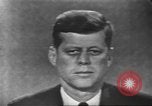
During an election debate in the US, John F Kennedy and Richard Nixon talk about the conduct, temperament, and speech of the U.S. President.
The third Kennedy-Nixon Presidential Debate in the United States. Charles Van Fremd from CBS News asks Democratic candidate Senator John F Kennedy whether he owed an apology to Vice President Nixon and the Republican Party, on behalf of Democrats, after former President Harry Truman "bluntly suggested where the Vice President and the Republican Party could go." Kennedy answers that President Harry S Truman has his methods of expressing things and he has been in politics for fifty years. He says that he could not tell President Truman to change his particular speaking manner, and perhaps only Mrs Truman could. Republican candidate Vice President Richard M Nixon says that U.S. President has an obligation not to lose his temper in public. He speaks of the importance of the standing of the office of the President, and how children all over America are influenced by the behavior and words of the President. He states that he is proud that President Eisenhower has restored dignity and good language to the conduct of U.S. Presidency. He implies that if he wins the election he would be the right kind of role model for children.
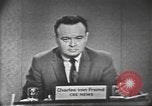
The third presidential election debate between Senator John Kennedy and U.S. Vice President Nixon in the United States.
The third presidential election debate held between Democratic nominee Senator John F. Kennedy and Republican nominee U.S. Vice President Richard Nixon in the United States. ABC news correspondent Von Fremd questions Vice President Richard Nixon about exodus of four billion dollars of gold in past three years from the United States. Vice President Nixon responds stating that there should be balanced budget in the country and increase in exports from the United States. He further says that the U.S. must support programs abroad for economic and military assistance. Senator Kennedy speaks about oil depletion. He further talks about gold. He says that United States have to maintain balance of trade, sound monetary and fiscal policy and control over inflation.
CRITICALPAST.COM: About Us | Contact Us | FAQs - How to Order | License Agreement | My Account | My Lightboxes | Shopping Cart | Advanced Search | Featured Collections | Website Terms & Conditions | Privacy Policy ©2026 CriticalPast LLC.
License Agreement |
Terms & Conditions |
Privacy Policy
©2026 CriticalPast LLC.