


 Francais
 Deutsch
 Italiano
Refine Your Search
Coney Island New York 1898 stock footage and images
- Showing 10315 to 10320 of 11281 results more
more Hide
Hide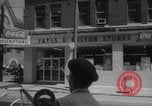
Yates and Milton Drug Store, Citizen Trust bank in Sweet Auburn neighborhood, Atlanta, Georgia
Street scenes in the Sweet Auburn neighborhood in Atlanta, Georgia. A bus stops in front of a Yates & Milton Drugstore (230 Auburn Ave NE, Atlanta, GA 30303, United States) in Atlanta, Georgia, owned by Clayton R. Yates and Lorimer D. Milton. A “Drink Coca-Cola Prescriptions” sign hangs outside the drugstore. African American commuters board the bus in front of the drugstore. Southern Bread advertisement on bus reads “New! Made with Buttermilk … Southern Bread”. African American men and women pass by the Yates & Milton Drugstore in the Sweet Auburn neighborhood. Butler Street YMCA (22 Jesse Hill Jr Dr NE, Atlanta, GA 30303, United States--formerly 20-24 Butler St) located in the Sweet Auburn Historic District, next to the Walden Building. Pedestrians crossing the road in front of the Yates & Milton Drugstore. Alexander & Company (208 Auburn Ave NE #10, Atlanta, GA 30303, United States) and Citizens Trust Co. building next door (210 Auburn Ave. NE) beside the Big Bethel AME Church. The Atlanta Daily World editorial office and printing press facility is also seen at 210 Auburn. (The Atlanta Daily World business office was located elsewhere on Auburn.) . A rotating time and temperature monitoring clock on top of the Citizens Trust Co. sign. This was the first African American owned bank to join the FDIC.
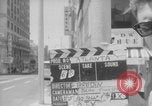
Downtown Atlanta, Georgia street scenes.
The Dawg House restaurant in Atlanta, Georgia. Sign hanging in storefront reads “The noblest of all animal is the dog- and the noblest of all dogs is the hot dog- it feeds the hand that bites it – Leo Aikman”. Pedestrians crossing the Forsyth Street at intersection with Peachtree St. in front of the Arthur Murray dance studio. Billboard on top of building reads “Miami New Everglades Hotel”. Cars stopping for pedestrians to cross Forsyth. Pedestrians in early 1960s fashions walk past a hat boutique. A Hoover truck is parked on the street. A woman crosses the street while holding her toddler son. View of downtown Atlanta as seen from a moving car. S.H. Kress department store and Baker’s Shoes shop on Broad Street.

Lathes produced inside a factory in Shenyang, China
Chinese Vice Director of Machinery Plant Number 1 in Shenyang, China stands with his office staff. Newly built lathes in the factory during China's Great Leap Forward program. A Chinese worker operating one of the lathes. Workers pull a crate containing a new lathe while other workers insert rollers underneath the crate to keep it rolling.
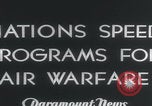
England recruits R.A.F. flyers while ramping up fighter production before WWII.
A man views a British Royal Air Force (RAF) recruitment poster. Poster reads “Join the R.A.F. and see the world”. British men marching through gate as they enter a military base as new recruits prior to World War 2. Several recruits trying on RAF coats in front of officers inside an office. Factory workers working on aircraft and mounting engine in a fighter plane, probably a Hawker Hurricane. Aerial view of an airfield with airplanes parked in formation.
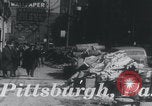
Workers cleaning up debris after the Pittsburgh flood of 1936
Pittsburgh, Pennsylvania after the Pittsburgh flood of 1936 (March 17-18, 1936). Workers cleaning up debris at 610 Stanwix Street in front of the Joseph Horne Co. department store building. Men tossing debris on a truck and shoveling debris out of the street. A large flood water pump emptying water onto the street. Policeman with a ruler pointing to a plaque mounted to the store's corner at Stanwix Street and Penn Ave. that reads “HIGH WATER, MARCH 15TH 1907”. The police officer then points to new high-water mark on the pillar which is much higher.

American and Iranian official tighten bolts connecting last track section in Iran
Railroad infrastructure development as part of United States aid in Iran. Men laying railroad tracks on a bridge. Donkey grazes and two men watch the construction in the foreground. A railroad track laying machine and workers hold a track. Man stands on top of track as a team of workers carry the track. Machine threshing rocks on track. Laborers use pickaxes and rakes to break up rocks. Teams of workers lay track on railroad. Laborers connect two railroad tracks. American engineer and Iranian official tighten bolts connecting last track section. Men moving a track. Workers crowd to watch two men fasten bolts. Workers cheering and clapping after the two men finished connecting the last track section. American engineer and Iranian official shake hands. Men watch a cargo train use the new tracks. A train rushes past camera in Iran.
CRITICALPAST.COM: About Us | Contact Us | FAQs - How to Order | License Agreement | My Account | My Lightboxes | Shopping Cart | Advanced Search | Featured Collections | Website Terms & Conditions | Privacy Policy ©2026 CriticalPast LLC.
License Agreement |
Terms & Conditions |
Privacy Policy
©2026 CriticalPast LLC.