


 Francais
 Deutsch
 Italiano
Refine Your Search
Coney Island New York 1898 stock footage and images
- Showing 235 to 240 of 11257 results more
more Hide
Hide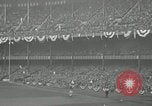
Montage of scenes reflecting life in the United States during the decade of the 1920s, following World War I
Baseball great, Babe Ruth starting to trot around the bases after hitting a home run. An inverted stunt biplane, N57323 with "EM Avery" readable on fuselage while flying inverted. A wing walker is strapped under the airplane (on top wing, now underneath). The airplane rolls over into upright position, trailing white smoke to be more easily seen by spectators on the ground. A 1920s jazz band comprised of African American musicians playing in a night club. A couple and then four women, dancing the Charleston. Point of view (POV) from moving car driving along Broadway in New York City at night, surrounded by neon light signs including some like the Winter Garden Theatre and the Rivoli Theatre. A flagpole sitter atop structure behind an RKO Keith's Advertising sign. Closeup of the man on his perch. A room full of women sewing garments in a factory. Wealthy, formal dressed couples at a city supper club, where an orchestra is playing. Exhausted couples clinging to one another on dance floor during a marathon dance contest. Gangsters firing a machine gun from window of a moving car. Charles A. Lindbergh steps past a policeman, to board his Ryan monoplane, "Spirit of St.Louis,"at Roosevelt field, Long Island, New York, on May 20, 1927. View of takeoff roll. Registration number "NX-211," visible atop the right wing. Manhattan ticker tape parade welcoming Lindbergh back to New York City, following his successful solo transatlantic flight. Charles Lindbergh speaking at a microphone. Traders on floor of the New York Stock Exchange during era of frantic stock market speculation. Money counted out at bank teller window. Labor strife at the gates of a Massey-Harris Company plant, with workers being hit with clubs and fleeing attacks by men hired by the company. Boy workers pose for a photograph While narrator mentions Child labor Act declared unconstitutional (1922). A girl worker. Boys employed as coal miners. Workers installing body panels on cars and working on engines in automobile production and assembly lines. Partially completed vehicles driving out of an automobile factory. Babe Ruth rounding third base and coming to home plate after hitting a home run in a baseball game.
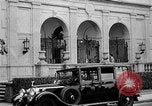
Creation of Good Neighbor Fleet of ships operated by Moore-McCormack Line with service from the U.s. to South America and Latin America
Exterior view of Pan American Union Building in Washington DC, with a 1930s Packard four door sedan-limousine parked in front. A man entering the building. Jefferson Caffery, U.S. Ambassador to Brazil, seated in an office and reviewing paperwork. Narrator describes the creation of the Good Neighbor Fleet (where Moore-McCormack Lines, also called Mooremack, was contracted to run three ocean liners of the U.S. Maritime Commission between the USA and South America, called the Good Neighbor Fleet.) Close up picture of brochure advertising the new fleet, and picturing the three ships (The California, Virginia and Pennsylvania from the former Panama Pacific Line, with new names Uruguay, Brazil and Argentina.) Next scene shows 3 men meeting (this is possibly Moore-McCormack Lines founder Albert V. Moore, on right, seated at a table and in discussion, possibly with U.S. Maritime officials. Man on left is possibly Emmet McCormack.) Passengers aboard liner SS Brazil as it departs port. Crowd on docks wave at the ship leaving New York harbor. View from on board SS Brazil in New York Harbor as a nearby tug boat sprays water. Skyline and skyscrapers of New York City's Manhattan Island seen in background. Map of South America showing route of a Good Neighbor ship. Good Neighbor Fleet ships at a harbor in South America. U.S. State Department diplomats in South America beside one of the ships as fleet service is inaugurated. Exterior view of Pan American Union building and its sign in Washington DC (later called the building of the Organization of American States). President Ortiz of Argentina, President Alfredo Baldomir of Uruguay, and President Getulio Vargas of Brazil are shown in discussion with various officials.
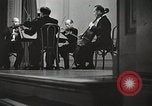
American Cities in the 1950s
Americans listen to a chamber string quartet playing music on stage. Vintage views of various famous American cities in the 1950s. Sweeping wide views of American wilderness with mountains in distant background. Elevated view of a river in America. A railroad marshaling yard with skyline of Chicago Illinois in the distance. Close view of two railroad trains passing in opposite directions in downtown Chicago with skyscraper in background. A city street in downtown Detroit Michigan with 1950s cars on the road. View of the Stone Arch Bridge in Minneapolis Minnesota and the city skyline in background. View of Saint Paul Minnesota with river, bridge, and some nearby factories. View of Saint Louis Missouri as seen from an anchored position on the Mississippi River. The city skyline of New Orleans from a distance. View of Pittsburgh skyline with the West End Bridge over the Ohio River in the foreground. People walk on the grounds of Liberty Island in New York, with the Statue of Liberty seen towering above. Aerial view of New York city's skyline, skyscrapers and New York harbor. Camera view panning from ground to top of Empire State Building in Manhattan. Aerial view of Washington DC and Potomac River. Ground view of Jefferson Memorial. The Lincoln Memorial, Washington Monument and U.S. Capitol seen together. Steps of Lincoln Memorial and view of statue of U.S. President Abraham Lincoln inside the memorial. An eastern American mountain view, witha lake or river in the foreground. View of Half Dome peak in Yosemite National Park seen from a moving vehicle. Elevated view of a dense forest in the western United States. Pacific coast scene of surf washing onto rocks in a rocky area with nearby cliffs and mountains.
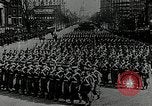
Early 20th century America footage; establishment and early circumstances of the U.S. Department of Labor
Film opens with view from a building overlooking President Woodrow Wilson's Inauguration Day parade along Pennsylvania Avenue, on March 4, 1913. A large contingent of U.S. Army West Point cadets march in forefront of the parade. Spectators line the sidewalks. Several stand atop buildings. Outgoing President, William Howard Taft is seen in his office signing a bill establishing the U.S. Department of Labor. Closeup of the bill and Taft signing it. Scenes of traffic and pedestrians in New York City. Some of the pedestrians appear to be wealthy class. Crowded early 20th century city streets filled with various horse drawn carriages together with bus traffic and early automobiles in chaotic confusion. A double decker bus with open top and sign "Fifth Avenue" and lower sign "To 22nd Street Only" operates in busy traffic on 5th Avenue beside horse drawn carriages and other motorized vehicles. Glimpses of women working in a factory; Men pouring molten metal into molds; Women punching time clocks as they leave a factory. Newly arrived immigrants at Ellis Island, New York City circa 1910 or during first 10 years of the 1900 decade. View of the Statue of Liberty. Women working in a textile factory. Men tapping a furnace in a steel plant. Pushcarts and peddlers at market lining the curb in a Jewish neighborhood of New York City (possibly lower east side). Brief view of pioneer Labor leader Samuel Gompers, founder of the American Federation of Labor. He hold a walking stick and doffs his hat. Sketches illustrating scenes of labor-related violence. Department of Labor sign being affixed to its location. A horse and wagon, representing the first assets of the new Department. A group of persons illustrative of the employees in the Department's Bureau of Labor Statistics.
Franklin D. Roosevelt's early years in politics before becoming President of the United States
Franklin D. Roosevelt seen, well-dressed, in overcoat and hamburg hat, as a successful New York lawyer, in 1910, when he decides to run for a seat in the New York State Senate. He is seen greeting supporters outside his family home, Springwood, in Hyde Park New York, after winning the election. Very brief glimpse of Eleanor Roosevelt. Governor James M. Cox of Ohio, Democratic Party candidate for President, is seen with Franklin Roosevelt,Assistant Secretary of the Navy, whom he selects as his running mate, in 1920. View of Eleanor Roosevelt being recognized in the Democratic National Convention at the Civic Auditorium in San Francisco, California. Views of Franklin Roosevelt driving in an open car and speaking before crowds during the campaign of 1920. One crowd is notable for the preponderance of straw boater hats worn and waved by the men in the audience. Scenes of family life, after defeat of the Cox-Roosevelt ticket. Eleanor Roosevelt with children: Anna Eleanor;Franklin Delano Jr. II; Elliot; James; and Anna's dog, in 1921, at their summer retreat on Campabello Island, New Brunswick, Canada. Franklin D. Roosevelt (FDR), seated in a wicker chair in front yard of the Campobello house, smoking a pipe and writing on some papers. FDR standing with a cane.His mother, Sara Delano Roosevelt, seated and conversing with FDR. Eleanor, with them, knitting as they converse. Political aid,Louis McHenry Howe.FDR posing with cane, alone, and with wife, Eleanor. Mrs. Roosevelt hosting a gathering at Springwood, to promote FDR's political future. Eleanor speaking at a political gathering.
Peacetime activities and contributions by the U.S. Army in the United States.
Scenes from Army Day on April 6, 1934. Secretary of War George Henry Dern, in broadcast to the nation about importance of the Army, in peacetime. Brief glimpses of the Yellowstone River lower falls and Old Faithful and Beehive geysers erupting in Yellowstone Park, Wyoming. View amongst log buildings in Reproduction of Army Fort Dearborn, at the 1933 Century of Progress Exposition in Chicago, Illinois. A pioneer wagon; Native American Indians in ceremonial regalia; antique locomotives and trains at the Exposition. Army General Leonard Wood being sworn in as the Governor General of the Philippines. Closeup of General of the Armies, John J. Pershing, America's highest ranking Military officer. Headquarters of Walter Reed Army hospital, in Washington, DC, named for U.S. Army Major Walter Reed, who confirmed that yellow fever is transmitted by mosquito. Acting on this, the U.S. was able to complete the Panama Canal. View of French dredging equipment sitting idle in the water after Yellow Fever prevented them from completing the Panama Canal. Closeup of U.S. Army General William C. Gorgas, who, in 1904, headed the Sanitary Department that controlled mosquitoes and eradicated Yellow Fever, so the Panama Canal could be finished. View of alligator in swamp near the Panama Canal. Photograph of George Washington Goethals, Chief Engineer credited with making the canal happen. Explosives employed in Panama Canal construction. Earth and rocks being loaded into open rail cars. A steamship transiting the Panama Canal. The Washington Monument; U.S. Library of Congress; and the Lincoln Memorial, cited as examples of accomplishments by U.S. Army engineers. The Wilson Dam, under construction by Army engineers, in Muscle Shoals, Alabama and system of levees being built to control the Mississippi River. The raging Mississippi River during 1927 flood. Flood victims being assisted by U.S. Army soldiers, at a tent camp, receiving food and clothing. An Army airplane flying over a forest fire. Army personnel supervising men in the Civilian Conservation Corps or CCC. Mail being loaded aboard an Army airplane, as airmail service is being opened between Washington DC and New York City. President Woodrow Wilson talking with Army pilot Major Reuben H. Fleet. Mail being loaded into the nose of an airplane. U.S. Army Douglas World Cruiser airplanes in flight, returning from their trip around the world in 1924. A pilot sitting in front seat of a Douglas O-38 airplane, pulls a fabric hood over his cockpit to practice "blind flying". View of the aircraft in flight, with instructor pilot in the open rear cockpit. Army aviators taking a camera and a rifle aboard their airplane as they prepare to leave on an aerial mapping flight. Aerial view of skyscrapers of Manhattan Island, New York City. Army Signal Corps personnel working on communications devices. A cable laying ship operating at sea, in support of the U.S. Army's Alaskan cable and telegraph system. Men loading chemicals into hoppers on Army crop dusting airplane. Several views of Army airplanes crop dusting. Glimpse of boll weevil, the target of their efforts. Closeup of Karl Connell, who as a major in the AEF, in World War I, invented a superior gas mask known as the “Connell” or “Victory” mask. A group of miners wearing gas masks enter a smoky mine entrance. The Army invented tear gas, which is shown being used to thwart a bank robbery, in a staged demonstration. Brigadier General Hugh Johnson, appointed by President Franklin Roosevelt, as head of the Great Depression era National Recovery Administration, or NRA, is seen about to give a speech. Narrator cites him as an example of U.S. Army officers who also serve the country in civilian life. Scene shifts to cadets on parade at the United States Military Academy, West Point, New York.
CRITICALPAST.COM: About Us | Contact Us | FAQs - How to Order | License Agreement | My Account | My Lightboxes | Shopping Cart | Advanced Search | Featured Collections | Website Terms & Conditions | Privacy Policy ©2026 CriticalPast LLC.
License Agreement |
Terms & Conditions |
Privacy Policy
©2026 CriticalPast LLC.