


 Francais
 Deutsch
 Italiano

Refine Your Search
Coney Island New York 1898 stock footage and images
- Showing 241 to 246 of 11285 results more
 Hide
Color Sound
Peacetime activities and contributions by the U.S. Army in the United States.
Scenes from Army Day on April 6, 1934. Secretary of War George Henry Dern, in broadcast to the nation about importance of the Army, in peacetime. Brief glimpses of the Yellowstone River lower falls and Old Faithful and Beehive geysers erupting in Yellowstone Park, Wyoming. View amongst log buildings in Reproduction of Army Fort Dearborn, at the 1933 Century of Progress Exposition in Chicago, Illinois. A pioneer wagon; Native American Indians in ceremonial regalia; antique locomotives and trains at the Exposition. Army General Leonard Wood being sworn in as the Governor General of the Philippines. Closeup of General of the Armies, John J. Pershing, America's highest ranking Military officer. Headquarters of Walter Reed Army hospital, in Washington, DC, named for U.S. Army Major Walter Reed, who confirmed that yellow fever is transmitted by mosquito. Acting on this, the U.S. was able to complete the Panama Canal. View of French dredging equipment sitting idle in the water after Yellow Fever prevented them from completing the Panama Canal. Closeup of U.S. Army General William C. Gorgas, who, in 1904, headed the Sanitary Department that controlled mosquitoes and eradicated Yellow Fever, so the Panama Canal could be finished. View of alligator in swamp near the Panama Canal. Photograph of George Washington Goethals, Chief Engineer credited with making the canal happen. Explosives employed in Panama Canal construction. Earth and rocks being loaded into open rail cars. A steamship transiting the Panama Canal. The Washington Monument; U.S. Library of Congress; and the Lincoln Memorial, cited as examples of accomplishments by U.S. Army engineers. The Wilson Dam, under construction by Army engineers, in Muscle Shoals, Alabama and system of levees being built to control the Mississippi River. The raging Mississippi River during 1927 flood. Flood victims being assisted by U.S. Army soldiers, at a tent camp, receiving food and clothing. An Army airplane flying over a forest fire. Army personnel supervising men in the Civilian Conservation Corps or CCC. Mail being loaded aboard an Army airplane, as airmail service is being opened between Washington DC and New York City. President Woodrow Wilson talking with Army pilot Major Reuben H. Fleet. Mail being loaded into the nose of an airplane. U.S. Army Douglas World Cruiser airplanes in flight, returning from their trip around the world in 1924. A pilot sitting in front seat of a Douglas O-38 airplane, pulls a fabric hood over his cockpit to practice "blind flying". View of the aircraft in flight, with instructor pilot in the open rear cockpit. Army aviators taking a camera and a rifle aboard their airplane as they prepare to leave on an aerial mapping flight. Aerial view of skyscrapers of Manhattan Island, New York City. Army Signal Corps personnel working on communications devices. A cable ship operating at sea, laying cable in support of the U.S. Army's Alaskan cable and telegraph system. Men loading chemicals into hoppers on Army crop dusting airplane. Several views of Army airplanes crop dusting. Glimpse of boll weevil, the target of their efforts. Closeup of Karl Connell, who as a major in the AEF, in World War I, invented a superior gas mask known as the “Connell” or “Victory” mask. A group of miners wearing gas masks enter a smoky mine entrance. The Army invented tear gas, which is shown being used to thwart a bank robbery, in a staged demonstration. Brigadier General Hugh Johnson, appointed by President Franklin Roosevelt, as head of the Great Depression era National Recovery Administration, or NRA, is seen about to give a speech. Narrator cites him as an example of U.S. Army officers who also serve the country in civilian life. Scene shifts to cadets on parade at the United States Military Academy, West Point, New York.

Airships in flight over Statue of Liberty
Views from one of two U.S. Navy Class C airships in flight over Bedloe's Island, New York City. Statue of Liberty on Bedloe's Island. Airships pass over the Statue of Liberty.

Montage of U.S. scenes covering various parts of the nation
Opening scene shows a wheat field in the United States. White hot molten metal collected in ladles as a furnace is tapped. Sandstone buttes the Navajo Nation's Monument Valley Park. Half Dome in Yosemite National Park. Michigan Avenue in Chicago, Illinois, as seen from a moving vehicle looking North from the Art Institute, with many skyscrapers of glass and steel. A white church in a suburban setting. The Japanese cherry trees in bloom along the Tidal Basin in Washington DC. A major river and an old fashioned stern wheeler River Boat cruising on it. A street scene in New Orleans, Louisiana. A roadway in Florida. A fishing village scene in New England. A formation of oil well pumps operating out West. Cowboys on horseback herding cattle in a wide open prairie view. View of the Statue of Liberty with dramatic sunset behind it. Two U.S. Marines conversing as they look at the Manhattan skyline in New York City. Aerial view of the skyscrapers on Manhattan Island. View of Times Square in Manhattan, with the Astor Hotel visible (It was razed in 1967). Police officer directing traffic at an intersection. Two Marines walking past the United Nations Building in Manhattan, New York City. View of the General Assembly Building and construction site of the The Dag Hammarskjöld Library Building being added in front of it. Camera pans upward showing Independence Hall in Philadelphia, Pennsylvania. Camera pans the U.S. Capitol building, followed by the Lincoln Memorial, the Jefferson Memorial, and the Washington Monument (viewed from steps of the Lincoln Memorial across the reflecting pool, in Washington, DC. A Marine color guard marches across the lawn in front of the United States Marine Corps War Memorial (Iwo Jima Memorial) in Arlington Ridge Park Virginia, as the Marine Band marches and plays. Closeup of the Memorial with American flag flying above it.
Dirigible USS Akron during its first flight from Lakehurst, New Jersey to Washington DC.
First flight of the dirigible USS Akron from Lakehurst, New Jersey to Washington DC. Airship floats in air, U.S. navy symbol and Akron written on it. The cabin at the bottom of Akron. Buildings and Potomac River shoreline seen from it. Views as it flies over the National Mall, the White House, the Washington National Monument, Lincoln Memorial, Main Navy and Munitions Buildings, and several Potomac River Bridges including the Memorial Bridge. Empty land seen at Gravelly Point where National Airport was later built. Passengers in the dirigible looking out the windows at the sights below. Control room, navigation captain and crew members talk, including good views of the ship's captain, Lieutenant Commander Charles E. Rosendahl, U.S. Navy. A cook checks on roasts cooking in an oven. Airship flies directly over Washington Monument. Views of Union Station from the airship, and then views from directly over the U.S. Capitol. Many views of the airship in flight taken from an adjacent airship or plane. Views of another U.S. city on the east coast, and then views of the airship flying over Manhattan Island. New York City skyscrapers and skyline seen from the airship.
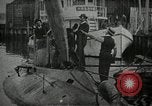
Holland type submarine of the Plunger class being tested by civilian technicians of Electric Boat Company.
Holland type submarine of the Plunger class tied up at the Electric Boat Company at New Suffolk, Long Island , New York circa 1902. Civilian technicians standing on deck of the boat.. They load a torpedo aboard, using a block and tackle.. It goes down into the hull of the submarine. The Holland type submarine running at periscope, fires the torpedo. The torpedo runs just below the surface, leaving a visible wake. The submarine rises and runs along a conning tower depth. It dives again and rises again.
U.S. film designed to boost national morale during World War II. Numerous scenes of American forces engaged in combat.
Several American school children, including one in a Boy Scouts of America uniform, recite the pledge of allegiance during World War 2. Scene broadens to encompass a school yard filled with elementary school students reciting the pledge in front of an American flag flying high on a pole. As scene fades images appear of battleships firing guns; an F4F airplane taking off from an aircraft carrier; landing craft approaching a beach; American soldiers fighting with small arms and a flame thrower, in jungles of New Guinea; a U.S. gun crew firing heavy artillery; and a U.S. P-38 aircraft on a rainy runway, spraying water as it takes off, in the Aleutian Islands. U.S. troops firing automatic weapons on a Pacific Island. A B-17 pilot wearing an oxygen mask in his cockpit, flying in a formation creating contrails at high altitude over Germany. Waist gunner firing at an attacking German fighter plane that explodes in air. U.S. troops in jeeps moving over jungle road. U.S. ski troops on snow in Iceland heading downhill toward their tents in the snow. American troops during amphibious landing in the Philippines. U.S. troops aboard army halftracks on desert in Iran. American paratroopers dropping from C-47 aircraft over France. U.S. soldiers marching through two large gates with cadre of Chinese soldiers in China. American troops fighting in Italy and firing a 155mm howitzer. U.S. infantry following a sherman tank over a war-torn landscape with shells bursting nearby. Crowded, busy street scenes of traffic and pedestrians in Manhattan, New York City, and Chicago, Illinois. Army tanks being manufactured by war production workers in a Detroit war production plant or factory. A Los Angeles shipyard filled with workers at shift change. Closeups of individual American soldiers in combat helmets. U.S. troops descending rope nets from transport ships to board landing craft, and approaching the beaches of Normandy, France, under fire, on D-day, June 6, 1944. Views of the Statue of Liberty, including closeups.
CRITICALPAST.COM: About Us | Contact Us | FAQs - How to Order | License Agreement | My Account | My Lightboxes | Shopping Cart | Advanced Search | Featured Collections | Website Terms & Conditions | Privacy Policy ©2026 CriticalPast LLC.
License Agreement |
Terms & Conditions |
Privacy Policy
©2026 CriticalPast LLC.