


 Francais
 Deutsch
 Italiano
Refine Your Search
Coney Island New York 1898 stock footage and images
- Showing 295 to 300 of 11259 results more
more Hide
Hide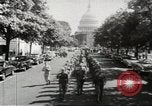
The United Nations Security Council passes Resolution 82 on June 25, 1950 and takes action in response to North Korean aggression against South Korea.
In the United States, American troops prepare to reinforce those responding to North Korean aggression against South Korea in the Korean War, and parade along Constitution Avenue in Washington DC, with Capitol building seen in background. American soldiers boarding a train to transport them to a port of embarkation. Remainder of the film is devoted to soldiers from the 53 nations contributing forces to the United Nations (UN) action. Canada contributes troops to the effort. Camera closeup of shoulder emblem on a Canadian officer boarding a train. Canadian troops marching to a port of embarkation. Turkish troops on their way to Korea, pass in review before a commanding officer. Troops of the Netherlands, also seen marching. Australian troops assembled before sailing to Korea. Swedish doctors and nurses board a ship bound for Korea, where they will set up field hospitals to care for wounded. British sailors boarding transport ship to Korea. Brief view of the Royal Navy Colossus class aircraft carrier, HMS Triumph (16) underway in Korean waters. Australian soldiers boarding an aircraft to Korea. One raises his rifle and waves from the top of the stairs as he enters the plane. More soldiers climbing gangways to large transport ships. Asian civilians waving small flags as they cheer departing soldiers. British soldiers wearing berets with pom poms are seen disembarking from a troop ship. More views of United Nations troops marching in formations. The UN General Assembly building in Lake Success, Long Island, New York. View of delegates inside the building. Film ends showing a rotating globe of the world, with flags of Nations participating in UN actions in Korea, being shown as the globe passes their respective countries.
United States Coast Guardsmen patrol beaches throughout the United States with the help of trained dogs and radio sets.
United States Coast Guardsmen patrol coasts in the United States. Coast Guardsmen mounted on horseback as they patrol coastlines throughout the United States. Narrator states they are guarding the coast from landings of enemy saboteurs who would arrive by submarine (reference to the Coast Guard discovery of Operation Pastorius Nazi German would-be saboteurs caught on Long Island, New York.) Coast Guardsmen ride horses on a beach. Trained dogs and radio sets also assist them in patrolling the shoreline.
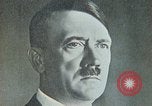
FBI catches Operation Pastorius criminals and hands evidence of their sabotage plots to the United States Military.
A picture of German leader Adolf Hitler. Footage of Pearl Harbor attack by Japan during World War 2. A reenactment shows landing of Operation Pastorius would-be saboteurs in Long Island, New York and presence of the FBI at the site collecting evidence the Germans had buried. Evidence of their plots to bomb various sites in the United States is collected by the FBI and presented to the United States Military. Views of some of their captured equipment and uniforms. Faces of the Operation Pastorius captured criminals (who included George John Dasch, Ernst Peter Burger, Herbert Haupt, Heinrich Heinck, Eddie Kerling, Herman Otto Neubauer, Richard Quirin, Werner Thiel) during their military tribunal hearing in July - August 1942.
German Generalleutnant Dittmar formally surrenders to U.S. soldiers in Magdeburg, Germany during World War II.
German General (Generalleutnant) Kurt Dittmar surrenders in Magdeburg, Germany during World War 2. German military commander General Dittmar, who was also Official Military Commentator of the German Armed Forces, stands with his party, including his son, young German soldier Berend Dittmar, Major Pluskat, and Major Werner, as American soldiers escort them. General Dittmar carries on an extended conversation with a French war corresondent. View of destroyed bridge span over the Elbe River, Magdeburg, Germany. German General Dittmar and his son, the boy soldier carrying a white flag with Red Cross on it, walk along sandy shore. They are met by U.S. Army soldiers of the 117th Regiment, 30th Infantry Division, including Captain Henry Abbes of Glendale, Long Island, New York, Commander of 'K' Company, who escort them. German General Dittmar conversing with captors while smoking a pipe, and then walking with his son, accompanied by American officers, through rubble strewn street of Magdeburg. (Records indicate that General Dittmar had traveled across the Elbe to ask for assistance in evacuating injured German soldiers and civilians from the east bank of the Elbe. U.S. Major General Leland Hobbs refused, and rather than returning across the River Elbe, Dittmar surrendered.)
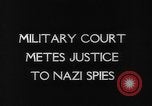
Operation Pastorius Nazi spies at trial in Washington DC; FBI agent shows sabotage tools of the accused.
Nazi spies involved in Operation Pastorius are tried in the Supreme Court of the United States in Washington DC. The exteriors of the Supreme Court of the United States. The captured would-be saboteurs are taken to the Court in armored paddy wagons to be tried for espionage, attempted sabotage, and treason. View of the accused riding in the vans, and the vans entering near court building. Federal Bureau of Investigation (FBI) agent digs with a shovel on sand beaches in Long Island, New York, to find explosives stored there by the spies. FBI agent shows the incendiary devices carried by the Germans who landed on the Atlantic shore from a submarine. An FBI agent shows captured uniforms, belt containing money, wooden blocks loaded with hidden detonator caps, pens and pencils that contain incendiaries to start fires. An indendiary pencil is demonstrated. Seven U.S. Army Generals, appointed by President Roosevelt to hear the case, are seen outside the court building. The Generals enter the court. Two high ranking U.S. officers appointed to defend the accused are seen as they enter the court. Prisoners enter the court, escorted by guards. Director of the Federal Bureau of Investigation (FBI) of the United States, John Edgar Hoover, enters the courtroom. The officers sit. Attorney General of the United States Francis Beverley Biddle present and seen during court proceedings. Prisoners sit during the trial. (World War II period).

Montage of scenes showing American civilian mobilization on the home front, life in the Navy, war scenes and demobilization after war.
View of a U.S. battleship heading toward the camera at high speed. Images of hip's wake becoming gradually more turbulent as camera focuses closer upon it in successive views. U.S. sailors in uniform. The first wears a the Silver Star medal. The next wears a Navy Cross medal. The third sailor wears a Cross medal with red and gold ribbon. A petty officer and two sailors posing together, each one displaying Cross and star medals, respectively. The scene fades to this last three, wearing civilian clothes in a flashback to the beginning of World War 2. The three watch as a draftsman lays out a Roll of Honor for a place called Middletown. Townspeople cheering at an outdoor sporting event. Next they sit and watch a tennis match. Next, many are seen as sailors scrubbing the deck of a battleship. Scene shifts to a Navy Wave guiding a C-45 aircraft into parking position. Another one is parked behind her. Next a "white shirt" on deck of an aircraft carrier is seen directing an aircraft with signals. A Douglas Dauntless aircraft is parked on the deck behind him. Abrupt change of scene shows a wounded sailor being attended by a physician. Members of a Navy ship's crew enjoying a swim, hanging out on a boom extended from their ship, and using rubber rafts and a dinghy as they enjoy recreational time allowed by the Captain. A sailor in a dining hall relishing a large piece of chicken. In contrast, a sailor at an antiaircraft station eats hastily. Twin guns are silhouetted behind him. Sailors getting dressed to go on shore leave. Photos of pinup girls displayed on locker behind them. They leave, but one sailor remains behind, on some kind of restrictions. Sailors on deck in formation as they are inspected by officers. One asks a sailor to adjust his hat and also examines his tie. A sailor sitting alone by a lake in Central Park, New York City. A sailor standing watch in setting sun. A chief Petty officer instructing a sailor on wearing his hat. Successive closeups of the imposing face of the Chief. that transitions into the face of a Lieutenant Junior Grade who is yelling at a sailor. Scene shifts to actual World War 2 battle footage scenes as Navy crew battles fire in an aircraft carrier's Island during naval combat in the Pacific. Hose lines are stretched across the flight deck and smoke envelopes the ship. Injured are carried to place of safety. Another scene aboard a U.S. Navy ship in World War 2, shows a Navy Chaplain praying over sailor who was killed, followed by a ceremonial burial at sea for the dead. U.S. Marines fire rifle salutes as coffins slide out from under American flags to carry the fallen sailor into the sea. As the nation demobilizes after the war, various "rabble-rousers" begin to cause trouble. One is seen speaking before a group of women, who seem influenced by his remarks. Scene shifts to aerial views from a low-flying airplane revealing the total destruction and rubble over miles of a German city, probably Berlin, from Allied bombing and shelling during World War 2. Views of suffering survivors of World War II (especially children) in various parts of the world. Emaciated and starving children in a war-torn area.
CRITICALPAST.COM: About Us | Contact Us | FAQs - How to Order | License Agreement | My Account | My Lightboxes | Shopping Cart | Advanced Search | Featured Collections | Website Terms & Conditions | Privacy Policy ©2026 CriticalPast LLC.
License Agreement |
Terms & Conditions |
Privacy Policy
©2026 CriticalPast LLC.