


 Francais
 Deutsch
 Italiano
Refine Your Search
Coney Island New York 1898 stock footage and images
- Showing 3553 to 3558 of 11259 results more
more Hide
Hide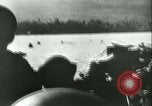
Signal Corps weekly film reports sent to Photographic Center and used in training films for U.S. troops during World War II.
The role and contribution of the U.S. Army Signal Corps in combat and war. Amphibious landings of the first wave of Allied troops including Signal Corps Units in Normandy, France on D Day during World War 2. The Joint Assault Signal Companies (a Signal Corps Unit that accompanies the soldiers on every beach landing) go ashore in Normandy. Soldiers in landing crafts approach the beach. Landing crafts anchored along the shore line. A U.S. flag on the beach. Crafts approach the beach. U.S. Army Signal Corps combat photographers using motion picture cameras to film the battle that ensues on the beach and in the fields. Gun fire and explosions in the battlefield, filmed by combat cameraman. Allied aircraft in flight. Airmen load weekly film reports of the war in all Theaters made by Signal Corps officers from a van into an aircraft. The films are sent to the Photographic Center in New York. A soldier assembles the films. Technicians organize and arrange the films. They place the film reels onto racks. The film content is used to make training and orientation films for the U.S. troops. Troops watch the films in order to cut down the training period, and stay informed about the order of event in other Theaters of Operation. The films include 'Why We Fight' and 'The Fighting Men' series. Clips and recordings from these films.
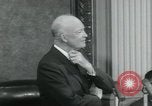
President Dwight D Eisenhower talks about Russian statements during a press conference in Washington DC, United States.
President Dwight D Eisenhower at a press conference in Washington DC, United States. President answers press reporters' questions. He first answers a New York Times correspondent's question regarding the recent Russian violation of the UN charter and the threat to use violence against the Allies. He then responds to a question posed by a United Press reporter regarding the movement of Saudi Arab troops, blockade of Israeli ships and the attack on Israeli villages.
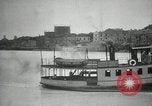
Workers unloading goods from ship at Savannah harbor, Georgia, United States.
Workers unload goods from a ship at the Savannah harbor, Georgia, United States. Workers place resin barrels in a row. Shift to view of New York Harbor. Ship passes with Statue of Liberty in the Background.
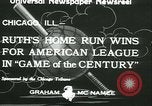
First Major League Baseball All Star Game; Ruth's home run gives American League a 4-2 victory
Newsreel clip on Major League Baseball's first-ever All-Star Game in 1933 at Chicago's Comiskey Park. As title card notes, a home run by Babe Ruth (not seen in this clip) would propel the American League to a victory over the National League. Game footage: Joe Cronin of the Washington Senators flies out to end the third inning. Lon Warneke of the Chicago Cubs pitches for the National League. In the top of the fifth inning, Wally Berger of the Boston Braves grounds out to first. View of some of the 47,595 fans in attendance. In the bottom of the fifth, the Yankees' Babe Ruth takes a ball and a brushback pitch, then hits a single, running to first in his distinct "pigeon-toed" style. With Ruth on first, Warneke strikes out Lou Gehrig of the Yankees. (Note numerous photographers on the field.) Al Simmons of the Chicago White Sox hits a single, but Jimmie Dykes of the White Sox grounds out to end the inning. In the top of the sixth inning, Lefty O'Doul of the New York Giants grounds out to first. Pepper Martin of the St. Louis Cardinals grounds out with Lon Warneke on third, scoring Warneke. With bases empty, Frankie Frisch of the Cardinals hits a home run. Final score would be 4-2, AL
U.S. Army Air forces pilots learn about the Republic P-47 Thunderbolt airplane
From a U.S. Army Air Force Training film, "How to Fly the P-47. Pilot Familiarization." United States pilot seated on table writes a postcard to his mother, "Mrs D.Q. Hopkins. 1024 Clay Avenue, Pelham, New York" Board in the background with 'Daily Assignment of today' written on it. Scene shifts to forward view from cockpit of a Republic P-47 aircraft flying low over the flight line at an Air Base. Momentary glimpse of the pilot and his post card in the office. Back again, to forward view from cockpit of a P-47, but this time it is on final approach to the runway. Scene shifts to ground view of a P-47 landing. It taxis to the ramp and parks. The crew chief stands on the wing as the pilot completes and signs the aircraft's Form 1 (record of any problems). Five pilots walk past the flight line. The pilot, wearing a seat pack parachute, climbs down from the cockpit. The five pilots, seen earlier, approach, and one introduces them to the P-47 pilot (Captain Hopkins). They are Lieutenants assigned to his training flight. He greets them and shakes hands with all. The group ask questions about the P-47. Then they all go to the pilots room. As Captain Hopkins takes off his flight gear he tells them the P-47 is designed to operate at high altitude. He describes the P-47, referencing a large illustration of it on the wall. (World War II; WW II; World War 2; World War Two)
Sketches of the Boston tea party and unrest among American colonists
Sketches of struggle for borders and territory between Canada and United States. Leaders of American colonists like Patrick Henry protesting taxation without representation. British guards protecting paper. Burning of paper used for taxation. Images of traders from New York area who made great wealth trading overseas. Fire on British ships. Sketches of the Boston tea party with colonists disguised as Indians hurling tea into the harbor. Sketches of former British Prime Minister William Pitt and Lord North shown debating in Britain. With commentary and narration by J. Frank Willis.
CRITICALPAST.COM: About Us | Contact Us | FAQs - How to Order | License Agreement | My Account | My Lightboxes | Shopping Cart | Advanced Search | Featured Collections | Website Terms & Conditions | Privacy Policy ©2026 CriticalPast LLC.
License Agreement |
Terms & Conditions |
Privacy Policy
©2026 CriticalPast LLC.