


 Francais
 Deutsch
 Italiano
Refine Your Search
Coney Island New York 1898 stock footage and images
- Showing 3679 to 3684 of 11259 results more
more Hide
Hide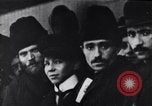
Accomplishments of the Amalgamated Clothing Workers of America, and later challenges of the Civil Rights movement in America
Turn of the Century immigrants to the United States pose aboard ship. Some wear fez hats. View of clothing industry workers at sewing machines in early 1960s. Picture of Sidney Hillman and his wife, circa 1910. Older garment worker cutting cloth. Clothing or garment factory workers punching a time clock in the early 1960s. Men operating sewing machines. A cutter marking cloth from a pattern. A man sewing button holes on clothing. Old pictures of earlier garment workers. More modern view of unionized clothing workers at sewing machines. A cutter using a machine to cut multiple layers of fabric. Supervisors discussing a sample of sewn product. numerous views of men and women sewing garments. Flashback to earlier times of workers marching to demand a union contract. Union member distributing literature at a factory gate. Small group of union picketers on sidewalk. Union leader speaking to group of women workers in Southern town. Union organizer with bloodied head, smoking cigarette. Striking Workers (mostly women) standing in group outside employment office of Tuf-Nut Garment Manufacturing Company in Little Rock,Arkansas. The striking women being arrested by policemen. Change of scene to closeup of Alabama State policeman smoking cigar. Civil rights marchers during demonstration in Birmingham Alabama on May 7, 1963 during the "Birmingham Campaign" or "Birmingham Movement". Fire fighters in fire engine pumper truck stops near police on street in town and sets up fire hoses to spray high powered water directly at African American civil rights marchers. Civil Rights marchers soaked by high powered water hoses. One protestor or demonstrator tries to run away from the fire hose and is grabbed by two white police men. A protestor takes cover behind a telephone poll as a firehose is directed toward him. A black man converses with two women on a snowy street. Civil Rights marchers of the African American Southern Christian Leadership Conference carrying signs during a demonstration. People fill the area around the reflecting pool by the Lincoln Memorial during the March on Washington for Jobs and Freedom on August 28, 1963. A man and his daughter share time together on a snowy day. Children sledding in the snow. People ice skating on lake in Central Park, New York City. Closing views of early immigrants to the U.S.A.
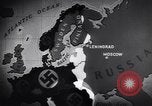
German Operation Barbarossa on the Eastern front in World War II
Animated map shows extent of German controlled areas in Europe following their conquest of the Balkans in World War 2. Norway is under their control and German forces threaten Leningrad and Moscow. A soviet defense line is shown on the map. The German attack is shown to come from 5 directions on June 22, 1941, with the launch of German Operation Barbarossa. A sky filled with German Heinkel He 111 bombers is shown. German Panzer III tanks with 75 mm guns. Army trucks carry German troops into battle. German soldiers on motor cycles and infantry advance under fire. Animated map shows principal German targets as Leningrad, Moscow, and Kiev. It then shows beginning a drive from the North to encircle Leningrad. Arrows show where German Marshal Fedor von Bock's forces drove 480 miles into Soviet territory. Slates identify cities being overrun by German invaders, including: Pskov, Novgorod, Brest-litovsk, Minsk,Mogilev, and Vitebsk. On July 17, 1941, a German tank is seen entering Smolensk, past the Dnieper River threatening Moscow, itself. To the south, German forces, under Marshal Gerd von Rundstedt, cut deep into the Ukraine. Newspapers world-wide consider the Soviet forces close to defeat. Slate shows communique from the German High Command stating: "The issue in the East is already settled. Smolensk is the last halt on the road to Moscow." German infantry marching. Scene shifts to heavy artillery being fired by Soviet forces in a snowy scene clearly later in the year. Animated map shows German forces very close to Moscow on October 15, 1941, forcing the Soviet Government and all foreign missions to move to Kuibyshev, 700 miles to the east. Adolf Hitler, in a speech on October 3, 1941, states that the enemy is broken and will never rise again. Animated map shows 500 thousand square miles of Soviet territory occupied by German forces. Views of fires burning in Russia. Damaged and abandoned Soviet industrial plants. A German guard atop a hill looks down on thousands of Soviet people in the occupied areas of Russia. Damaged and abandoned Soviet T-26 tanks. Glimpse of damaged Soviet aircraft and field artillery. Headline in New York World Telegram newspaper reads: "Berlin Admits Russ War May Last Winter." Another headline reads: "Red Army Holds Push On Moscow." Weary German soldiers traveling in horse-drawn wagons, pulling field artillery. Soviet and German war planners are seen at work. Slate quotes Adolf Hitler saying: "A single blow must destroy the enemy, without regard for losses... A gigantic all-destroying blow." German armor moving along a road. Animated map shows this technique in the German invasions of Poland, France, the Balkans, and Yugoslavia. In contrast, the Soviet planners are seen, as map illustrates how they intend to take advantage of the vast area of their land by holding lines of defense an falling back as necessary to keep engaging the invaders across interior of the Soviet Union. Soviet infantry are seen marching along a road. German troops riding atop their tanks. Soviet troops forcing German invaders into close combat in her cities. Soviet soldiers running in a city and firing heavy machine guns. Bomb damage and rubble inhibit German armor mobility in cities. Cities where this kind of Soviet resistance prevailed were: Rostov, Kharkov, Kiev, Kursk, Smolensk. German troops leaving a city with heavy black smoke rising in the background. More views of cities where Soviet troops are engaged German forces in House-to-house battles, including: Odessa, where the Old Opera Theater building is shown sandbagged and relatively undamaged. The Odessa NI tank, created from an STZ-3 agricultural tractor.

16 million men register themselves in United States for the WWII draft, and President Roosevelt addresses from White House.
As World War II heats up, 16,500,000 men between ages 21 to 36 register themselves throughout the United States, signing up during the first peacetime conscription in U.S. history. (This was triggered by passage of the Selective Training and Service Act of 1940, also known as the Burke-Wadsworth Act, the genesis of "Selective Service.") Opening scene shows men lining up to register for the draft before the United States entered World War 2. Views of men filing out their registration forms. At 00:22 famous prize fighter, Barney Ross, is being registered. (He jokes that the registrar shaking his hand has too strong a grip.) At 00:34 Hollywood cowboy Gene Autry is seen registering. Close up view of street signs at Chinatown intersection of Bayard Street and Mott Street in New York City. Sign below it notes "School Street. Drive Slowly. Make no unnecessary noise." Line of many registrants of Chinese-American descent waiting in line, and processing paperwork. Scene changes to another area of the city, where a line of mostly African American men wait outside a registration building. Some cheer and wave for the camera. A police officer at the entrance hustles them inside, pulling some of them along. View of the exterior of the White House in Washington DC. United States President Franklin D Roosevelt addresses the nation's men of draft age, telling them that the call up of 800,000 men for training in year one, and less than one million men in each subsequent year, is a program of defensive preparation only. Roosevelt says to the registrants that "Democracy is your cause. The cause of youth." ( Note: clip is silent except for President Roosevelt speaking at the end.)

Senator Joseph McCarthy criticizes former President Harry S. Truman
Senator Joseph McCarthy attacks the former President, Harry S. Truman, for using the term "McCarthyism." In a press briefing, “Reply to Harry S. Truman on ABC Radio” in New York City, Senator McCarthy decries the harm done to America because of Truman's failure to fight Communism and for putting interests of the Democratic Party above those of the Country, which he calls “Trumanism”.
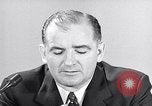
Senator Joseph McCarthy criticizes the policies of former President Harry S. Truman
Senator Joseph McCarthy attacks the former President, Harry S. Truman, for using the term "McCarthyism." In a press briefing, “Reply to Harry S. Truman on ABC Radio” in New York City, Senator McCarthy decries the harm done to America because of Truman's failure to fight Communism and for putting interests of the Democratic Party above those of the Country, which he calls “Trumanism”.
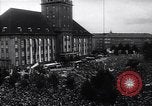
Berlin Crisis: The Western Powers respond to threats from the Soviet Union
Opening scene shows the Rathaus Schöneberg (John-F.-Kennedy-Platz, 10825 Berlin, Germany) where Mayor of Berlin Willy Brandt addresses a large crowd of West Berlin citizens, concerned about the building of the Berlin Wall by the Soviet Union. Many carry placards and signs, including some in English, reading: "We trust Kennedy, Pay any price, Bear any burden, for survival of Liberty" and "Millions behind the Iron Curtain ask for help." Scene shifts to a limousine driving into the center of a crowd. United States Vice President Lyndon B. Johnson steps from the car, accompanied by General Lucius D. Clay, who is seen next, with arm raised, acknowledging the crowd, while standing with Johnson and Brandt, at a podium cluttered with microphones. (Narrator refers to him as "Father of the Airlift.") The next day, British and American soldiers are seen driving in jeeps and trucks and M59 Armored Personnel Carriers, through cheering crowds, as they arrive to reinforce their Berlin garrisons. Closeup of cheering Berliners, waving handkerchiefs. Change of scene shows animated map of Europe illustrating the Westward expansion and growth of Soviet Communist occupation through World War II and the postwar era, concluding with East Berlin, in 1962. The threat to other Nations and regions is also illustrated. Legislators are seen in session in the plenary chamber of the German Bundestag in Bonn. Chancellor Konrad Adenauer is addressing the assembly. He states that Germany does not stand alone in the world. In France, Prime Minister Georges Pompidou addresses the National Assembly, regarding the Berlin Wall. In London, Prime Minister Harold Macmillan addresses Parliament. In the United States, on September 25, 1961, President John F. Kennedy, is addressing the UN General Assembly, in New York, about the dangerous crisis in Berlin. Scenes of the Berlin wall and Checkpoint Charlie. Memorials to persons killed attempting to escape East Berlin, are seen along the wall.
CRITICALPAST.COM: About Us | Contact Us | FAQs - How to Order | License Agreement | My Account | My Lightboxes | Shopping Cart | Advanced Search | Featured Collections | Website Terms & Conditions | Privacy Policy ©2026 CriticalPast LLC.
License Agreement |
Terms & Conditions |
Privacy Policy
©2026 CriticalPast LLC.