


 Francais
 Deutsch
 Italiano
Refine Your Search
Crimea Ukraine 1942 stock footage and images
- Showing 217 to 222 of 2514 results more
more Hide
Hide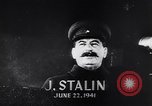
Soviet Union military and civilians mobilize for war against Nazi Germany during World War 2
Soviet Premier Joseph Stalin addresses the people of the Soviet Union during World War II. Men, women, and children listen to the speakers broadcasting the speech made by Stalin. “This war is not an ordinary war! It is the war of the entire Russian people.” the narrator translates Stalin’s speech. A printing press prints Russian newspapers. Man distributes newspapers. Russian men riding horses. Patriotic Russian men marching into a town to enlist in the war effort. Women plastering Soviet propaganda posters. Women and children trained for military tactics. A short-haired Russian woman tests a rifle. Boys use pickaxes in mining. A woman joins the Soviet Army. A female factory worker works with a lathe. An elderly Russian man harvesting wheat. A locomotive train driving. A woman piloting a ship. Women driving tractors. Women carry large sacks on their backs. Russian soldiers taking a metal bedframe. Farmers raising cattle. Houses, factories, and other infrastructure destroyed by fire and dynamite by Russians themselves. View of the Dniepropetrovsk dam in Ukraine. Russians blow up the Dniepropetrovsk Hydroelectric Station to prevent it from falling to Nazi hands. A woman torches her house. Farmers produce in fields. An old man with rifle watches sky for Nazi bombers. Burning houses and villages due to Soviet scorched earth policies. Guerrilla units trained and they march. Guerrilla soldiers with rifles. Men and women Soviet guerrilla soldiers talking. Soviet men hide in the bush. Guerrilla soldiers push down a telegraph post. A burning train. Guerrilla fighters shoot down German soldier. A burning oil depot. Exploding Nazi installations such as bridges, buildings, and warehouses. Russian guerrilla soldiers fire with machine guns. Animated map depicting Nazi German forces stopping outside Moscow. The Kremlin in Moscow. Fresh reserves of the Soviet Red Army march in Moscow.
Russian General Suhonov being welcomed by United States Army Major General Terry Allen in Delitzsch,Germany
United states Army Major General Terry Allen greets Russian General Suhonov as he arrives in an American military jeep in Delitzsch,Germany. The two Generals salute as United States Army band plays from a Soviet music sheet. Photographers take pictures of the two officers. General Terry Allen puts Timber wolf patch on sleeve of Russian General Suhonov,Commander of 118th Ukraine Division.
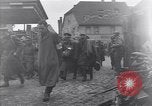
Russian Army officers pass by on a street in Delitzsch,Germany, joined by American officers
Russian Army officers of 118th Ukraine Divisoin pass by a street as two U.S. Army 104th "Timberwolf" Division soldiers on duty stand by the side of the road in Delitzsch,Germany. (World War II period).
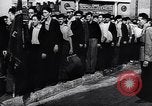
Soviets mobilize for war on the home front during the German invasion of Russia in World War II
A huge number of local men, volunteering to join the Red Army, are seen parading (in civilian clothes) through a Soviet town, in 1941, during time of the World War 2 German invasion of the Soviet Union, known as Operation Barbarossa. Men lined up at an outdoor recruiting station where Army officers and a clerk are seated at a table. View of a man signing his name and date of birth a sheet of paper. Next, he shakes hands with all the recruiters. Next, recruits are seen walking in loose formation. They are still in civilian clothes, but carry sacks with their first government- issued belongings. Change of scene shows workers in a factory and miners working in a coal mine. they use a machine driven conveyor to move chunks of coal from the mine. Scientists at work. The man at extreme right is Soviet Nobel Laureate Physicist, Pyotr Leonidovich Kapitsa (Peter Kapitza). He heads the Department of Oxygen Industry. attached to the USSR Council of Ministers. Oxygen bubbles in a scientific glass device. Several views of fiery molten steel flowing in a steel mill. Older retired man back at work in a machine shop, operating a milling machine, to help the war effort. A man using calipers as he instructs a woman in a machine shop. Closeups of a young women working on various machines in the shop. One at a lathe, stops to inspect a piece of turned steel she is making. A man hot forging a part on a drop forge. A woman monitoring machinery controlling the forge. Women from rural areas in the Ukraine, attend a class to learn about tractors. Instructor using a large illustration to explain parts of a tractor. One of the women manipulates a tractor part. Another adjusts a carburetor. One closes the side hood of a tractor. One woman gets behind the wheel of a tractor, for the first time.Her instructor manipulates its gears as they drive it forward. A line of school children walks in a village with their teachers. Next, the girls are seen cultivating crops on a truck farm, and the boys are seen working in a wheat field. Three boys are assigned "Sentry Duty" and climb wooden towers to maintain lookout for invading German paratroops or other forces. An older man performing similar duties on a rooftop in a village. Another man on the lookout atop a wooden tower. An old man with a rifle on the lookout. Another man holding a rifle in a wheat field.
German anti-aircraft and Panzer tank attacks on Soviet Union forces of Eastern Front during World War 2
German antiaircraft units fire at soviet bombers in Eastern Front during World War II. Von Kleist and Guderian Panzer Divisions roll past burning villages in Soviet Union just 500 kilometers from Kiev, Ukraine. General Guderian speaks with the officers. Soviet tank units surrender. 65,000 Soviet prisoners march under German guard.
German Operation Barbarossa on the Eastern front in World War II.
View of the city, Pskov, on the Veilakaya river. A steel bridge is seen and city across it with smoke rising. German troops march in loose formation over a bridge in Novogorod. Views of German camouflaged tank (with shrubbery) and other armor and troops entering Soviet cities of Brest-litovsk, Minsk, Mogilev, and Vitebsk. View of German Panzer III tank heading toward the camera as it enters a narrow street in Smolensk. Animated map shows progress of these German advances and highlights German forces under German Field Marshal Gerd Von Runstedt cutting deep into the Ukraine. Headline on Chicago Daily News reads: "Nazis Claim Knock-out Victory" with subtitle line reading,"Moscow line cracks." Other newspapers reflect conviction that Soviet forces face imminent defeat by Germany. Slate shows communique issued by the German High Command, stating: "The issue in the East has already been settled. Smolensk is the last halt on the road to Moscow." More views of marching German troops. A battery of Soviet artillery firing from a snow-covered field. Animated map shows German forces moving close to Moscow. Foreign diplomats are moved from Moscow to the city of Kuibyshev. Hitler speaking on October 3, 1941, saying "This enemy is broken and will never rise again." Animated map depicts 500 thousand square miles of Soviet territory occupied by December, 1941, and compares it to the entire west central United States encompassing the states of : South Dakota, Iowa, Nebraska, Kansas, Missouri, and Oklahoma. Fires raging in agricultural area of the Soviet Union. Destroyed Soviet industrial plants, and huge numbers of Soviet citizens under German occupation. Views of destroyed Soviet armor, aircraft and artillery pieces. As season changes, German forces are seen in rain gear moving slowly through cold rainy weather. Some walk beside horses and other ride on horse-drawn caissons along with artillery pieces. Segments of film show contrast between the German military strategies. The German forces would plunge deep into enemy territory and create an area of conquest. This is illustrated by a slate bearing Adolf Hitler's statement that, "A single blow must destroy the enemy, without regard for losses, a gigantic destroying blow." An animated map illustrates the success of this approach by the Germans in Poland, France, and the Balkans. German Generals seen planning the same "Blitz" strategy against the Soviets. Film shifts to the Soviet strategy, showing their idea of building stronger defense, as they fall back, taking advantage of the great size of their territory. Views of Soviet troops on the move. View of Shells knocking out a German tanks. Panzer III tanks advancing. Panzer VI tanks completely covered by German troops catching rides. Soviet field artillery and machine guns firing in cities, forcing German soldiers to leave their vehicles. Soviet cities bombed out and burning, with debris and obstacles limiting the ability of armor to navigate in them. Montage of battle scenes cities of Rostov, Kharkov, Kiev, Kursk, Smolensk, all thwarting the Nazi blitz into the Soviet Union. Battles being waged in cities. (World War II; WW II; World War 2; World War Two)