


 Francais
 Deutsch
 Italiano
Refine Your Search
Crimea Ukraine 1942 stock footage and images
- Showing 223 to 228 of 2514 results more
more Hide
Hide
Ukrainians and Belorussians, who fled to France to escape poor treatment under Polish domination, return home after 20 years.
The Soviet ship Vyacheslav Molotov is seen, docked at the French port of Le Havre. A crane raises cargo onto the ship. Ukrainian and Belorussian passengers stand on the pier, ready to board the ship that will take them to their former hometowns. One woman walks up the gangplank with a flag and a carryall displaying the image of Joseph stalin. On the pier, French Army officers process the embarking passengers, as a Soviet Army officer stands nearby. Closeup of documents being stamped. (Narrator states that these refugees fled their homes for France, 20 years earlier, when they were under the domination of Poland.) The Soviet officer encouraging passengers up the gangplank. View from high on the ship, of passengers clustered around the processing station. Camera pans up to the ship's funnel, where Soviet hammer and sicle is displayed. View from behind people waving on the dock, of the passengers lining the railing of the ship, waving goodbye as the ship slowly begins to move forward and then is seen underway. Scene fades to reopen showing the ship in waters of the Black Sea approaching the port of Odessa, Ukraine. Buildings seen upon cliffs overlooking the port. Several views of the passengers assembled on deck looking toward shore. Closeups of passengers and their flags. A Ukrainian woman gives a speech about her joy at homecoming. Other passengers applaud. A man holds up a homemade sign reading (in Russian) "LONG LIVE SOVIET-HOMELAND I-EE-GOVERNMENT." Passengers disembarking down the gangplank, carrying flags and riding in open small trucks away from the ship.
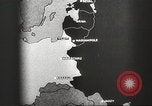
German Operation "Barbarossa," the invasion of the Soviet Union in World War II
German troops advance in Transcarpathian Oblast, Ukraine, during World War 2. Map shows the Polish-Ukrainian (Soviet Union) border. Narrator refers to the Battle in the East (the Eastern Front). German armored forces, camouflaged with branches of shrubbery, attack to the East, primarily from Poland, in Operation Barbarossa. Stug III self-propelled assault guns are seen, as well as towed artillery pieces moving along rural roads in agricultural areas. German officers look through binoculars. Spire of a church seen in distant rural village. German artillery firing at close to zero elevation. A small village with houses burning. Closeup of German tank commander looking out from his top hatch. German soldier receiving first aid for cut on face. German infantry engaging defenders in house-to-house combat with small arms. Houses ablaze in the village.
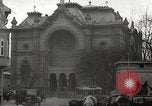
Jews walking and standing outside buildings and houses in in Ungvar, Province of Ruthenia in Hungary.
Jewish resident in Ungvar (Uzhhorod), Province of Ruthenia, in Hungary (Carpatho-Ukraine). Jewish synagogue and other buildings along the sides of the street in the town. Jews walking on the street. Closeup views of Jewish people including a orthodox Jew teenage boy with side curls (payos). Other Orthodox Jewish men and boys with various hats and payos. The exterior of a building. Men discussing amongst themselves. A man bringing a hen to a Rabbi. Names on the stores including Adolf Mermelstein Textic. Closeup view of Jewish man smoking a pipe. (Footage is just before outbreak of World War 2.)
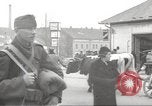
People and soldiers walking on the streets in Ruthenia, Hungary.
Life of the people in Ruthenia, Hungary (Carpatho-Ukraine). The market of Ungvar (Uzhhorod). Women at the market. Civilians gather on the street. Buildings in the area. Children and soldiers standing on the street. Hungarian soldiers marching in column on the street. Numerous horsecarts pass by carrying goods and people.
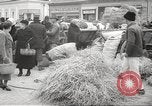
People gather and buy fruits from the market in Ruthenia, Hungary.
Life of the Jews in Ruthenia, Hungary (now part of Zakarpattia Oblast, Ukraine). The market of Ungvar (now known as Uzhhorod). People gather on the street. Ruthenian peasants shopping on the street. They pick up the hay stacks from the street. Buildings in the background. Horse-carts pass on the street. Cattle moving. Women discuss amongst themselves. Women seated near baskets with fruits or vegetables at a market on the street. People buy food from the women.
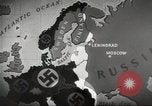
German forces invade the Soviet Union in Operation Barbarossa during World War II
Animated map shows German potential thrusts into the Soviet Union (Operation Barbarossa) coming from six different directions an targeting key cities like Leningrad and Moscow. June 22, 1941 is highlighted on the map. Large formation of German twin engine bombers with extended landing gears is seen in flight. Formation of German Panzer III tanks moving across a field. Formation of German Kfz.70 Personnel Carriers filled with troops. Formation of German soldiers on motorcycles (some with side cars) moving across a field. German troops leaving their transports and running into woods, as they encounter shelling. Animated map reiterates German emphasis on Leningrad, Moscow and Kiev (in Ukraine). It shows German forces converging on Leningrad, and then towards Smolensk. (World War II; WW II; World War 2; World War Two)