


 Francais
 Deutsch
 Italiano
Refine Your Search
Crimea Ukraine 1942 stock footage and images
- Showing 409 to 414 of 2514 results more
more Hide
Hide
The siege of Malta and the North Africa campaign during World War II.
Italian warships maneuvering in the Mediterranean during World War 2. Destroyers pass a Corazzata-class Italian battleship. Italian IMAM Ro.43 reconnaissance planes are launched from a battleship. Two Corazzata-class Italian battleships underway. Change of scene shows the island of Malta, viewed from a low flying airplane. A formation of Italian CANT Z.508 seaplane bombers flying overhead to attack Malta. View from ground on Malta of anti-aircraft flak burst clouds in the air above. Smoke rising from bomb bursts. Glimpse of a large British warship slowly easing out of its dock. Single engine aircraft overhead moving through heavy flak clouds. More bomb explosions. Local civilian people and refugees, including many children, seeking safety from bombing. People perusing destroyed buildings. A formation of British Bristol Blenheim light bombers in flight over North Africa. British forces firing artillery in Libya. War materiel abandoned by retreating Italian forces in Eritrea and Somaliland. British troops and a contingent of Ethiopian troops march into Addis Ababa, escorting Emperor Haile Selassie as he is restored to his throne in May, 1942. Next, German armor in North Africa is seen burning. A knocked out German tank viewed through window of a British armored vehicle. More burning German armor. German aircraft destroyed on the ground at an airbase. Bombs lined up on the ground. Huge number of Italian prisoners of war marching across the desert in Libya.
Soviet Russia mobilizes to defend against German offensive (Operation Barbarossa) in World War II.
Film opens showing Adolf Hitler, in World War 2, with Field Marshal Walther von Brauchitsch, Army Commander-in-Chief, and other top military members, planning for Operation Barbarossa (Attack to the East toward the Soviet Union). As he walks away from the table, he speaks briefly to Grand Admiral Erich Raeder, head of the Kriegsmarine (German Navy). Next Hitler and Marshall Hermann Goering are seen strolling and conversing at the Eastern Front headquarters, "the wolf's lair," (Wolfschanze) near Rastenburg, East Prussia (now Poland). Scene shifts to the Soviet Union, where Joseph Stalin is seen speaking at a podium. A large outdoor audience, including some soldiers, is gathered to listen. Images showing the Soviet people responding to defend against the German Nazi invasion. Closeup of Soviet soldiers with shouldered weapons. The nearest is holding a PPSh-41 submachine gun. Closeups of Soviet women and men in military uniforms. Soviet citizens heading to enlist in the military. Soldiers marching loosely n a city street. Patriotic singing is heard in background. A formation of Soviet women marching. Some carry furled banners. Soviet women carrying simple farm implements, marching in a rural part of Russia and joining others who are working to prepare anti-tank ditches and barriers in the countryside. Views of hundreds of people working on this project. Weapons being provided to rural Soviet guerrillas who will operate behind enemy lines. Anti-aircraft guns being set up overlooking a harbor. Closeup of Soviet soldiers manipulating controls on a camouflaged anti-aircraft gun and others maneuvering a four-barreled anti-aircraft machine gun. Local farm family members on makeshift towers keeping watch over huge fields of wheat. Soviet farmers harvesting the wheat with scythes. An armed farmer shielding his eyes as he searches the skies for German airplanes. Closeup of a man cutting wheat with a scythe as women gather the sheaves behind him. Motorized harvesters at work in a field of wheat. Closeup of a woman operating one. Tractors used in harvesting. Women and children gleaning what remains behind in the harvested fields. Farmers driving their cattle East (away from advancing Germans). Evacuating Soviet people employ a scorched earth policy, burning their homes, barns, and anything that might be of value to advancing German forces. Views of burning houses. Soviet industrial enterprises working around the clock producing war materiel. Seen are petroleum facilities; a large plant expelling coke; coal pouring into a barge; men at work at a steel furnace; ribbons of hot steel moving out of rollers; a huge manufacturing plant in operation. Next, a Soviet Kliment Voroshilov (KV) tank is seen moving across a field. Soviet Russian Polikarpov I-16 fighter planes in flight. A large formation of German Dornier DO 17 bombers in flight high overhead. Soviet forces retreating. Views of fallen German soldiers, fires burning, and remnants of a downed German bomber. German prisoners of war marching under guard and others surrendering with hands in the air. Closeups of some German prisoners. A Russian Petlyakov Pe-2 aircraft parked in snow with engines running. Fallen German soldiers lying in the snow along a roadway, in Winter of 1941-42. A Russian Kliment Voroshilov (KV) tank maneuvering in the snow. Russian Bt-7 Light Cavalry Tanks proceeding toward the front in Springtime, 1942.
Dr. Enrico Fermi and assistants reenact experiments at site of the Chicago Pile-1 (CP-1) nuclear reactor, University of Chicago
Men walking towards the West Stands of Stagg Field, where the Institute for the Study of Metals, occupies the southern half of the abandoned stands. To the North, where the center of the building protrudes toward Ellis Avenue, is the squash court area in which the famous Chicago Pile number 1 was built, and achieved controlled, sustained nuclear fission, on December 2, 1942. Scene shifts to different area where a sign reads: "5655, Institute for the Study of Metals, Delivery Entrance." Scene shifts again, to Dr. Enrico Fermi and two assistants in front of a facsimile of the Chicago Pile 1. One assistant holds a simulated "control rod" that he "withdraws" from from the pile, while Dr. Fermi glances at a geiger counter and makes notes in a book. This is repeated for several takes, including one taken much closer. Dr.Fermi and his assistant smile as they take these actions. The second assistant, sits at a desk, where a slide rule is visible, and makes notes in a book. A large geiger counter is seen with lights flashing. Above the lights the counter is labeled "Interpolation," and the numbers: 1,2,4,16, and 32 appear above the lights, respectively. Dr. Fermi is then seen in another part of the lab, where he is making adjustments on some unseen device and annotating a book. Piping of various sizes is seen in background. He repeats these actions a number of times for the camera.

Unescorted B-17 Flying Fortress planes under heavy attack by German FW-190s during Schweinfurt raid in World War II.
Scenes of the first daylight strategic bombing by the United States Air Forces against targets in German-controlled Europe. A dozen B-17s execute the first mission against railroad marshaling yards in German-held Rouen, France, on August 17, 1942. A year later, large numbers of U.S. bombers attack Schweinfurt, Germany during World War II. U.S. B-17 Flying Fortress planes take off from U.S. Air Base in England. A formation of B-17s in flight. They head towards Germany. U.S. General Dwight D. Eisenhower and his aides confer. Unescorted B-17s over Schweinfurt under heavy attack by German FW-190 fighter planes. The B-17s drop bombs over the target area. Ruins of Schweinfurt after bombings. A FW-190 goes down after facing attack. Dead and wounded men unloaded from B-17s which return from the Schweinfurt raid. Panoramic views of ruined Schweinfurt on August 20, 1943.
U.S. President Franklin Roosevelt visits Bell and Curtiss aircraft factories in Buffalo, New York
On November 2, 1940, U.S. President Franklin Roosevelt and party visit P-39 aircraft production line at the Bell Aircraft Company factory, 2050 Elmwood Avenue, Buffalo, New York, and P-40 production lines at the Curtiss Aeroplane factory, 2303 Kenmore Avenue, Buffalo, NY. Workers in the Bell plant pose around and inside fuselages taking shape along a production line for Bell P-39 Airacobra airplanes. In the Curtiss plant, view from rear, of Secret Service agent in coat and hat, standing on running board of an open Packard motor car carrying President Franklin D. Roosevelt, and his party as they drive slowly along an aisle in the factory, showing P-40 aircraft in various stages of completion. The President is barely visible in the back seat. (This is a 1939 Packard twelve, model 1708, special parade car, built for the President's use.) View from ahead of the President's car, as it proceeds along the Curtiss P-40 production line. (The President, in coat and hat, sits in the right rear seat.) As they progress along the production line, the aircraft seen are increasingly more complete. At the Bell plant, the motorocade passes a fully assembled P-39 on display. The President holds a desk model of the plane. The American flag and Presidential flag are displayed on the front of the car. The president is now seen without his hat. The car moves into a section of one of the factories that fabricates wing assemblies and other smaller parts. Closeup front view of the President and party as the car begins to exit the Bell factory on Elmwood Avenue. The building has "Bell Aircraft Corp." written on it. Employees are lined up outside the plant and applaud the President. [Note: There is a possibility that some scenes may be from other Buffalo-area aircraft factories that started production in 1942, including the Bell Plant in Wheatfield, NY (Niagara Falls) and the Curtiss Plant #2 at the Buffalo Airport.]
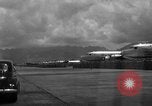
President Franklin D. Roosevelt at Hickam Field and at Alea Naval Hospital in Hawaii, during World War II
Rear view of a car in President Franklin Roosevelt's motorcade driving along the flight line at Hickam Field, Honolulu, Hawaii, during World War 2. Several C-54 aircraft are seen (Navy designation R5D). President's The President sits with Admiral Chester Nimitz, in the back seat of an open 1942 Packard convertible motorcar. (It displays private use "A" gas ration stamp, the most restrictive, on its windshield.) Medics carry a wounded soldier, on a litter,past the car, and the President shakes his hand. A new scene shows the President's VC-54C airplane (Sacred Cow) parked in front of the air base terminal building, which it topped by a sign reading: "Aloha Air Transport Command." Change of scene shows spectators filling the lower level and porch of a building at the U.S. Naval hospital, Alea Heights. Next the President's car is seen surrounded by hospital staff in formation to honor him. Nurses in white stand at attention on the ground, and a large formation of sailors stand at attention on a porch above.