


 Francais
 Deutsch
 Italiano
Refine Your Search
Crimea Ukraine 1942 stock footage and images
- Showing 415 to 420 of 2514 results more
more Hide
Hide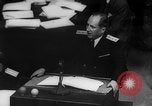
View of the Nazi Concentration Camps and its victims, and other atrocities committed by Nazi forces in World War 2.
Images and testimony related to the Nuremberg Trials held at the Palace of Justice in Nuremberg, Germany in October 1946. Flashbacks of a variety of Nazi crimes against humanity during the years of World War II. Reference to testimony of Kenaris and Hans Frank in describing Nazi policies and methods for exterminating Poles and others. Pictures recording the implementation and results of Nazi policies; atrocities and murder of victims in Ouradour Sur Glane in France, in Bande in Belgium, in the Catacombe of San Callisto in Italy and in Czechoslovakia. Nazi German soldiers seen leveling and destroying the town of Lidice in Czechoslovakia in 1942, after massacre of many residents, in retaliation for the assassination of SS Reich Protector Reinhard Heydrich. Corpses of the victims of the Nazi concentration camps, including Auschwitz, in 1945. Bones of humans in crematory ovens. Cramped starved women camp victims inside barracks. Stacks of luggage and suitcases of victims at a concentration camp, along with locks of hair, stacks of toothbrushes. Shaving cream brushes, shoes, clothing, and finally, piles of bones of camp victims. Testimony of Rudolf Franz Ferdinand Höss (sometimes spelled Höß or Hoess or Hess) describes concentration camps at Auschwitz in Poland. As scenes of victims in hospitals are shown, testimony of Rudolf Hoess is read, describing medical experiments include lowering the body temperature, injecting the body with poisons and infectious diseases and subjecting the body to high altitude pressure chambers. Shows pile of mutilated corpses.The "Arbeit Macht Frei" sign over the camp entrance of Auschwitz. Scenes of dead victims of Nazi brutality in the concentration camps.
Nuremberg Trials reveal the Nazi enslavement of people in occupied countries and atrocities against Jewish people during World War II.
Opening scene, in 1946, is the courtroom where Nazi officials are being tried for war crimes at the Palace of Justice in Nuremberg, Germany, where the procecutor has completed charges 3 and 4, concluding the indictment against them. Sitting in first row of the dock are Hermann Göring (or Goering) (hidden behind soldier), Rudolf Hess, Joachim Von Ribbentrop, and William Keitel. The camera focuses on Fritz Sauckel, as he is identified as the Nazi slave labor chief. Supporting documents are shown. Film footage scenes of slave workers being rounded up and working on shipping docks, emptying rail cars, repairing railroads, and digging in open pit mines, under Nazi military guard. Next are shown views of Hermann Goering walking in an occupied village in 1942, overseeing the confiscation of all of the livestock. German soldiers releasing and rounding-up cattle, sheep, and pigs that had belonged to citizens of an occupied village. Dr. Wilhelm Frick is shown. He is charged with eliminating elderly, insane, or uncurable sick Germans, considered "Useless Eaters" and subject to Nazi euthanasia programs. Several frail and sick or mentally disabled persons are shown. Crosses are shown marking burial places of these persons outside the institutions in which they died. Next, several German Jewish men in civilian clothes are seen rushing to a work site where they are put to work as slave labor digging with shovels under direction of a Nazi military officer. Scene shifts to Nazi Storm Troopers (Sturmabteilung) harrassing German Jewish shopkeepers, writing anti Jewish messages on the windows, encouraging boycott, and preventing their businesses from operating. More views of Nazi Storm Troopers causing trouble in the streets. Next scene is Hermann Goering reading some dictates as Hitler and Hess, along with other Nazi officials, sit in attendance. The so called "blood purity" rules or blood purity laws of the Nuremberg Laws define German citizens narrowly and prohibit marriage between "German Citizens" and Jews. An unseen audience roars its approval. Jewish people are next seen being rounded up and beaten, mistreated, harassed, and evicted from home. Back at the trial, the prosecutor speaks of Nazi SS Brigadier General Jürgen Stroop cleaning out the Warsaw Ghetto, in Warsaw, Poland, in utter ruthlessness in 1943. Scenes of Polish Jews people being driven and dragged out by SS and Gestapo forces, many unclothed, and the entire place being dynamited afterward. View of a detonation system, and then a huge explosion and walls of the Warsaw ghetto in Poland area are seen crumbling to the ground. Buildings burning and people leaving with injured on a stretcher. Scenes of Nazi agents, Gestapo, and Wehrmacht Army chasing Jews from sewers using tear gas and driving them from buildings using light tanks and armored vehicles. Jews are rounded up, beaten with clubs, and dragged by Nazi German SS and Gestapo authorities who capture them. Back in the courtroom, Rudolf Hess is seen describing how Nazi doctors would screen arrested Jews as they entered concentration camps. Views of crowds of Jews entering a concentration camp near a railroad train depot. A large group of Jewish children at a camp. Children hold up their arms and the boys and girls reveal tattoo numbers on their arms. More views of women and children moving through outside paths of a concentration camp, surrounded in barbed wire and fencing. Views of so-called camp shower baths in which prisoners were killed by poison gas. Clothing of prisoners hanging outside the gas chambers, which the prisoners were told were delousing chambers. Views of the gas chamber shower heads and gas output vents. Views of naked prisoners, some seated and some laying down, inside a gas chamber. View of dead, naked prisoner bodies stacked up in a room. View of bags filled with gold from rings and teeth of the dead. Canvas bags and chests containing the teeth and gold jewelry, held in the Reichs Bank. Closeup of corpses. Bodies being loaded and unloaded from flatbed trucks and being dragged by camp inmates and German soldiers, and thrown into mass graves.
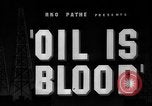
Production of petroleum at oil refineries and its transportation in United States, before and during World War II
Documentary titled, ' Oil Is Blood ' on production and transportation of petroleum and its by products in United States. Crude oil in a pit. Man takes samples from the pit. View of derricks at an oil drilling site. Derricks at sea. Exteriors of a building near the derricks. Service station attendants, pumping gas and cleaning the windshield, on a 1942 Lincoln Continental convertible, at a "Tydol Flying A" gas station. Scenes of busy highways and plenty of fuel give way to empty roads, closed gas stations, and restricted hours for obtaining fuel, as it is rationed during World War 2. Views of persons obtaining ration stamps and books. Various gasoline ration books including the "A" books (allowing the smallest amounts) and "B", "C", and other books allowing larger rations to more essential users. Oil rig "roughnecks" inserting new sections of pipe and proceeding to drill. Closeup of a "gusher" before it is capped. Men filling railroad tank cars with petroleum products. A long train of tank cars pulled by a steam locomotive. Animated map illustrates the ocean shipping lanes that formally served as means to transport fuel and oil, before the German U-Boat threat made them too dangerous for general use. Drums of fuel and oil being loaded aboard a ship to supply the Allies during the war. A convoy of ships heading to the war zone of North Africa.

President Roosevelt addresses congress after attack on Pearl Harbor in 1941; civilians enlist in U.S. military for World War 2
World-wide wartime activities during 1941 and 1942. President Roosevelt addresses Congress after the attack on Pearl Harbor in 1941. Crowd applauds. Citizens and cars stopped in busy New York listening to the news on the radio being broadcast regarding the declaration of war against Japan. Long queues and lines of civilian men get registered in the U.S. army as recruits are called up. Men taking oath of U.S. military service in New York and Washington DC (on U.S. Capitol steps) and other cities in mass recruitment events. New recruits stand in line in a city to register for U.S. Navy or U.S. Army service. New recruits shown include baseball star Joe Dimaggio, boxer Joe Louis, John Aspinwall Roosevelt (who was President Roosevelt's youngest son), Tyrone Power, Clark Gable, Douglas Fairbanks Junior, and Warren Pershing (son of famed General John Pershing) all seen registering to enter military service. Justice Frank Murphy of the U.S. Supreme Court is seen operating a machine gun during training. Another scene with a mass group of recruits standing and taking an oath of military service.
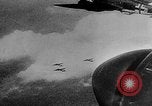
Rise and training of Free French Resistance fighters in World War 2; propaganda film supporting efforts of Free French.
Alternating World War 2 footage and dramatized scenes with actors. German Luftwaffe bombers destroying French cities. Invasion of France by Germany. Burning buildings and debris in French cities during 1940 invasion. Hitler viewing Eiffel Tower while visiting Paris in June 1940 after occupation. German flag atop Eiffel Tower. Allied fighter aircraft shot down, pilot ejects and parachutes to ground as aircraft crashes with explosion. Pilot landing in parachute, gathering and hiding parachute. Actors conversation segment. Footage of sad looking and defeated French soldiers marching in streets of France under occupying German guard, as depressed French citizens look on. French General Philippe Petain at desk delivering speech that calls for collaboration with Germans. Close ups of sad and crying French men, women, and children in streets of France suffering war and occupation. Petain salutes soldiers during a parade after he abolishes representative government. Petain speaks from podium to gathered soldiers. View of French General Charles De Gaulle, in Britain, calling for continued French resistance and speaking to French officers on a warship. Actor dialog segment. Footage of Petain visiting Hitler. They shake hands while photographers record the meeting. Actor segments. Footage of Free French forces training and marching in various cities. Free French soldier receives machine gun training. French officer training in Russia at a Soviet recognition ceremony. French soldiers carry railroad ties and discuss over a map. RAF spitfires in flight. Sign at training camp "French Air Force Squadron. Flexible Gunnery School." Allied naval ships at sea; close views of ship guns. Smoke rises from French ship fleet scuttled at Toulon November 27, 1942. Mobilized French citizens receiving rifle training. Free French Army encampment with French flag raising ceremony. French citizens gather to read posted German notices. Parade celebrating liberation of Paris in World War II. Happy French citizens smile and cheer French, American, and Soviet allies marching in Paris.
A new rolling mill begins operation at the first Metallurgical Plant in Uzbekistan, USSR
Title slate reads,"the First Metallurgical Plant in Soviet Central Asia." Narrator says construction started 4-years ago during the Battle of Stalingrad in World War 2 (1942-43). Interior of the plant is shown from a vantage point high above the factory floor. Strips of hot steel are seen being extruded from a rolling mill. Closeup of the rolling mill in action and workers standing beside it. Closeup of the mill's rollers and hot steel blank passing through them. Workers handle the hot steel with long tools, as they move it back and forth to different sets of rollers. Narrator says the rolling mill has a capacity of 50 thousand tons per year. Closeup of two steel workers. Change of scene with view from above and then from below, as a furnace is tapped and molten steel flows into a crucible, emiting smoke and flames. Closeup of Uzbek steel workers employed at the steel plant. Next, workers are gathered in a ceremony marking the opening of the new rolling mill. A plant supervisor speaks before the gathering. A huge picture of Joseph stalin forms a backdrop. (Note: This is the The Uzbek Metallurgical Plant, aka V. I. Lenin Uzbek Metallurgical Plant, located in Bekabad, Tashkent Oblast,Uzbekistan. The 300-millimeter light rolling mill, seen here, began operating in October, 1946.)