


 Francais
 Deutsch
 Italiano

Refine Your Search
Crimea Ukraine 1942 stock footage and images
- Showing 427 to 432 of 2514 results more
 Hide

United States 1st Infantry Division soldiers fight against the Germans in Africa and later capture Sicily during World War II.
'The fighting first' about the role of United States 1st Infantry Division in various campaigns during World War II. A soldier of United States 1st Infantry Division. Combat boots of soldiers during the civil war and World War I. A map shows the 1st Infantry Division units moving across the Atlantic Ocean towards North Africa for Operation Torch in November, 1942. Soldiers of 1st Infantry Division go to England and loaded onto ships as they move to Africa. U.S. General Terry Allen aboard a ship. Infantry soldiers fire in Oran, Algeria. Aircraft in flight, explosions occur and a convoy of trucks on advance during the battle in Oran. 1st Infantry Division troops as part of US II Corps battle against Nazi General Rommel's armies in Tunisia, North Africa. Battle scenes against German forces in North Africa in a variety of locations, overlaid with this narration: "we damn near flunked out at the Kasserine (Kasserine Pass). But we learned the score and we started to teach Gerry a few things out of our book. We rammed our way back to Gafsa and down Rommel's throat at El Guettar, where we tore up his crack 10th panzer division." In 1943, men of 1st Infantry Division load onto ships and arrive in Sicily. Troops advance into a town in Sicily after capturing it. Damaged houses in a city in Sicily.

Norwegian Prime Minister Quisling presents a model of a Viking ship to Hitler in Germany during World War II.
A gift being presented to German Chancellor Adolf Hitler in Germany in February, 1942. German soldiers lined up in a courtyard as a car arrives. Norwegian Prime minister Vidkun Quisling climbs up the stairs of a building. Interiors of the building as Quisling shake hands with Hitler. He presents him a model of a Viking ship.
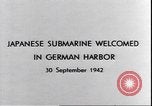
A Japanese submarine is welcomed in a German harbor as officers greet each other during World War II.
A Japanese submarine in a German harbor on September 30, 1942 during World War II. A German ship in the foreground and the Japanese submarine in the background. Nazi naval officers lined up on the deck of the ship as they salute the Japanese crew on the deck of the submarine. Nazi officers come aboard the submarine and review the Japanese crew. German and Japanese officers pose. A girl presents flowers to a Japanese officer. Japanese officers talk to a German Naval officer.
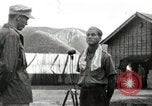
An American prisoner talks about the harsh treatment at a Japanese prison camp in Honshu, Japan during World War II.
American prisoners of war being interviewed at a Japanese prison camp in Honshu, Japan after World War II. A U.S. officer interviews a prisoner who has been liberated from a Japanese prison camp. The prisoner says that his name is James Robertson. He says that he is from St. Louis and was born in Chicago, United States. He speaks that he came to fight against the Japanese on April 22, 1941. He states that he was captured by the Japanese on May 6, 1942 in Corregidor, Philippines. He narrates an incident to prove that they were tortured at the prison camps. He also states how hot tea was poured on the legs of a prisoner.
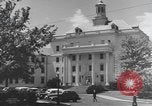
Setting up of hospitals to treat veterans suffering from neuropsychiatric disorders in the United States.
Medical facilities related to neuropsychiatric disorders being provided by the Veterans Administration in the United States. Exteriors of a V.A. hospital building. Animation shows the increase in number of neuropsychiatric patients from 1942 to 1950 and forecasts growing through the 1980s. Narrator describes high prevalence of such problems among veterans. (Also known as "shell shock" or, more recently, Post Traumatic Stress Disorder, or PTSD.) Exteriors of hospitals and training schools where neuropsychiatric specialists train. A doctor talks to a patient in a bed. Neuropsychiatric research being conducted in a laboratory. A technician works on an instrument. A neuropsychiatric specialist being trained. A technician works on an instrument. Psychiatrists discuss. They give various therapies to patients like the shock therapy, the socializing therapy in which a patient plays golf.

A hospital under the Veterans Administration that treats patients suffering from various diseases in the United States.
Medical facilities related to medicine and surgery being provided by the Veterans Administration in the United States. A graph depicts the increase in number of patients suffering from medicine and surgical diseases up to 269% from 1942 to 1950. Two war veterans at a hospital as they recover after an ailment. A surgery being performed. A pathological conference being conducted. Specialists give on the spot directions as they look after the patients. Doctors examine patients as they take X rays. A doctor looks after veterans suffering from various diseases. Patients at a hospital suffering from tuberculosis. Patients in wheel chairs. Women lying down in a garden. A doctor takes a patient's X ray. He looks at the X ray film.