


 Francais
 Deutsch
 Italiano
Refine Your Search
Crimea Ukraine 1942 stock footage and images
- Showing 433 to 438 of 2514 results more
more Hide
Hide
Invasion of Corregidor by U.S. 503rd Air Regiment and 24th Division during World War II.
Battle of Corregidor fought between U.S. troops and Japanese troops in Corregidor, Luzon Island, Philipinnes during World War II. Japanese troops lower the U.S. flag and raise the Japanese flag after the fall of Corregidor in 1942. U.S. troops in Japanese prison camps. Invasion of Corregidor on February 16, 1945 by U.S. 503rd Air Regiment and 24th Division. A U.S. convoy underway at sea. U.S. naval battleships attack shore targets. Planes take off from an airfield. U.S. 503rd Air Regiment dropped by parachutes. Paratroopers land in Corregidor. U.S. 24th Division comes ashore in amphibious vehicles, troops land and fight their way inland.
Procedures for rotating U.S. Army airmen from England to United States for rest and relaxation during World War 2.
A film titled 'Happy Warriors' on procedures for rotating U.S. Army Air Force airmen from England to the United States for rest and relaxation during World War II. Several views of U.S. B-17s, B-24s and other bombers in flight through flak over enemy areas in Europe. Tail codes on B-17s identify them as belonging to the 95th Bombardment Group of the U.S. 8th Air Force. Various crew members seen at their respective crew stations aboard the bombers. Falling bombs explode on ground targets.View of a failed engine in flight and the propeller being feathered. General Eisenhower shaking hands with crew of a B-26 Marauder named "Son of Satan," with about 50 bombs painted on its fuselage for missions flown. A military bus arrives at the 127th Replacement Battalion's Washington Hall. USAAF fliers step from the bus and make their way to the receiving office. A sign reads: "New Arrivals Report to Rear Door." Among the group of aviators walking to the reception area is one carrying a small puppy dog. Colonel William A. Gayle, Battalion Commander, of Montgomery, Alabama (and later Mayor of Montgomery), poses with his headquarters staff. "Puddles" the mascot dog of the Post joins in for the picture. Posing and smiling is Sergeant Major Holloway, who has been Colonel Gayle's "right hand man" since the unit was organized in 1942. The fliers stand informally as a Sergeant calls the roll. The fliers undergo screening of their individual possessions for security purposes. A navigator has his maps taken away, to be returned when he returns from leave. Captain Baldridge, in charge of the mess,tastes and personally approves dishes from the kitchen before they are served to the Army aviators.
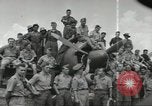
Pilots and planes of the Royal Netherlands Indies Army Air Corp, or ML-KNIL, in Singapore during World War II..
Scenes of the Royal Netherlands Indies Army Air Corp (ML-KNIL) at Kallang Airfield in Singapore during World War 2. Group of Dutch pilots gathered together for a group photo around aircraft B-3111, the plane of Lt. Frederik Pelder. The pilots are from 2-VLG V which was ordered to Singapore when the shooting war began, arriving 9 December 1941 and returning back to Semplak on 18 January 1942. Skull and cross bones held by commanding officer of 2-VLG-V, Captain Jacob Pieter van Helsdingen. The pilots and crew laugh and smile for the group photo shoot. A Dutch Martin 139WH (export version of the B-10) being loaded with bombs. Machine gunner seated in position in the aircraft. The Dutch Martin 139WH in flight overhead. Several views of Dutch Brewster B-339D fighter aircraft taxiing and in flight. Dutch pilots "scramble" (in response to alarm )and run quickly to their "Brewsters." Dutch Brewster B-339D aircraft take off in flights of three and join up in formation. An Australian Hudson I aircraft with Twin Wasp engines seen briefly as it taxis on the airfield.
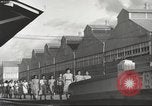
Filipino people going about their routine activities in the Philippines; Filipinos trained by American soldiers.
Part of a 1944 film showing scenes of Filipino people circa 1940, before World War 2. At opening, Filipino women are seen walking alongside a row of factory buildings. A factory room filled with Filipino women dressed in white caps and white uniforms engaged in production at individual individual work stations in a factory. A machine shop filled with Filipino men engaged in metal work. Several people at the window of an office, conducting business with a woman inside. A stock or commodities market office with quotes on tote boards. Women working alongside a moving production line. A woman operating a fabric processing machine. Filipino miners pushing hopper cars of mined ore across a bridge. Miners riding on an engine pulling a train of hopper cars filled with ore from a mine. Filipino longshoremen handling cargoes on a wharf. Scene shifts to an open field where a number of Filipino men are being trained to use firearms during World War 2. One is being coached by an American soldier as he works with a Browning M 1917 water cooled machine gun. Lines of Filipino men firing rifles under supervision of U.S Army trainers. A contingent of uniformed Filipino soldiers, led by an American soldier, marches past a sign, in an camp of tents, reading "A-T Company, 1st Filipino Infantry." Filipino soldiers at a tent camp, being instructed by an American soldier, using a large set of maps. Camera pans over a camp of many tents laid out in order. A formation of Filipino soldiers marches between tents. An American soldier opening his foot locker at his quarters. An illustrated portrait of General Douglas MacArthur. A formation in a field with a Filipino band playing and a Color Guard carrying the American and Filipino flags. A large group of Filipino children walking along a path. A Filipino boy lying on the floor in his home, reading a large book. Filipino school girls seated at benches next to tables. Women doing laundry at an outdoor pond. Next, an actor in khaki clothing sits in a tent and speaks as if addressing American soldiers regarding the Philippines. Among other things, he says,"These people aren't natives. They aren't beggars. They have cities and farms and industries.They have schools and courts and a Constitution. They also have pride and patriotism and self-respect. They love freedom They'll die for it." He cautions American soldiers about their behavior vis-a-vis Filipinos. He states that "Filipinos are American." He alludes to messages received from American and Filipino defenders in Fort Mills, at the fall of Corregidor on May 5, 1942. View of radio towers and worker in radio studio. Morse code messages heard as an American army radio operator with a headset transcribes the messages. Scene shifts to an amphibious invasion fleet attacking a Japanese held island in the Pacific.
American forces prepare for war; ASF Lieutenant General Brehon B. Somervell addresses officials (WW2)
Continental Army cavalry riding horses and soldiers marching in an American Revolutionary War reenactment. Continental Army soldiers carrying the wounded on their backs under heavy rain. United States Army soldiers marching in New York City during World War II. Views of enormous numbers of U.S. Army soldiers marching in formation. Large columns of U.S. Army soldiers seen approaching camera position and from above. A soldier with an Army Service Forces (ASF) patch marching. Close up of the Army Service Forces (ASF) patch. Commanding General of the ASF Lieutenant General Brehon B. Somervell smiling. A notice detailing the War Department Reorganization effective March 9, 1942. Army Ground Forces commander Lieutenant General Lesley J. McNair. Army Air Forces Commander General Henry H. Arnold. General Somervell and Army Chief of Staff George C. Marshall. Soldiers advance towards a battlefront. Wounded are evacuated from the area. The soldiers stand in formation. Officials seated at a desk. General Somervell addresses them and speaks on the value of war material. A dead German soldier in tank. Dead bodies of Japanese soldiers scattered on the beach in the Pacific. Tires and scraps for use by the army. A newspaper advertisement reads “Your scrap will save some brave boy’s life!”. Ceiling prices listed in grocery store during wartime. Japanese planes bombing Malaya and Singapore. Burned houses after Japanese bombardment in Asia. A burning house in China. An oil tanker explodes and burns after being bombed at sea. Tanks advance towards the front. Generalissimo Chiang Kai-Shek and wife Soong Mei-Ling (Madame Chiang). An airplane in flight, bombarding a target area. Prisoners of war standing. Dead bodies lying on the ground. Destroyed area after an enemy attack. The soldiers and the tanks advance towards the battlefront. Barrage balloons in flight overhead. Allied flags on display such as the Soviet Union and England.
Montage of World War 2 scenes from all theaters of Allied operations and scenes of the U.S.A.
Peaceful scenes of pre-war England, showing a church with sheep grazing on its lawn, and a college building with ivy growing on the walls. In contrast, explosion and results of German bombing is shown, with buildings collapsing and ruined from the German blitz over England. A long line of Chinese soldiers marching along the Great Wall of china. Shadows of three Japanese bombers flying over Chinese landscape. On May 4, 1942, Madame Chiang Kai-Shek decorates American fliers who made the first attack on Tokyo in World War 2. Wearing a Chinese decoration around his neck, Lieutenant Colonel Jimmy Doolittle, who led that raid by U.S. B-25 bombers from the Aircraft Carrier USS Hornet, poses with Madame Chiang and others of his group. Scenes of Moscow, Soviet Russia, including a T-70 light tank moving rapidly along a city street. A Soviet Petlyakov Pe-2 dive bomber taking off in a snow storm. U.S. troops on a halftrack in North Africa. British artillerymen firing a 25 pounder in the desert. Glimpses of smoke rising from enemy strikes at cities in England, Russia, and China. Scenes of destruction from bombing. Brief street scenes of unharmed and intact towns and cities in the United States, including brief New York City scene of pedestrians and traffic in Times Square. Defense workers in America going to work at Ranger Aircraft Engines factory (later part of Fairchild Aircraft and Engine Corporation), and a star flag showing war service by worker families. Farmers in Western U.S. harvesting grain. Railroad trains and river barges carrying harvest from U.S. farms. Herds of cattle and sheep being raised for the war effort in Western U.S. Aerial view of orchards and farms in America. A mining bucket filled with iron ore. Barge carrying the ore. A steel mill in operation. Scrap iron being recycled. View from production floor of U.S. bomber aircraft being built in a defense plant. Countless freight cars in a railroad marshaling yard at a port, where a tug boat and a freighter are seen in the water. War materiel piled up at the port. A convoy of supply ships underway.