


 Francais
 Deutsch
 Italiano
Refine Your Search
Croydon London England United Kingdom 1932 stock footage and images
- Showing 1249 to 1254 of 26292 results more
more Hide
Hide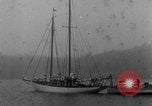
President Roosevelt on board Amberjack II, with his sons and Norman Davis
United States President Franklin D Roosevelt, aboard the yacht, Amberjack II, anchored in a New England harbor. His sons Franklin Jr. and John Roosevelt are also on board. President Roosevelt spends time conversing with U.S. Diplomat, Norman Davis. Accompanying vessels can also be seen in vicinity of the Amberjack II.
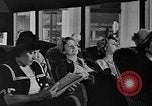
World War II film intended to encourage American civilians (especially women) to participate in the home front war efforts.
Mix of actual World War 2 footage scenes outside the United States, and dramatized war scenes inside the U.S. Narrator speaks as a U.S. soldier writes a letter to his mother at home, in which he contrasts the hardships of war torn countries and peoples with the relative safety and lack of suffering of the U.S. population during World War 2. Opening scene shows typical American women riding in a bus. One woman, ostensibly the soldier's mother, climbs aboard a bus as another woman steps out of it. A woman visits a friend who says she had to give up her Red Cross work because it didn't leave her time to get her hair done each week. A group of women at a garden party bridge club. Narrator says one of them could not work at a USO canteen because it conflicted with her bridge party. A woman lounging in a garden chair, is claimed to avoid a war job because they are all boring and dirty. A maid serves some hard to obtain foods to two woman at lunch. The hostess accused of obtaining them on the black market. The scene shifts to the letter writing son serving with the army in Europe. He relates taking a village recently, and the film shows residents cheering as the American soldiers occupy it. Fire fighters direct streams of water on burning wrecked buildings. Refugees fleeing their homes. Several nuns helping some as they evacuate. shells striking as refugees travel. Populations fleeing and refugee citizens leaving as invading forces come, in Russia, Czechoslovakia, Poland, France and France. View of people running for shelter in China. At this point, the film shows the chaos in those countries superimposed on America, where fires are being fought, and ambulances respond to help injured. A woman picks up her child as she and others run, looking skyward with dread. Air raid sirens sound in the background. A British soldier looks over a scene where Asian people are evacuating from war torn homes. A group of despairing European people. The film creates an imaginary image of and ordinary American woman digging through the rubble of her destroyed home. American women lined up, in front of bomb damaged buildings, to receive one egg a month. Other American civilians lined up to receive a ration of potatoes. Women in England are seen shoveling rubble from the remains of their homes after a blitz bombing by the German Luftwaffe. In Russia many women are seen digging and performing manual labor which the narrator says is labor forced by invading forces (possible slave labor forced by Nazi German forces). Women in Greece clearing rubble. Again, film creates imaginary view of Americans clearing rubble from their destroyed houses and evacuating en masse. Two American women comforting another in front of her burning home. More views of Americans in mass evacuation, carrying their belonging with them. Narrator states children are evacuated first and them film shows scenes of English children being sent to safety on buses. View of Russians evacuating in horse-drawn carts. Imaginary transition to Americans evacuating known local places. Chinese evacuating across a bridge, assisted by British soldiers. More imaginary scenes of Americans evacuating. A soldier writing a letter and then packing up his gear to move on with members of his army unit. They line up in formation and then march. Imaginary view of American women marching side by side with them. Glimpse of large formation of uniformed nurses marching. Last scene is of American flag superimposed on marchers.
C-47 planes airdrop containers; soldiers retrieve supplies from drop site (WW2)
A group of United States Douglas C-47 Skytrain Military transport planes in flight. They air drop special containers by parachute over Newbury, Berkshire, England during World War II. The parachutes open and descends with the supplies. A Jeep with a trailer drive to the drop site. Soldiers remove the container from the parachute and loads it into the back of the trailer. Another soldier gathers the parachute and the other two helps him carry the parachute away. Soldiers in the Jeep.
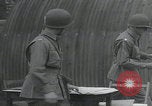
Staff officer points to sand table model and discusses plans (WW2)
A United States Army staff officer points out terrain features on sand table model outdoors in Newbury, Berkshire, England during World War II. He holds a photograph on one hand and a stick on another. He points with his hand. The officer’s stick points to the model. The officer is joined by other officers, including a staff sergeant. Officers crowd around the sand table model. An officer leans on desk while working outdoors. His left leg stands on a wooden chair. He is joined by another officer who shows him a board. The two officers discuss plans together. A Quonset hut is seen in the background. A third officer joins in, delivering a document. The officers discuss plans and view the sand table model for reference.
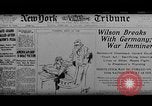
U.S. President Wilson declares war against Germany and U.S. General Pershing arrives in France during World War I.
America declares war against Germany during World War I. A report in ' New York Tribune ' is pictured. President Woodrow Wilson at his desk in his office in Washington D.C., United States as he declares war against Germany. A copy of Joint Resolution declaring war against Germany. General Pershing reaches England and then France where he visits Napoleon's tomb, Les Invalides along with other French officers. United States Secretary of Navy, Josephus Daniels and Assistant Secretary of Navy Franklin D. Roosevelt as America joins the war. Allied ships underway at sea. United States battleship New York at sea. Sailors aboard a ship. Admiral Rodman addresses the crew aboard a ship.
Allied Army paratroopers land at Arnhem Netherlands and advance inwards fighting with enemy during World War II.
United States Army and British Army airlifts paratroopers from England to the border of Holland during World War II. British and American transport airplanes and gliders land near Arnhem Holland (Netherlands). Soldiers, tanks and guns supplies offloaded and soldiers begin fighting with the enemy. Soldiers of Dutch Army aid the Allied forces. Allied soldiers rescue injured soldiers and advance towards enemy lines. Allied soldiers meet with Dutch Resistance or Dutch Underground Army members wearing identifying armbands. Group of German Army prisoners is seen including many young boy soldiers. Allied landing draws attention of German units allowing U.S. Army units to cross border into Germany. American soldiers near a bridge and crossing into Germany. They pass near railroad station at Roetgen Germany. Nazi German prisoners use horse carts and bicycle transport while being led away under Allied guard.
CRITICALPAST.COM: About Us | Contact Us | FAQs - How to Order | License Agreement | My Account | My Lightboxes | Shopping Cart | Advanced Search | Featured Collections | Website Terms & Conditions | Privacy Policy ©2026 CriticalPast LLC.
License Agreement |
Terms & Conditions |
Privacy Policy
©2026 CriticalPast LLC.