


 Francais
 Deutsch
 Italiano
Refine Your Search
Croydon London England United Kingdom 1932 stock footage and images
- Showing 1297 to 1302 of 26292 results more
more Hide
Hide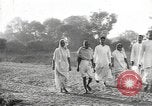
Scenes of Mahatma Gandhi associated with end of his imprisonment and 21-day fast in India
Indian political leader Mohandas Karamchand Gandhi also called "Mahatma Gandhi," recovering from his imprisonment and 21-day fast to promote improved lives for India's Dalits, aka "untouchables," whom Gandhi calls "Harijan" (roughly equivalent to children of God). Mahatma Gandhi walks with his wife Kasturba Gandhi and a few other people, across a field towards a hospital building. In next scene, Gandhi stands in a rail car being interviewed. Then, in a formal public interview inside an auditorium, he is heard speaking and describes himself as a "soldier of peace." Glimpse of Gandhi seated outdoors under a canopy of nationalist flags, in 1932. Scene shifts back,again, to the rail car interview, where he is being seen off by well-wishers. He is then seen in a hospital where he is asked about his notions of eliminating the Indian caste system. (Film ends before any reply.)
Mix of moving images and still photos showing events in life of German rocket pioneer, Reinhold Tilling
Film opens showing large cloud of white smoke rising from a rocket propelled rail car. That is followed by a series of still pictures showing various designs of German rocket pioneer, Reinhold Tilling. Next, the airplane used to test fire Tilling's rockets at altitude, in 1933, is seen, with rockets slung beneath its wings. Pilot is seen climbing into the airplane cockpit. This is followed by series of photographs taken from the ground as rockets are fired from the plane. The airplane is seen small, at altitude, in some. Scene shifts to fire raging at one of Reinhold Tilling workshops, at Osnabruck, Germany, where he and two assistants were fatally injured when gunpowder charges they were compressing for rocket engines, exploded on October 10, 1933. Slate (in German) reads German rocket pioneer engineer Reinhard Tilling shot one of his rockets, on Tempelhof Feld near Berlin, 800 meters into the air. The rocket landed 500 meters away from the launch site, on November 13, 1932. Change of scene shows men standing in a boat on Lake Dümmersee as they retrieve a Tilling postal rocket from the water. Its wings are extended in the glide position. Views of other boats on the lake and of men holding several folded postal rockets.

World War 2 U.S. aircraft bombing scenes; Strategic Air Command Headquarters at Offutt Air Force Base, Nebraska
History and scenes related to the U.S. Air Force Strategic Air Command (SAC). Wheat crop blowing in wind and abandoned harvesting machinery in fields of Nebraska. World War II aerial view of several U.S. Army Air Force B-17 bombers in formation flight. Tail Codes of "triangle C" identify them as belonging to the 303rd Bomb Group (H), 1st Air Division, 41st Combat Wing Eighth Air Force, based at RAF Station, Molesworth, England. A closeup shows B-17,tail number, 41-24416 of the 358th Bomb Squadron. (Its name, "Black Diamond Express,"is not seen.) Lettering on side of one of the B-17 aircraft includes word, "Doodle". View of bombardier using bomb sight in aircraft during bombing run.. Aerial view of buildings on ground. Close up as bombardier completes settings and pulls lever. Bombs away view as bombs are dropped from open bomb hatch toward industrial target. View from aircraft as bombs hit industrial buildings and massive explosion as buildings in target zone are destroyed by B-17 bombing during World War II. Dramatic view of smoke, and rubble soaring upward toward camera on aircraft. View on ground of bombs hitting target and workers in an oil tank and marshaling yard area rushing to assist after damage from U.S. bombing campaign in World War 2. Fire fighters try to extinguish fire. Wreckage due to bombing. Damaged rail lines and trains. U.S. Army Air Force B-29 aircraft in flight as seen from air. POV B-29 bomber from pilot seat area looking forward at bombardier and nose of aircraft. View of bomb door hatch open on B-29 and release of an atomic bomb similar to "Little Boy" atomic bomb that destroyed Hiroshima. View of a massive atomic bomb explosion. Smoke rises from nuclear bomb blast. Views from cameras used in atomic tests showing buildings and equipment at moment of impact. Massive wind and immediate destruction from atomic blast wave. Sweeping views of undeveloped land near SAC HQ at Offutt AFB, and views of the Headquarters of Strategic Air Command, United States Air Force. A Minuteman missile standing near the building. Point of view from visitors entering the headquarters, as an an air policeman directs them. Insignia of SAC (Strategic Air Command) on the wall. Identity card of visitor matched. Model of airplane. Guards checks the Identity card of visitor and opens door
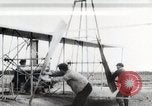
First joint flight by Wright Brothers in 1910 near Dayton Ohio. Also scenes from other "firsts" in early aviation history up until 1919.
Wright brothers' first aircraft flight together near Dayton Ohio in 1910. Wilbur Wright is in the pilot's seat with Orville Wright as passenger to his right. (Until this flight, the Wrights had never flown together so that if one of them was killed, the other could continue their work.) Next, a view of Alberto Santos-Dumont, and the first European flight made by him on 13 September 1909. Following segment shows crowds gathered at Washington DC Polo field as truck arrives carrying mail to be loaded on the first U.S. Air mail flight, May 15, 1918. Army pilot, Lieutenant Webb, in his JN-4H airplane, on Southbound flight from New York, takes off from Philadelphia, where he stopped to pick up more mail. He flies over the Washington Polo Field upon arrival. We see his airplane being unloaded as he jumps down from cockpit and crowds watch. Views of first transatlantic flight begins with takeoff of three out of four existing United States Navy Curtiss flying boat aircraft from Newfoundland, on May 16, 1919. Curtiss flying boats NC-1, NC-3, NC-4 are seen at takeoff from Newfoundland on first leg of the transatlantic journey. Flying Boat NC-4 is also seen at one of its foreign ports, though which is unclear (Azores, Lisbon, or England).
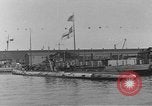
Surrendered German U-boat U-111 is docked in the Brooklyn Navy yard, New York, to help in the American postwar Victory Bond Drive
German U-boat U-111, that was surrendered, after the armistice, and interned at Harwich, England, is seen docked at the Brooklyn Navy Yard, in New York City. It was brought from Harwich by an American crew to help stimulate subscriptions in East Coast cities, during the Victory Bond drive . Sailors demonstrate movement of the deck gun on the U-boat. They also raise the periscope, in a demonstration, while the boat is still docked. Principal naval officers, currently in command, Lieutenant Commanders Garnet Halings and G.W. Russell , pose on the deck with members of the crew including some perched on the conning tower of the submarine. View of German and United States flags on the U-111.
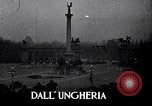
Hungarian military units parade on the streets of Budapest, Hungary during World War II
Hungarian troops in World War 2 gather for a parade in Heroes' Square (Budapest, Hősök tere, 1146 Hungary) at the end of Andrássy Avenue, in Budapest, Hungary. Millennium Memorial visible (also known as Millenary Monument). Monument pedestal visible with text AZ EZERÉVES HATÁROKÉRT, which means "For the Millennium Boundaries". Royal Hungarian Army soldiers and officers in cars, seated atop armored cars, and marching on foot. German Dornier DO-17 bombers in flight overhead. View of German military and Hungarian political dignitaries on stage, including Hungarian Prime Minister László Bárdossy. Officer fastens flag of the Kingdom of Hungary to the instrument of a trumpeter. Formations of Motorcyclists lead a parade along a main thoroughfare. Many open trucks carrying troops take part. Some tow light field artillery pieces. Military members and civilians (almost all women) stand on either side of the road to witness the event. The civilians wave and cheer. Many Hungarian 39M Csaba armored scout cars assembled in front of the Museum of Fine Arts Budapest (Budapest, Dózsa György út 41, 1146 Hungary) beginning to join the parade. A Japanese boy and girl are seen in the crowd smiling and displaying a Japanese flag. Clip ends showing vehicles towing 40mm Bofors anti-aircraft guns on wheeled mountings.
CRITICALPAST.COM: About Us | Contact Us | FAQs - How to Order | License Agreement | My Account | My Lightboxes | Shopping Cart | Advanced Search | Featured Collections | Website Terms & Conditions | Privacy Policy ©2026 CriticalPast LLC.
License Agreement |
Terms & Conditions |
Privacy Policy
©2026 CriticalPast LLC.