


 Francais
 Deutsch
 Italiano
Refine Your Search
Croydon London England United Kingdom 1932 stock footage and images
- Showing 1327 to 1332 of 26292 results more
more Hide
Hide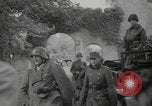
Nazi German General Karl-Wilhelm von Schlieben and Rear Admiral Walter Hennecke surrender to Allied forces in Cherbourg, France (WW2)
The surrender of German General Karl-Wilhelm von Schlieben, Rear Admiral Walter Hennecke and the 709th Static Infantry Division to American forces in Cherbourg, France during World War 2. General von Schlieben and Rear Admiral Hennecke and other German troops are taken to the Allied headquarters in Cherbourg after making a request that they be permitted to surrender to Major General Manton S. Eddy, the Commander of the U.S. 9th Infantry Division. Commander of the 7th Army Corps General J. Lawton Collins interviews General Karl-Wilhelm von Schlieben alleged to have said “I learned in Russia that small groups can achieve major delays” General von Schlieben talks to General Lawton Collins. General Karl-Wilhelm von Schlieben and Rear Admiral Walter Hennecke outside the Allied headquarters. General Karl-Wilhelm von Schlieben walks past an American armored vehicle. Both General Karl-Wilhelm von Schlieben, Rear Admiral Walter Hennecke talking outside and their photos taken before boarding a jeep to be transferred to his prison in Trent Park in England. United States soldiers gathered outside the Naval Headquarters building while a German prisoner calls out for others to surrender. A German soldier carries a white flag, followed by surrendering German troops with hands up as they leave the Naval Headquarters. A wounded American soldier with facial injuries covered by bandages and gauze.
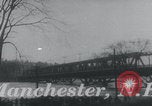
Amoskeag Falls during 1936 Manchester New Hampshire flood.
Amoskeag Falls Bridge over the Merrimack River with raging waters during the Great Flood of 1936 (New England) in Manchester New Hampshire. Remnants of a house is seen going over the falls and floating under the Amoskeag Falls Bridge. Workers stacking sandbags at the Amoskeag Falls Dam power house in an effort to save it. View of Amoskeag Falls Dam powerhouse surrounded by flood water. Two Martin B-10 bombers in flight over an overflowing river. View from a Martin B-10 rear cockpit as United States airmen push food supplies out of bomb bay. Package dropping from a B-10 over Pennsylvania.
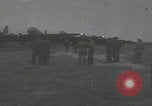
Preparation and night take off followed by D-Day bombings (WW2)
United States Army 8th Air Force bombers lined at an airstrip in England the night before D-Day in World War II. U.S. General Brereton gives a signal for take-off. The bombers take off one by one in the night. Soldiers wave to bid them good luck. 8th Air Force Martin B-26 Marauder bombers in flight. A formation of bombers flying towards France. Gun turret inside a bomber. Allied invasion fleet sails closer to the coast of France at dawn. 8th Air Force fighters fly over the Channel Islands and the French shoreline. Allied bombers bombing the coast of Normandy prior to the ground forces landing there. Bombers release bombs over enemy shore batteries. Bombs hitting German controlled targets and smoke rising from bomb sites.
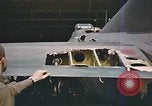
Crewmen inspect flak damaged U.S. 8th Air Force B-17 Flying Fortress bomber at an airfield in England during World War II.
U.S. 8th Air Force B-17 Flying Fortress bombers in England during World War 2. Crewmen inspect flak damage to B-17F, tail number 42-29487 named "Ritzy Blitz" (name not shown) of the 91st Bombardment Group, 324th Squadron, stationed at RAF Bassingbourn, Cambridgeshire, England. Severe damage is seen on left wing flap and left elevator.
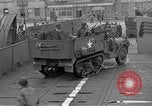
Allied amphibious force assembling in England, prior to D-Day invasion of Normandy, in World War II
Allied amphibious forces assembling in Weymouth Harbor and Portland Harbor, England, in preparation for the invasion of Normandy, France during World War 2. U.S. Army halftrack backing onto a Landing Craft Tank ( LCT), alongside Stone pier, Castletown, Portland, England. Closeup of a young soldier silhouetted against sky during loading operations. A soldier looking from his ship at the transport ship USS Barnett (AP-11) anchored nearby. Higgins boat shuttling away from the USS Barnett. Several of her Higgins boats are tied alongside, and one is on a hoist. View of the Submarine Chaser, USS PC-617, tied up alongside the Barnett. Scene shifts to portside view of the USS Dorothea L. Dix (AP-67) at anchor. View from the water, of LCLs(L)540 and 542 docked next to each other. U.S. Landing Craft Tank LC(T)-636, along with others moored to buoys. U.S. Landing ships Tank (LSTs 300 and 350) are seen anchored next to one another. Closeup of LST-134 with Higgins boats nearby. Landing Craft Tank-157 with barge tied up aside, full of trucks, DUKWs, a tractor, and other cargo. Closeup of LCT-213 underway past the camera boat.
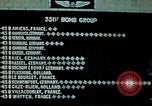
U.S. 351st Bomb Group is briefed before a bombing mission at the RAF base in Polebrook, Northamptonshire, England .
U.S. 351st Bomb Group at RAF Station Polebrook, Northamptonshire, England during World War II. A display board of the U.S. 351st Bomb Group, at RAF Station Polebrook, England, shows 15 principal targets and the number of times they've been struck by B-17s of the Group. The most missions were flown against Schweinfurt, Germany (25 times) and second most, against Hanover, Germany (17 times). Another recent status board records missions against Amiens and Evreux,and Romilly, France; Stuttgart, Germany; and Brussels,Belgium.Swastikas indicate German aircraft shot down during these raids. A C-45 aircraft lands and parks at the field. Major General Ira C. Eaker,Commander 8th Air Force, steps from the plane for a visit with the 351st Bomb Group. He proceeds to the briefing room, in a Quonset hut. Four Officers of the Group pose. View of heavy bombs in the bomb dump. Views of bombs hung wing racks of a B-17 to increase its bomb load. Bombs being transported on motorized dollies. Airmen writing in chalk on a bomb. It reads: "From the boys K of C #92 Jim, MH." Fliers at nighttime in their Quonset hut quarters. One writes a letter. Others trying to sleep, as sounds of aircraft engines are heard. Officer opens door of quarters and wakes crew members, telling them breakfast is at 3AM and briefing at 4AM. Briefing officer asks fliers to guess what the target of the day will be. Several make suggestions. The briefing officer removes a cover from the mission map, revealing target deep in Germany. The fliers respond with good-natured boos. Commander gives final instructions.,
CRITICALPAST.COM: About Us | Contact Us | FAQs - How to Order | License Agreement | My Account | My Lightboxes | Shopping Cart | Advanced Search | Featured Collections | Website Terms & Conditions | Privacy Policy ©2026 CriticalPast LLC.
License Agreement |
Terms & Conditions |
Privacy Policy
©2026 CriticalPast LLC.