


 Francais
 Deutsch
 Italiano
Refine Your Search
Croydon London England United Kingdom 1932 stock footage and images
- Showing 2011 to 2016 of 26292 results more
more Hide
Hide
Retired veteran aviators share Luncheon at Bolling AFB celebrating Air Force record-setting flights in 1929 and 1963.
A large group of retired Air Force officers are seen seated at a number of tables during a luncheon celebrating the 35th anniversary of the 1929 endurance record setting flight of the Fokker C-2A aircraft named "Question Mark." The event is in the Bolling Air Force Base Officers' Club. Closeup of General Carl Spaatz, addressing the group from a podium. Colonel Harry Halverson and aviation mechanic, Sergeant Roy Hooe, who both flew on the Question Mark, are listening, along with Major Sidney J. Kubesch (who,in October 1963, was aircraft commander on the B-58 bomber that set a speed record, flying 8,028 miles from Tokyo to London in 8 hours, 35 minutes and 20.4 seconds). Lieutenant General Ira Eaker addresses the group next. Closeup of him and of General Spaatz tilting his head to hear. The audience applauding. Sergeant Roy Hooe then addresses the group. The clip ends as the luncheon ends and the participants socialize.
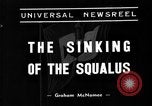
May 24, 1939. Minesweeper USS Falcon (AM-28) employs a diving bell to rescue survivors from the sunken submarine USS Squalus.
Aerial view of the U.S. Navy Minesweeper, USS Falcon (AM-28) dispatched from New London, Connecticut, to rescue crew members from the sunken submarine USS Squalus. Closeup from beside the Falcon as crew members open a diving bell that was sent down 240 feet to the ocean floor for the rescue. Several rescued crew members from the submarine are helped out of the diving bell and climb aboard the Falcon. (A total of 33 crew were saved in four descents of the diving bell). Next, survivors reach a dock. A woman speaks with one of the rescued men as he steps into a car. Views of the Falcon and several support vessels. Scene shifts to 13 July 1939, when the first attempt is made to raise the Squalus. An officer officer manipulates valves to send compressed air down into the hull of the Squalus. Next, foam is generated in the water as the bow of the Squalus emerges clearly showing its number, 192. The submarine remains in that condition, with bow elevated and then sinks again. (Note: several more attempts were made in subsequent months to raise the Squalus, until, finally, on 13 September 1939, the boat was successfully raised and towed to the Portsmouth Navy Yard for repairs. The submarine was renamed USS Sailfish and recommissioned in May 1940.)
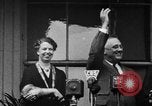
Some activities of U.S. First Lady, Eleanor Roosevelt, during the 1930s and 1940s.
Scenes from the beginning of the Roosevelt Administration in 1933 through 1942, in World War II. First Lady Eleanor Roosevelt waving with President Franklin D. Roosevelt, from a balcony. In a different sequence, she models different clothing fashions for photographers, and sitting with another woman, as she prepares her daily newspaper column, entitled: "My Day." She is seen horseback riding, with companions, in a wooded park. Crowd fills the area around the Lincoln Memorial and reflecting pool, as African American contralto, Marian Anderson, descends steps of the memorial and begins her famous Easter Sunday concert, on April 9, 1939. This concert and venue was made possible by the intervention of Eleanor Roosevelt, after Marian Anderson was denied the opportunity to sing at Constitution Hall because she was an African American. Narration mentions Eleanor Roosevelt's active support for civil rights for all people. First Lady, Eleanor Roosevelt, is seen sitting with Secretary of the Interior, Harold L. Ickes, in the audience. Mrs. Roosevelt speaking as she testifies before a congressional committee regarding care for the elderly. Eleanor and Franklin Roosevelt sitting in a garden where she knits while he works over some papers. Grandchildren run to them. Eleanor Roosevelt with King George VI and Queen Elizabeth Bowes-Lyon, in London, 23 October 1942, viewing destruction wrought by the Nazi German Blitz in World War 2. Eleanor Roosevelt in her Red Cross uniform, visiting soldiers at a U.S. Army hospital, during the war.

U.S. Air Force aircraft lands and U.S. Air Force personnel are greeted in the U.S.
U.S. Air Force jets completes Atlantic Round Trip. U.S. Air Force aircraft lands after completion of a round trip circuit of two U.S. Air Force jet tankers Bravo and Alpha from New York to London. A man signals for landing. The pilot in the cockpit. Air Force personnel disembark the jet. Personnel are greeted by an officer.
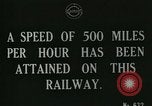
An early maglev train said to have reached a speed of of 500 miles per hour in England.
Car on a railway track surrounded by concentric circles of metal. It appears to be a very early magnetic levitation train. Slate at head of film claims it has reached speeds of 500 mph. As the cars pass along the track, a sign reading, "Danger Current On" is seen.
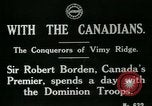
Canadian soldiers with Sir Robert Borden on a field in England during World War I.
Sir Robert Borden, Prime Minister of Canada, spends a day with the Dominion troops of Canada, famous for their conquering of Vimy Ridge during World War 1. Scene of the field (likely near Shorncliffe). Soldiers train and drill, advancing on a battlefield, running and lying down prone to ready rifles and bayonets. Near barracks, they gather and listen to an address from Sir Robert Borden. Canadian Army soldiers raise hats and cheer.
CRITICALPAST.COM: About Us | Contact Us | FAQs - How to Order | License Agreement | My Account | My Lightboxes | Shopping Cart | Advanced Search | Featured Collections | Website Terms & Conditions | Privacy Policy ©2026 CriticalPast LLC.
License Agreement |
Terms & Conditions |
Privacy Policy
©2026 CriticalPast LLC.