


 Francais
 Deutsch
 Italiano

Refine Your Search
Croydon London England United Kingdom 1932 stock footage and images
- Showing 2557 to 2562 of 26292 results more
 Hide

Women of Auxiliary Territorial Service maintain aircraft during World War II. New volunteers arrive
Women, of the British Auxiliary Territorial Service, work maintaining aircraft during World War II. A woman performs maintenance on nose section of an airplane engine. One woman explains aspects of an engine to several others. A woman climbs into cockpit of an autogyro, while another pulls propeller through several times. A third woman lies on ground under aircraft performing maintenance inside an open panel. New women volunteers are lined up in formation on concrete apron in front of hangar, while supervisor speaks to them.

Women of Britain work in the "Land Army" in grain fields, pitching hay and driving tractor, during World War 2
British women working in agriculture, in the "Land Army" on the home front, during World War II. They wear the uniform consisting o breeches, jersey, and slouch hat. Women are seen gathering harvested crop, pitching hay onto horse -drawn wagon and driving tractor in field. Women riding on wagon pulled by draught horse. A woman leads the horse, pulling empty wagon, out the gate of the farm.

British Field Marshal Douglas Haig visits disabled veterans of World War I
Field Marshal Douglas Haig visiting with wounded veterans of World War I. Some are in wheel chairs. Others sit on chairs. Some carry canes. Several men sit on chairs. Nurses are seen in background. A contingent of war veterans marches and is saluted by Marshal Haig. Later, Marshal Haig speaks from a podium. seated behind him is a French General and some other officials.
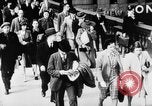
The state of British citizens including children during the war and reduced ration supplies in Great Britain.
Conditions of people and children in Great Britain during World War II. British people, who have been on short ration for two years due to the war, on the streets. Children given food, more than the ration of an adult. The young children drink milk. They appear to be in a group center, likely for children evacuated for their protection. A boy paints on a large paper. A girl sleeps.

Royal Air Force's new huge sleek Victor-Bomber in its ultra modernistic appearance at an airbase goes into operational service.
Royal Air Force's new Victor-Bomber in its ultra modernistic appearance. The new Victor Bomber parked at an airbase. The bomber goes into operational service. Airmen standing near the Victor Bomber discuss about papers. Crewmen fill jet fuel in a V-bomber. The huge sleek V-bomber takes off and flies in sky.
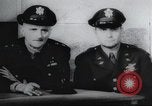
U.S. General Ira Eaker discusses the air raid after bombing Rouen, France during World War II.
Discussion of the first B-17 raid in the European theater (on Rouen, France) during World War II. Major General Carl Spaatz, Commander of the U.S. 8th Air Force, comments about this first such use of American heavy bombers against German targets in World War 2. He notes that this raid was led by Brigadier Ira Eaker, head of U.S. Bomber Command. He invites Eaker to comment on the raid. General Eaker reports that pilots maintained good formations and gunners caused German fighters to back away. He states that the main targets during the air raid were marshalling yards and a Locomotive repair facility. An intelligence officer debriefs two members of a flight crew, following a mission. They answer questions. One of the crew members points out their target on a map, and reports success at hitting their targets..
CRITICALPAST.COM: About Us | Contact Us | FAQs - How to Order | License Agreement | My Account | My Lightboxes | Shopping Cart | Advanced Search | Featured Collections | Website Terms & Conditions | Privacy Policy ©2026 CriticalPast LLC.
License Agreement |
Terms & Conditions |
Privacy Policy
©2026 CriticalPast LLC.