


 Francais
 Deutsch
 Italiano

Refine Your Search
Croydon London England United Kingdom 1932 stock footage and images
- Showing 2563 to 2568 of 26292 results more
 Hide
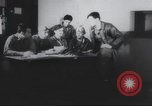
B-17 crew of the U.S. 8th Air Force is debriefed by intelligence officer upon return from a bombing mission.
A U.S. intelligence officer interviews members of a flight crew upon their return from a bombing mission in World War 2. Pilot of the aircraft says that as the B-17 aircraft approached the target over the river, they were hit by Flak in the left wing and tail surface. The Pilot says they dropped their bombs effectively and were attacked by "109s or 190s" (Messerschmitt Bf 109s or Focke-Wulf FW-190s) that dove down on them and swooped up underneath. He refers to his ball turret gunner sitting next to him and says he knocked off one of them. The gunner says he saw the German plane when it came down from the tail, dove under, and started coming up. When asked, the gunner says the German plane was about 900 feet away when it was hit by his machine gun fire. He also noted they were the last ship in the bomb run. Next, after questioning the tail gunner, the intelligence officer asks the Bombardier about his actions. He explains that after releasing his bombs, he began to plot their positions as they exploded on the ground. He notes they got good bursts on the engine sheds, on the concentrations of box cars in the center of the marshalling yards, and on the viaducts leading to the center of the bridge. He notes that all the bombers ahead of them hit some part of the target, with most dropping their bombs right where they were supposed to. (World War II; WW II; World War 2; World War Two)

Allied officials confer aboard USS Augusta (CA-31), and troops readying prior to D-Day invasion of Normandy during World War 2
Recap of Allied Forces preparations for invasion of Normandy (D-Day) during World War II. Allied troops rest and play aboard ships underway at sea. Naval crew being briefed on shipboard. Officers examine map. Troops work with weapons on deck of ship. Allied officers, possibly including General Omar Bradley, confer aboard USS Augusta (CA-31) regarding weather conditions. Paratroopers of Airborne Division board buses. Buses leave camp. Paratroopers lined up at an airfield for inspection. From edited film produced in 1947.
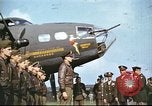
U.S. Army Lt. General Jacob Devers personally congratulates crew of the B-17 bomber, "Memphis Belle."
Commander of U.S. Army Forces in Europe, Lieutenant General Jacob Devers, personally congratulates the pilot, Captain Robert K. Morgan, and each crew member of the 8th Air Force B-17 bomber, "Memphis Belle." Commander of U.S. 8th Air Force, Major General Ira Eaker, is present during the ceremony, which is extensively covered by photographers, cinematographers, newsmen and broadcasters. (BBC microphone can be seen.) Some actions are repeated at the request of the military film director on the scene. The name and artwork on the nose of the aircraft is clearly seen as well as the 25 bombs (for missions) and 8 swastikas (for downed German airplanes) painted on the "Memphis Belle" fuselage. (World War II period).

A cameraman operates a Mitchell camera aboard a U.S. 8th Air Force B-17 bomber in flight over Europe during World War II.
U.S. 8th Air Force B-17 Flying Fortress bombers in flight over Europe during World War II. Aerial formation of B-17s. A cameraman operates a 35mm Mitchell camera in an airplane. The B-17s in flight.

NORAD staff at the Command Operations Center in Cheyenne Mountain, Colorado
Views of the interior of the Command Operations Center (COC) of the North American Air Defense Command (NORAD) deep within Cheyenne Mountain, Colorado. A U.S. Army Staff Sergeant is seen at one of the duty stations. He receives phone calls and makes notes. View of lighted control panels in otherwise darkened Control Center.

Crew of a British warship demonstrate method of searching and fixing enemy targets during World War II
British warship anchored in port during World War 2. Sailors, wearing steel helmets, on the bridge of the ship. Large direction finder, with antennae attached, rotates on the superstructure of the ship. Below decks, a crewman plots information on a board. He wears a steel helmet with "RLS Berry" written on it. British Navy Lieutenant speaks into microphone. A crewman looking at pelorus instrument. Other crewmen ostensibly watch enemy actions through binoculars. Man looking out from crow's nest. The background shows several ships in a major port, with substantial buildings lining the waterfront.
CRITICALPAST.COM: About Us | Contact Us | FAQs - How to Order | License Agreement | My Account | My Lightboxes | Shopping Cart | Advanced Search | Featured Collections | Website Terms & Conditions | Privacy Policy ©2026 CriticalPast LLC.
License Agreement |
Terms & Conditions |
Privacy Policy
©2026 CriticalPast LLC.