


 Francais
 Deutsch
 Italiano
Refine Your Search
D-Day stock footage and images
- Showing 1423 to 1428 of 4856 results more
more Hide
Hide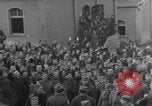
Group of US, Czech, Russian, Yugoslavian prisoners cheering, waving and laughing at liberation of OFLAG XIII-B Camp Hammelburg (WW2)
Freed Allied prisoners of war at OFLAG XIII-B, known as Camp Hammelburg, outside of Gemünden, Germany during World War II. A group of United States, Czech, Russian, Yugoslav prisoners of war standing together along with the liberating 14th U.S. Armored Division soldiers. Two prisoners talk to each other. The prisoners cheering, waving and laughing. Two prisoners walk down the road smiling; one waving a copy of Yank Magazine, the other a chunk of bread. U.S. Amry M-4 tank crashes through barbed wire fence of Camp Hammelburg. A group of freed prisoners gathers. Several prisoners stand and pose. Mass gathering of elated former prisoners. Freed prisoners of war dash toward U.S. soldiers and embrace them. (Note: This was the conclusion of the originally failed "Operation Hammelburg", initially attempted by "Task Force Baum," under Captain Abraham Baum, ten days prior. Inmates at the camp included the recently injured and captured Captain Baum, and Lieutenant Colonel John K. Waters, son in law of U.S. Army General George Patton. LTC John Waters was injured during the initial rescue attempt 10 days prior and was hospitalized and not seen in this film.)
German Protestant minister speaks and graves at cemetery in Germany.
Burial service in Germany. A German Protestant minister speaks on dais during the ceremony. German civilians standing to attend the ceremony. Flowers and bouquets on graves in foreground. Views of cemetery. Clergyman comes and speaks at dais.

Roof of Gold Mine collapses, trapping three men 150 feet down and men reached by drilling a bore hole in Nova Scotia.
Disaster of Moose River Gold Mines in Nova Scotia. Collapsed Moose River Gold Mines and pile of debris. Rescue miners inspect the site. The men reach by drilling a bore hole on the sixth day to bring food, water and a telephone. Survivors of the disaster. On April 12, 1936 the roof of the mine collapses, trapping three men 150 feet down for 11 days. Rotted timbers split. The rubble traps the cable. Plane in flight. People and relatives of victims at the surface, express grief, sadness, and mourning. Rescuers on surface. Survivors are carried out on litters. Large crowd gather.
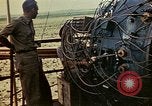
Views of wire connections to detonators on nuclear device 'Gadget' used in the Trinity nuclear test, Alamogordo, New Mexico
Views of the nuclear test device nicknamed, "Gadget", showing network of wires going to detonators surrounding core. The first ever atomic bomb device is in position at the top of its test tower, the day before it produced the first nuclear detonation in history. This device was detonated in the early morning of the next day, July 16, 1945. The detonation test event was named Trinity. (World War II period).
Major sources of air pollution and recommendations to control it in the metropolitan city area of Kansas, United States.
Air pollution in the metropolitan city area of Kansas, United States. View of Kansas City skyline on clear day and on smoggy day. Vehicles move on the streets. View of jet airliner taking off, emiting smoke. View of Kansas center city. An animated map shows seven Counties that differ in terms of land use, industrialization and economic activities in Missouri and Kansas. Kansas City Municipal and Fairfax airports, with aircraft taxiing. Aerial view of the airport areas with smog visible. View of bridges with factories behind barely visible through the smog. Rural road, with open burning of refuse in a large fire, with black smoke rising. Smoke rising from low building and from Large industrial plant. Aerial view of Kansas City from over the river, with smoke obscuring the scene. Aerial view of smoke and pollution blanketing the whole area. Industrial plants along the river edge billowing smoke. The representatives of Kansas and Missouri present findings of the airport area survey during a conference. Animated illustrations of pollution sources: refuse burning; industrial processes; fuel combustion; and mobile sources.

U.S. President Richard Nixon addresses people in the United States on withdrawal of remaining U.S. troops from Vietnam.
Television broadcast of U.S. President Richard Nixon's speech from the White House in Washington DC, United States on the withdrawal of remaining U.S. troops from Vietnam on 29th March 1973 during the Vietnam War. The White House. The Seal of the President of the United States. The President talks about that period of the Vietnam War when he joined the office and speaks about the program he initiated to end the war. He says American prisoners are on their way from Vietnam and people of South Vietnam are now free to choose their government. He says North Vietnam is not complying with few provisions of the Peace Agreement. He says that they should honor all those American soldiers who died during the Vietnam War. He refers to the difficult days of the war including the moratorium to end the war which was organized on October 15, 1969 when millions of Americans took day off from work and schools to participate in local demonstrations against the war. Nixon refers to the period of April 1971 when he ordered attacks on Communist bases in Cambodia. He talks about the period of May 1972 when he ordered air strikes in North Vietnam and the period of December 1972 when he ordered more air strikes.
CRITICALPAST.COM: About Us | Contact Us | FAQs - How to Order | License Agreement | My Account | My Lightboxes | Shopping Cart | Advanced Search | Featured Collections | Website Terms & Conditions | Privacy Policy ©2026 CriticalPast LLC.
License Agreement |
Terms & Conditions |
Privacy Policy
©2026 CriticalPast LLC.