


 Francais
 Deutsch
 Italiano
Refine Your Search
D-Day stock footage and images
- Showing 1417 to 1422 of 4856 results more
more Hide
Hide
People gather for the launch of U.S. ships during World War II in Maine, United States.
Christening ceremony of 6 cargo ships and 2 U.S. Navy Destroyers at a shipyard in Maine, United States, during World War 2. A sign reads '48 days' representing a new record achieved in building a ship in only 48 days. People gathered for the christening ceremony. Women stand holding flowers. The crowd gathered at the shipyard cheers. Men and women open champagne bottles. Various ships slide down ways into the water during launch.
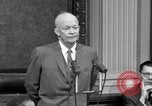
U.S. President Dwight Eisenhower answers queries of newsmen during his 130th press conference in Washington DC, U.S.
U.S. President Dwight Eisenhower during his 130th press conference in Washington DC, United States. Donald J. Gonzales, a newsman, says that when the President said he was unaware of the possibility of a Soviet statement on ending nuclear weapon tests, the U.S. Secretary of State John Foster Dulles said just on the previous day that this has been discussed in the previous days. The pressman asks the President for his reaction to the Soviet announcement. The President replies that he did not say that he was unaware of anything about it but did not have any proof that it was going to occur. He says that he cannot say anything more than what the Secretary said after complete discussions. The President further says that they had discussed this as a possibility on their own side, that is unilateral abandonment of tests and decided that it was not good for the United States at that time. Pressmen seated during the conference. Another pressman, Henry N. Taylor, gets up and puts forward a query to the President. He asks that last week the President had told them that he was convinced any nuclear test could be detected if there was a test ban. Yet the President, in the response to Russia, says test bans could be evaded in secrecy. The pressman asks the President if he could clear it. President Eisenhower says that the U.S. Secretary of State Dulles might have said that they are not certain there have not been tests, particularly underground tests or so small and in remote regions where there would not be debris and instruments would not be sensitive enough to pick them up. The President says he does not believe that explosions can happen in huge megaton character and not have evidence of it. Cameramen taking pictures. The President shakes hands with the officials and meets the pressmen.
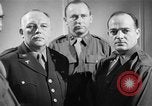
World War 2 Combat Exhaustion patients undergo personality tests, receive sleep therapy and various treatment in the U.S.
Treatment for combat exhaustion cases among U.S. soldiers following combat in World War II. U.S. officers talk about operation plan of a hospital and speak about three sections including admission, treatment and rehabilitation. A patient undergoes a physical examination. A dental survey and necessary laboratory studies. Doctors seated at table to perform an intelligence tests and mental examination. Psychiatric and other personality tests and intelligence test are administered including Rorschach test and Kohs block design test. The doctors check the psychiatric and physical report of the patient by looking at an X-ray. Patients receive sleep therapy: A nurse and an army doctor give narcosis therapy (continuous sleep treatment), by administering barbituates that keep a patient asleep for 18-20 hours per day for several days. Insulin is used on "loss of weight" cases: Combat exhausted soldiers lying on beds and receiving insulin before breakfast by nurses to stimulate their appetite. A nurse checks the weight of a patient during treatment. A nurse checks the diet which will be given to the patients in a kitchen. A patient receives an electric shock therapy treatment. A doctor injects a medicine into a patient. The patients go through physical exercises to maintain physical fitness. The patients are reeducated to know the causes of diseases. (Note: Clips deals with treatment for Combat Exhaustion, also later termed Post-traumatic Stress Disorder or PTSD.)
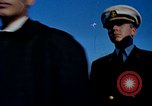
Vice President Lyndon B. Johnson becomes the 36th President of the United States after assassination of John F. Kennedy.
Features President Johnson assuming his new responsibilities as the President in an atmosphere of grief in the U.S. United States civilians walk in a long queue line and entering the U.S. Capitol Building to view the casket of President John F. Kennedy, days after his assassination death. The U.S. flag draped coffin of assassinated President John F. Kennedy (35th President of the United States) is seen in the center of the dome room. People cry and express grief, and comfort each other. Point of view shot of mourners exiting the U.S. Capitol building and looking out over the National Mall, with the Washington Monument visible in the distance. Night time exterior view of the White House. Scenes changes to show a man, possibly Indian, laying bricks at a construction site. A teacher in a college talking to a student in a courtyard. Women seated selling and buying goods at an outdoor market in Asia. A farmer driving a red tractor in the United States and tilling the soil of a farm field. A lit up room in the White House. Lyndon B. Johnson, former Vice President of the U.S. (now the 36th President of the United States) sits with documents at his desk and works in the White House. Close up side view of President Johnson as he works. Flashbacks: Views of President Johnson surrounded by large crowds, including a group of children, and being greeted during his trip to Asia, Europe, Africa and South Africa. LBJ signs promoting Lyndon Johnson at a Democratic Convention. Brief excerpts of Johnson speaking about Civil Rights and about space exploration, and about military readiness. President Johnson entering the House of Representatives chamber in the U.S Capitol five days after he became President of the United States to make his first speech to Congress as President. Lawmakers assembled give him a standing ovation as he enters.

President Johnson delivers a speech and people express grief after the assassination of Martin Luther King Jr. in the U.S.
From production "April Aftermath", showing mourning and grief throughout the United States after the assassination of Martin Luther King, Jr. on April 4, 1968. The flag of the United States is lowered at half mast. People watch on television President Johnson's speech about the assassination of Martin Luther King Jr. (leader in the American Civil Rights Movement). Families are seen at home gathered around the television to watch the speech. Views of several families of husband and wife and children gathered in their living rooms viewing television sets to watch the address. Most are white families. One family is an African American family watching television. President Lyndon B. Johnson delivers a speech. The Seal of the President of the United States on a dais. President Johnson declares April 7 as a national day of mourning for the civil rights leader. Mourning ceremonies are conducted in all churches and pilgrims of the United States. Television broadcast the faces of leaders and the news about the assassination and people expressing grief. A large crowd of civilians gather at a condolence meet. People in a line enter a building to express their grief. They come outside the building. A large crowd of civilians gather and attend the condolence ceremony. They express grief.

Clyde Schlieper and Wes Carroll depart and return to Marine Stadium in Long Beach, California after making a new world record.
Fliers land at Marine Stadium in Long Beach, California after setting a new world record of 30 days and 6 hours in flight. Their Piper Cub dubbed "Spirit of Kay" takes off. Spectators look towards the sky. A sea plane taxis on water for departing. Clyde Schlieper and Wes Carroll return to Marine Stadium after setting the world record for the longest sustained flight -thirty days in the air. Men assist them in getting off from the sea plane. W.E.S. Carroll, Clyde Schlieper and other personnel pose for a camera.
CRITICALPAST.COM: About Us | Contact Us | FAQs - How to Order | License Agreement | My Account | My Lightboxes | Shopping Cart | Advanced Search | Featured Collections | Website Terms & Conditions | Privacy Policy ©2026 CriticalPast LLC.
License Agreement |
Terms & Conditions |
Privacy Policy
©2026 CriticalPast LLC.