


 Francais
 Deutsch
 Italiano
Refine Your Search
D-Day stock footage and images
- Showing 2113 to 2118 of 4856 results more
more Hide
Hide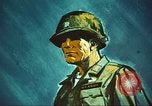
A man gets an admission letter from the West Point Military Academy in the United States.
A documentary film titled 'West Point, The Army Challenge' depicts the story of a young man who enters the West Point Military Academy in the United States. A cadet stands at attention with other cadets at the military grounds before receiving their graduation degree. Past events show the early life of the man and his entry to the West Point Military Academy. The man talks to his friends in his college. He is seated at a desk with his friends and they discuss amongst themselves. They discuss about their career. The man is advised by his friends to join the military academy. His college counselor tells him about the military academy. He says that it is a very good educational institution. He talks about the academic program of the academy and gives him a catalog. The man lying on his bed looks at the academy catalog. He looks at the syllabus and the background of the faculty. The man seated with officials at a desk and discusses to nominate him for the military academy. He goes for a medical check-up and does physical exercises. He receives his admission letter after some days. He discusses with his college counselor.
Peacetime activities and contributions by the U.S. Army in the United States.
Scenes from Army Day on April 6, 1934. Secretary of War George Henry Dern, in broadcast to the nation about importance of the Army, in peacetime. Brief glimpses of the Yellowstone River lower falls and Old Faithful and Beehive geysers erupting in Yellowstone Park, Wyoming. View amongst log buildings in Reproduction of Army Fort Dearborn, at the 1933 Century of Progress Exposition in Chicago, Illinois. A pioneer wagon; Native American Indians in ceremonial regalia; antique locomotives and trains at the Exposition. Army General Leonard Wood being sworn in as the Governor General of the Philippines. Closeup of General of the Armies, John J. Pershing, America's highest ranking Military officer. Headquarters of Walter Reed Army hospital, in Washington, DC, named for U.S. Army Major Walter Reed, who confirmed that yellow fever is transmitted by mosquito. Acting on this, the U.S. was able to complete the Panama Canal. View of French dredging equipment sitting idle in the water after Yellow Fever prevented them from completing the Panama Canal. Closeup of U.S. Army General William C. Gorgas, who, in 1904, headed the Sanitary Department that controlled mosquitoes and eradicated Yellow Fever, so the Panama Canal could be finished. View of alligator in swamp near the Panama Canal. Photograph of George Washington Goethals, Chief Engineer credited with making the canal happen. Explosives employed in Panama Canal construction. Earth and rocks being loaded into open rail cars. A steamship transiting the Panama Canal. The Washington Monument; U.S. Library of Congress; and the Lincoln Memorial, cited as examples of accomplishments by U.S. Army engineers. The Wilson Dam, under construction by Army engineers, in Muscle Shoals, Alabama and system of levees being built to control the Mississippi River. The raging Mississippi River during 1927 flood. Flood victims being assisted by U.S. Army soldiers, at a tent camp, receiving food and clothing. An Army airplane flying over a forest fire. Army personnel supervising men in the Civilian Conservation Corps or CCC. Mail being loaded aboard an Army airplane, as airmail service is being opened between Washington DC and New York City. President Woodrow Wilson talking with Army pilot Major Reuben H. Fleet. Mail being loaded into the nose of an airplane. U.S. Army Douglas World Cruiser airplanes in flight, returning from their trip around the world in 1924. A pilot sitting in front seat of a Douglas O-38 airplane, pulls a fabric hood over his cockpit to practice "blind flying". View of the aircraft in flight, with instructor pilot in the open rear cockpit. Army aviators taking a camera and a rifle aboard their airplane as they prepare to leave on an aerial mapping flight. Aerial view of skyscrapers of Manhattan Island, New York City. Army Signal Corps personnel working on communications devices. A cable laying ship operating at sea, in support of the U.S. Army's Alaskan cable and telegraph system. Men loading chemicals into hoppers on Army crop dusting airplane. Several views of Army airplanes crop dusting. Glimpse of boll weevil, the target of their efforts. Closeup of Karl Connell, who as a major in the AEF, in World War I, invented a superior gas mask known as the “Connell” or “Victory” mask. A group of miners wearing gas masks enter a smoky mine entrance. The Army invented tear gas, which is shown being used to thwart a bank robbery, in a staged demonstration. Brigadier General Hugh Johnson, appointed by President Franklin Roosevelt, as head of the Great Depression era National Recovery Administration, or NRA, is seen about to give a speech. Narrator cites him as an example of U.S. Army officers who also serve the country in civilian life. Scene shifts to cadets on parade at the United States Military Academy, West Point, New York.

People listen to the song 'God Bless America' sung by singer Kate Smith in the United States.
An American feature film 'This is The Army' depicts a performance by singer Kate Smith at the 21st anniversary of the armistice of World War I. Animated map shows Europe with fire in Poland. A man in the radio studio announces the name of Kate Smith on the stage, and noting the 21 anniversary of Armistice Day. A studio audience is present and applauds. Kate Smith introduces "God Bless America" as a new song, and then sings the song "God Bless America" with in-studio orchestra accompaniment. People watch the performance. An old man listens to the song, standing in front of his shop 'The Bugle Call.' He dusts a console radio with a feather duster and then goes inside and removes a bugle from a case labeled, ' Yip! Yip! Yaphank! 1918 ' At the Twardofsky business across the street, a man puts a small American flag into a basket as his father listens to the song on a small radio on the counter. People listen to the song in their houses and buildings. In a family living room: A couple seated in their living room listen to their console radio. A man, likely their son, seated at his desk listens to the song while studying. A woman looks at the photograph of a soldier, named Blake. Blake is then depicted listening to the same Kate Smith performance over a radio while stationed at Hickam Field in Hawaii. Characters Jerry Jones and Johnny Jones, played by actors George Murphy and Ronald Reagan are seen at the Jones and Jones production office. They listen to the radio. The character played by Ronald Reagan reads Variety Magazine.
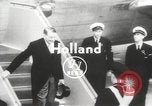
Queen Juliana and Prince Bernhard welcome President Rene Coty to the Netherlands
French President Rene Coty arrives at Amsterdam Schiphol Airport for a four-day official visit to the Netherlands. An airplane parked on Schiphol Airport (Evert van de Beekstraat 202, 1118 CP Schiphol, Netherlands). French President Coty comes out of the airplane. Pilots saluting. Soldiers and officials gather at the airport to greet the French president. Queen Juliana and Prince Bernhard of the Netherlands welcome President Coty. Flags of France and the Netherlands flying on flagpoles. Dutch people clapping. President Coty seated in a horse-drawn carriage with his wife, Germaine Coty. Rene Coty’s parade in Amsterdam. The carriage drives past on a street. People with small French flags gather along the sides of the street to greet President Coty. Children wave towards the French president. Dutch honor guard standing. Queen Juliana and Prince Bernhard walking. President Coty waves at Dutch children and adults in front of Garage Ben Maltha in Rotterdam. President Coty waves at people. Prince Bernhard accompanies President Coty.
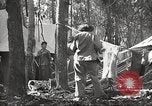
U.S. servicemen and women watch movies in Italy and various combat and occupation zones during World War II.
U.S. Army Nurses at their tent area in, Pacific combat zone, read notice of movie being shown at 7 PM on the airfield. They groom themselves in readiness to attend. Group of servicemen and women gathered at airfield outdoor movie, as C-47 airplane lands on runway beside them. U.S. Army aviators riding in a jeep to a U.S. Army Air Corps Theater, in Naples, Italy. View of servicemen gathering inside the theater. Sign outside the theater announcing the various films being presented that day. Part of the sign reads: "Movie, 3:30 and 7:30, 'Girl Crazy,'Sorry Joe, But No civilians may attend these shows (that includes girls!)" View of servicemen and women leaving the theater after the show. Army truck carrying movies to an outpost on the Italian front. Soldiers open the rear of truck and place announcement reading: "Now showing, 'Battle of Russia,' and Erol Flynn in 'Northern Pursuit.'" They set screen on side of truck and place projector on ground. U.S. troops gather to see the movie. U.S. Army 155mm guns firing on front lines in Italian campaign. Troops seated on a Sherman tank as others gather to watch a movie. In another location, troops gather to watch a movie on a screen set up on the front of a C-47 airplane. Building used for movie theater in a cold climate, with snow-covered mountains behind. Ambulatory wounded soldiers enter a cabin set up for showing movies, on a hospital ship. Audience of wounded servicemen and nurses tending them sit and watch a hollywood production. View of motion picture project being started. Smiling faces and expressions of the audience members as they laugh at comic scenes.
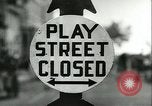
Children play games and receive instructions in handicraft during WPA supported play programs in New York City
Great Depression era Works Progress Administration (WPA) projects in New York City. A sign reads: 'Play Street Closed'. Children play various games and sports on a street in New York City that has been closed to traffic, under the supervision of WPA employees. A man instructs them. They play checkers, jacks, and a small court tennis game using ping pong paddles. They play round games holding hands and moving together. Children seen entering the toyery, an experimental program at the Heckscher Foundation For Children. A boy smiles as a woman in the toyery hands him a truck toy to borrow from the lending library of toys. Several children are shown trading in a toy for a different toy. Children seated in a room show each other flashcards to improve their reading skills, during remedial instruction time. Women in a Long Island City kitchen prepare school lunches for 800 needy children. A woman cook prepares a sandwich and a group of women wrap up batches of sandwiches. View of a day nursery, with a nap or rest area with small beds. A nurse in the nursery examines a child's mouth with a tongue depressor. Young children play with blocks in the nursery. They sit at tables in a dining room. Children drink milk and eat food.
CRITICALPAST.COM: About Us | Contact Us | FAQs - How to Order | License Agreement | My Account | My Lightboxes | Shopping Cart | Advanced Search | Featured Collections | Website Terms & Conditions | Privacy Policy ©2026 CriticalPast LLC.
License Agreement |
Terms & Conditions |
Privacy Policy
©2026 CriticalPast LLC.