


 Francais
 Deutsch
 Italiano
Refine Your Search
D-Day stock footage and images
- Showing 2137 to 2142 of 4856 results more
more Hide
Hide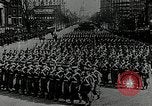
Early 20th century America footage; establishment and early circumstances of the U.S. Department of Labor
Film opens with view from a building overlooking President Woodrow Wilson's Inauguration Day parade along Pennsylvania Avenue, on March 4, 1913. A large contingent of U.S. Army West Point cadets march in forefront of the parade. Spectators line the sidewalks. Several stand atop buildings. Outgoing President, William Howard Taft is seen in his office signing a bill establishing the U.S. Department of Labor. Closeup of the bill and Taft signing it. Scenes of traffic and pedestrians in New York City. Some of the pedestrians appear to be wealthy class. Crowded early 20th century city streets filled with various horse drawn carriages together with bus traffic and early automobiles in chaotic confusion. A double decker bus with open top and sign "Fifth Avenue" and lower sign "To 22nd Street Only" operates in busy traffic on 5th Avenue beside horse drawn carriages and other motorized vehicles. Glimpses of women working in a factory; Men pouring molten metal into molds; Women punching time clocks as they leave a factory. Newly arrived immigrants at Ellis Island, New York City circa 1910 or during first 10 years of the 1900 decade. View of the Statue of Liberty. Women working in a textile factory. Men tapping a furnace in a steel plant. Pushcarts and peddlers at market lining the curb in a Jewish neighborhood of New York City (possibly lower east side). Brief view of pioneer Labor leader Samuel Gompers, founder of the American Federation of Labor. He hold a walking stick and doffs his hat. Sketches illustrating scenes of labor-related violence. Department of Labor sign being affixed to its location. A horse and wagon, representing the first assets of the new Department. A group of persons illustrative of the employees in the Department's Bureau of Labor Statistics.
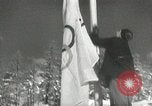
Torch bearing at the onset of the Winter Olympics in Canada.
People gather to watch the Winter Olympics in Canada. A man hoists the Olympic flag on a pole. A huge torch burning on the inauguration day. One of the previous Olympic winners gives a brief speech. Women in uniform march. Participants march while onlookers and dignitaries watch them.

The life of a farmer and his family under democratic rule in the Philippines.
A film 'This Is My Home' shows the life of a farmer and his family under democratic rule in the Philippines. Nipa huts in a rural settlement (called a “barrio”) in the Philippines. A hand made nipa hut (known as a “bahay kubo”) by the Philippine farmer. A Filipino woman, wearing a traditional Baro’t Saya attire, walks around in the house to check her sleeping husband, two sons, and a daughter. The woman opens her sliding Capiz shell-framed window before preparing breakfast for her family. The man wakes up. A white rooster crows. The farmer smokes a cigarette, pets his white rooster before taking his buffalo to a field. The farmer places a yoke on the buffalo, giving it a bath. He plows the field with the help of his buffalo. Another farmer helps him. Both the farmers stand to pray as church bells ring in the evening. The Philippine family eats a meal together at the end of the day.
Life of a farmer and his family under Communist and democratic rule in the Philippines.
The life of a Philippine farmer and his family under Communist rule in the Philippines. The Communists with guns in hand make the farmer work on a collective field and take possession of his house. Communist members frisk the farmers after finishing their day's work. Soldiers confront a farmer looking at a pet rooster that the communists confiscated, beats up a farmer after pilfering a mango fruit. Philippine children being taken away from their home and taken to Communists centers for training. A woman cries after soldiers take away her children. Communists soldiers misbehave with a young waitress. A portrait of Joseph Stalin is seen in the restaurant. A Filipino farmer warns his friend from praying while being watched by Communist soldiers. Philippine farmer with his family under democratic rule. Filipino man affectionately holding his wife while sitting in a veranda. A young Filipino couple laughing in a garden.
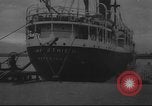
Port of Marseille during Spanish Civil War
Opening scene shows the commercial ship, Imerethie II, tied up to a pier at her homeport, Marseille, France, on a misty day. Camera pans along the wharf briefly, where small boats are tied. Large ships are seen moving in the port in the background throughout the film. Scene shifts to another area of the port where a German Zerstörer 1934 class destroyer is seen docked. Crew members are seen moving about on deck. Next, two armed Spanish civil war combatants, in utility coats and stocking caps are seen in closeup, stepping up to a dock and taking up positions as walking sentries. Two more Spanish combatants are also seen, one, possibly a flier, wearing a Nationalist officer's side cap.
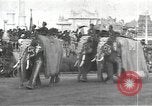
Various scenes in Bombay, India, including princely procession; Muslims at prayer; Mahatma Gandhi, and unrest in streets.
An Indian Prince rides in an elaborate carriage atop a decorated elephant in a procession in Bombay India. The procession passes what appears to be an elevated memorial statue protected by an elaborate four-posted pergola. A decorative city gate and multi-domed buildings are also seen. Scene shifts to a mosque, where a large outdoor gathering of Muslims pray en masse. A jubilant group of them, some wearing the Fez, smile and wave to the camera. Complete change of scene shows Indian Nationalist leader, Mohandas Karamchand Gandhi, outdoors, under a canopy, of Nationalist flags, in front of a building. He is surrounded by supporters. The next scene shows a man holding a Nationalist flag being accosted by police. Further unrest is shown as police and British authorities use truncheons and beat protestors to break up a gathering of Nationalists in a square near the Lloyds Bank building. A Red Cross worker carries an injured man over his shoulder. An injured man lying in the street. An ambulance of Medical Brigade Bombay, No. 2, arrives at the scene of the demonstration as authorities continue to break up the gathering. (Note: Reportedly, 150 persons were killed in this unrest, by the end of the day.)
CRITICALPAST.COM: About Us | Contact Us | FAQs - How to Order | License Agreement | My Account | My Lightboxes | Shopping Cart | Advanced Search | Featured Collections | Website Terms & Conditions | Privacy Policy ©2026 CriticalPast LLC.
License Agreement |
Terms & Conditions |
Privacy Policy
©2026 CriticalPast LLC.