


 Francais
 Deutsch
 Italiano
Refine Your Search
D-Day stock footage and images
- Showing 2263 to 2268 of 4856 results more
more Hide
Hide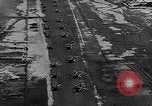
American advisory role broadens as South Vietnamese casualties grow in Vietnam War
Aerial view of many helicopters parked on rain soaked ground at an air base in South Vietnam. American army officers (military advisers to South Vietnam) hold conversations while standing near a UH-1 Huey helicopter. Next, a group of ARVN (Army of Republic of Vietnam) troops boarding a U.S. Piasecki-H21 helicopter and a Sikorsky H-34. Armed ARVN troops are seated inside, on the floor of a helicopter. Aerial view from above, of UH-1 choppers flying low across the terrain near a coastline. View from helicopter flyiing low along a river. Closeup of a Piasecki-H21 flying past the camera. South Vietnamese soldier looking out the window of a chopper. ARVN exit a hovering helicopter into shallow water and slog towards their objective. View of jungle from helicopter in flight. U.S. officers confer as a wounded American adviser is carried, on a stretcher, from the jungle to a waiting UH-1 helicopter, for evacuation. He is placed in the medivac chopper next to a wounded ARVN soldier. Closeup of Two South Vietnamese navy officers standing on a boat. One points to a South Vietnamese river gunboat firing at the opposite shore. Gun are seen firing from another gunboat. ARVN troops charge the shore in an amphibious training exercise. They enter sandy areas and employ shrubbery as camouflage. View over shoulder of one firing his rifle. Views of ARVN troops firing weapons as they advance in jungles and firing a mortar. Closeup of a wounded South Vietnamese soldiers being tendedon a stretchers . Vietnamese women and girls dressed in ao dai waiting anxiously. A soldier burning incense and praying for a fallen comrade.
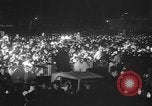
Wiley Hardeman Post receives welcome after flying solo around world and Colonel Roscoe Turner earns Bendix Trophy for speed
Wiley Post on arrival at Floyd Bennett field in New York, after flying around the world in 8 days. People take dinner at dining table to celebrate the setting of a new record in aviation. Crowd stands around the aircraft after arrival. Motorcade of Wiley Post in New York City. People welcome him with ticker tape parade in New York. Mayor of New York city, John Patrick O'Brien presents him with Medal of Valor. Next segment covers pilot Colonel Roscoe Turner who sets a new record of 10 hours and 5 minutes flying coast to coast from New York to Los Angeles. His Wedell-Williams Model 44 (WW-44) aircraft is seen landing and Roscoe Turner smiles broadly for the camera. He won the Bendix Trophy. From a November 10, 1958 newsreel recounting events 25 years earlier.
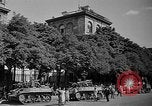
Allied troops amidst crowds of civilians near the Notre Dame de Paris Cathedral in Paris, France.
Several days after the liberation of Paris in World War II. Several M3 (M3A1) Stuart Light tanks parked at the side of road. Parisians stroll near the Notre Dame de Paris Cathedral (Parvis Notre-Dame – Place Jean-Paul-II, Paris). Nurses and medics in white garb and U.S. soldiers in a Jeep in front of the cathedral. Armed French civilians drive German soldiers away in and open truck. A crowd of civilians milling about in front of the cathedral. A white Red Cross ambulance van passes through the crowd. American troops on military vehicle, in midst of crowd.
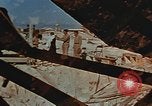
U.S. Navy and Marine personnel recover after the battle of Midway in World War II
Recovery actions by U.S. Navy and Marine personnel in the wake of the Battle of Midway in World War 2. Opening scene shows religiious services being held by a bomb crater that had once been a chapel on Midway Island. That evening, marines are assembled near flag-covered coffins of fallen comrades, in a burial ceremony. A marine chaplain conducts a funeral service, as Marines stand, with their rifles, at parade rest Several views from different perspectives of the event. An honor guard fires a volley with rifles. The American flag is at half staff, in the background. Among the officers seen is Marine Major James Roosevelt, son of the U.S. President, Franklin Roosevelt. Next, Navy boats are seen offshore, carrying the fallen for burial at sea. U.S. Navy aircraft fly in formation overhead. A marine scans the sky with binoculars as dense black smoke continues to billow from the petroleum facility bombed by the Japanese several days ago, and hangs like a pall over Midway Island. The American flag on a tall pole, is highlighted against the black smoke. Film ends with series of Slates summarizing Japanese losses in the Battle of Midway. The first shows 4 Japanese Carriers sunk. It is painted over by a brush containing red paint. Another slate announces 28 Japanese Battleships, Cruisers, Destroyers sunk or damaged. A paint brush places a large black cross over that slate. A final slate states 300 Japanese aircraft destroyed. The red paint brush appears again, but this time it marks a big “V” for Victory across the slate.
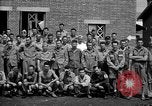
Japanese prisoners of war work under American guards and former American prisoners of war at a camp area in Mukden, Manchuria.
Showing change of prisoners from American to Japanese in Mukden, Manchuria during last days of World War II. Former POW (prisoners of war) Constant J. Wasilewaki, surviving POWs from cattle boat in which 1,623 POWs left the Philippines but only 400 reached Japan. Survivors of Bataan "Death March" includes Lieutenant Colonel Tarpley, Trspnell, Wilson and Lieutenant C.Y. Christis, men of 200th Coast Artillery corps. American prisoners of war Criville A. Johnson, Robert E. Butler worth play bass and guitar that they made while in prison. Cartoon called 'Changie- Changie' drawn by Benny Pinson, depicting change of prisoners from American to Japanese. Prison wall. High tension wire on top. Lieutenant Christie stack Red Cross carton atop pile. Japanese prisoners carry supplies under guard.
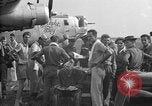
American POWs being evacuated as they board B-24 in Mukden, Manchuria during World War II.
American prisoners are evacuated in Mukden, Manchuria during last days of World War II. US Army Air Force B-24 Liberator as propellers turn. POWs (prisoners of war) standing beside the plane and read magazines. American POWs being evacuated, POWs board the plane. They wave from inside.
CRITICALPAST.COM: About Us | Contact Us | FAQs - How to Order | License Agreement | My Account | My Lightboxes | Shopping Cart | Advanced Search | Featured Collections | Website Terms & Conditions | Privacy Policy ©2026 CriticalPast LLC.
License Agreement |
Terms & Conditions |
Privacy Policy
©2026 CriticalPast LLC.