


 Francais
 Deutsch
 Italiano
Refine Your Search
D-Day stock footage and images
- Showing 2413 to 2418 of 4856 results more
more Hide
Hide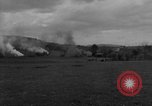
German troops surrender to United States troops, Polish prisoners of war in prison camp during WW2
116th Cavalry Regiment, 12th Armored Division, XXI Corps, Seventh US Army move toward Weilheim in Oberbayern during World War 2. Burning farmhouses in Bavarian countryside. German soldiers run across a field, raising their hands to surrender. At Werdenfelser barracks ( Oflag VII-A ) POW camp for Polish Army officers, Polish prisoners wave their hands to welcome United States troops. United States soldiers enter prison camp gate. Behind barbed wire wall, Polish prisoners greet US troops. German soldiers with raised hands, running from camp. Corpses of two executed SS men, Colonel Max Teichmann and Captain Widmann (some sources claim one body is that of Ernst Otto Fick) shot at approx. 3 pm that day by U.S. 1st Tank Division forces as they attempted to leave Murnau. United States Army vehicles enter Murnau Germany.

Map of the Burma Road, aerial views of Burma Road, Chinese laborers working on the Burma Road in mountains
Animated map showing Burma Road, a road linking Yunnan, China to Rangoon, Burma (present-day Yangon, Myanmar). Aerial view of the Burma Road. Part of the Burma Road on hillside. Chinese laborers clear away rocks. Laborers use pickaxes for digging rocks. Laborers working on Burma road use sledgehammer to chip away rocks. Chinese laborers’ children smash small stones while playing nearby. Chinese laborers working on Burma Road in mountain slope. Film narration by Ronald Reagan (future United States president).
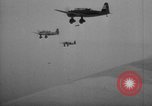
Japanese bombing of Rangoon, Burmese citizens evacuate from bombing during WW2
Three Imperial Japanese Army light bombers (likely Mitsubishi Ki-51 Sonia Type 99 Assault Planes) drop bombs over Rangoon (present-day Yangon, Myanmar) during World War 2. Explosion from dropped bombs. Burmese child runs away. A child rides on the back of his mother running away from bombing. Japanese bombers drop more bombs over buildings in Rangoon, destroying them. Buildings on fire due to Japanese bombings. Huge fire in roof of building. Burmese refugees sit on roof of moving train cars as railroad train moves down track. Farmland on fire. Rangoon’s destroyed buildings after Japanese bombings. Buddhist statues surrounded by debris.
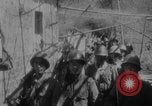
Imperial Japanese Army invades and bomb Mandalay, Burmese refugees flee for India, British soldiers destroy supplies during WW2
Imperial Japanese Army marches towards Mandalay, Central Burma (present-day Myanmar) during World War 2. They pass sign post reading, "Mandalay 82, Rangoon 348, Hanza 6" Imperial Japanese Army Mitsubishi G3M1 Model 11 Land-based Attack Aircraft bombers drop bombs on Mandalay. Explosion from dropped bombs as viewed from air. Children run away. Japanese bombers drop more bombs. Bomb explosion at ground level. Buildings on fire in Mandalay. A train full of evacuating Burmese locals, some holding on to railings of rail cars. Animated map showing Japanese capture of Burma. British troops in retreat driving a crowded truck. POV driving down road past long line of refugees fleeing Burma for India. Refugees in ox carts. British Army demolition squad destroys equipment and materiel, burn oil supplies to prevent Japanese Army usage. Oil derricks burning. British soldiers retreat at a running pace to small boats. British soldiers retreat on boats as oil supply burns. Huge fire from oil supply. Refugees carry their belongings, flee on foot. Line of Chines soldiers retreating. Burmese and British soldiers lead refugees on foot on elephant trails, jungle, across river and mountains, to India. Camp for Burmese refugees in India. Soldiers carry an injured patient on a stretcher. United States General Joseph Stilwell talks to a Chinese colleague. “We got run out of Burma, that's humiliating as hell. I think we ought to find out what caused it, go back and retake the place.” General Joseph Stilwell says.
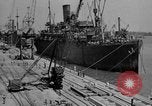
Military supplies to China from United States and the United Kingdom transit from Calcutta, India to China during WW2
Workers load supplies in Calcutta port in India during World War 2. A crane lowers stacks of boxes. Indian laborers roll artillery shells. A row of United States army trucks. Various materiel and military supplies, including rolls of chain link fencing and rolls of barbed wire. United States soldiers prepare a row of tanks for shipment. A transport boat on the Hooghly River in Calcutta, India (present day Kolkata, India). Sign on boat reads, "Rambari." Transport boat sets sail for the Brahmaputra River. A train begins to depart on the Bengal-Assam Railway. Indian worker transfers boxes to another train during a stop. Laborers repair train tracks damaged by monsoon rains. United States Army Douglas C-54 Skymaster planes in flight.
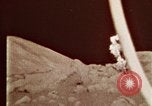
Apollo astronauts hopping, singing, exploring, planting the United States flag on moon
View of Apollo astronaut (probably Gene Cernan) bunny hopping on the moon while Apollo 17 astronaut Dr. Harrison Schmitt sings a few bars of "The Fountain in the Park" but with alternate words "I Was Strolling on the Moon One Day" as Gene Cernan joins in. On April 23, 1972, Apollo 16 astronauts John Young and Charlie Duke approach a house rock at the edge of North Ray crater. Charlie Duke exclaims, "Look at the size of that rock!" Apollo 17 astronaut Harrison Schmitt holds a moon rock while Gene Cernan says, “We hope that this will be a symbol of what our feelings are, what the feelings of the Apollo Program are, and a symbol of mankind; that we can live in peace and harmony in the future.” Apollo 14 astronaut Alan Shepard and Ed Mitchell setting up the United States flag on the moon. View of the earth from space, on the the moon, as astronaut Harrison Schmitt comments, "This glow represented to all of us, I think, not only home but a very fragile place that we have come back and felt that needed not only protection but understanding"
CRITICALPAST.COM: About Us | Contact Us | FAQs - How to Order | License Agreement | My Account | My Lightboxes | Shopping Cart | Advanced Search | Featured Collections | Website Terms & Conditions | Privacy Policy ©2026 CriticalPast LLC.
License Agreement |
Terms & Conditions |
Privacy Policy
©2026 CriticalPast LLC.