


 Francais
 Deutsch
 Italiano
Refine Your Search
D-Day stock footage and images
- Showing 2419 to 2424 of 4856 results more
more Hide
Hide
German WW2 V-1 flying bomb drop target test and explosion.
German V-1 rocket testing in Udetfeld (present-day Mierzecice, Poland) during World War 2. Title card says “Geheime Kommandosache” (“Secret commando operation” in English). “Erprobungsstelle der Luftwaffe Karlshagen” (“Test site of the Air Force Karlshagen” in English). During WWII, a wingless V-1 flying bomb without wings attached is seen descending to ground below, missing its target and exploding.
German V-1 prototype bomb is dropped at an altitude of 2000 meters and explodes during WW2 testing.
German V-1 rocket testing in Udetfeld (present-day Mierzecice, Poland) during World War 2. Title card says “Geheime Kommandosache” (“Secret commando operation” in English). “Erprobungsstelle der Luftwaffe Karlshagen” (“Test site of the Air Force Karlshagen” in English). Information on “Flakzielgerät 76 Zünder 106” (“Flak target device 76 Detonator 106” in English). V-1 doodlebug prototype is dropped from an altitude of 2000 meters during testing in Udetfeld. The V-1 flying bomb explodes after hitting the ground.
Ships and airplanes navigate in fog, submarine depth charged by destroyer (WW2)
Douglas C-47 Skytrain flying in fog. A radar mobile station with rotating radar dish. C-47 lands on airfield under low visibility conditions. A fighter landing on aircraft carrier deck of a United States Navy aircraft carrier. Large U.S. battleship at sea. Sailor wearing deck-communications helmet. Close up of interior ship siren sounding. United States sailors wake up and jump out of bunks while siren sounds. A radar dish rotating onboard a ship. Hands actuating fire control triggers on a battleship. Multiple U.S. naval ships firing guns night and day. Battleship hit by guns. Battleships firing artillery on enemy ships and shorelines of islands. Submarine underwater. A U-boat submarine periscope seen above water surface. A United States Navy crew operates radar gunnery control system in destroyer, tracking a nearby submarine. Navy captain with sailor at the helm on destroyer. Destroyer shoots depth charges into water. Depth charge flying in air and then detonating in the ocean shortly after its release. Explosions under water destroying the U-boat submarine. Consolidated PBY Catalina flying above a naval flotilla. United States ships navigate through fog. (World War II period)
The Philippines under Japanese occupation, liberation by allied forces, Philippine Independence ceremony.
The Philippines under Japanese occupation, liberation, and subsequent granting of independence by the United States in World War 2. Bodies of Filipino and United States soldiers killed during the Japanese invasion of the Philippines. Captured American, Filipino, and Australian soldiers raise their hands after the Fall of Corregidor. United States General Jonathan M. Wainwright negotiating the surrender of The Phillipines with Japanese General Masaharu Homma in 1942. Brigadier General Lewis C. Beebe and Major Thomas Dooley are seen to Wainwright's left. An American warship firing during the United States Pacific campaign to defeat Japanese occupying forces in the Pacific. United States soldiers get off an amphibious landing craft during the U.S. retaking of the Philippines. United States General Douglas MacArthur arrival in Leyte Gulf with a retinue consisting of Philippine President-in-exile Sergio Osmeña, Lieutenant General Richard Sutherland, Philippine Brigadier General Carlos P. Romulo, Major General Courtney Whitney, Philippine Sergeant Francisco Salveron and CBS Radio correspondent William J. Dunn in Palo, Leyte, the Philippines- a fulfillment of his promise to return to the Philippines. General Douglas MacArthur speaking at the Independence Day ceremony in Manila on July 4, 1946. “America never wavered in that purpose. America today redeems that pledge.” Says General MacArthur. United States Senator Millard Tydings, the co-sponsor of the Tydings–McDuffie Act (a law that provides independence to the Philippines after a 10-year transition as a Commonwealth) attends the ceremony. Paul V. McNutt, the United States High Commissioner of the Philippine Commonwealth (later the first United States Ambassador to the Philippines), reads the United States President Harry Truman's official proclamation of Philippine Independence. Filipino elites and United States dignitaries watch the ceremony in the Independence Grandstand (a temporary structure built in front of the Rizal Monument). Manuel Roxas being sworn in as the first President of the Philippines after gaining independence from the United States. The Philippine national anthem, Lupang Hinirang, plays in the background. High Commissioner McNutt lowers the United States flag from the flagpole as President Manuel Roxas raises the flag of the new Republic of the Philippines. A celebratory parade following the Independence ceremony takes place, which includes floats from various provinces in the country. A float with signs reading: "Let's Produce and Rebuild,". "Mountain Province" float with women wearing formal Filipino Baro’t Saya gowns. "The City of Manila" float with soldiers. "The University of the Philippines" (UP) float featuring two women dressed as allegorical figures and sign saying, “The University of the Philippines At the Service of the State”. "The Division of City Schools" float features two Filipinos in traditional attire in front of a Statue of Liberty model. A float, likely belonging to the National Library of the Philippines, with children and a huge book model. The Chamber of Commerce Philippines float contains a machine gear model and small models of an aircraft and a ship. American soldiers marching, carrying the United States flag. A military marching band play. Filipino soldiers marching with the Philippine flag. Military aircraft in flight above the Independence Grandstand in Manila.
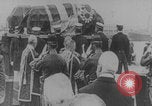
Funeral of Archduke Franz Ferdinand and Countess Sophie in Vienna.
Funeral of the heir presumptive of the Austro-Hungarian throne, Archduke Franz Ferdinand, whose assassination was the immediate cause of World War 1. Arriving in Trieste (now in present-day Italy), Roman Catholic priests bless coffins of Archduke Franz Ferdinand and his wife, Countess Sophie Chotek von Chotkow und Wognin, the Duchess of Hohenburg. Austrian officers observe as priests fling holy water onto couple’s coffins. Austrian guards unload a coffin from a funeral horse-drawn carriage. Austrian guards of the 7th Uhlans and 4th Dragoons march alongside funeral carriages of Archduke Franz Ferdinand and Countess Sophie in Vienna, to be buried in their family crypt at Artstetten Castle in Artstetten-Pöbring, Lower Austria. Brief shot of Franz Joseph I of Austria.
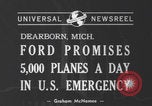
Ford executives inspect military planes as company promises to meet war demands for aircraft (WW2)
Ford executives meet with a U.S. military official as the company promises to build 5000 aircraft per day to meet war production demands in World War 2. Ford executives inspect planes. Charles “Charlie” Sorensen, Ford executive responsible for Ford’s defense contracts, speaks with United States military officer and inspects a Curtiss P-40 (possibly an XP-40) fighter. Edsel Ford, Charlie Sorensen and an officer inspect the fighter’s cockpit. Henry Ford, wearing a straw boater, observes the meeting. Propeller of the P-40 fighter plane. Henry Ford listening to a discussion. Military aircraft in flight over mountains as seen from an aircraft. Spectators watch and take photographs. View of aircraft in flight. Cockpit POV view of a group of bombers in flight. Aerial view of three United States Army bombers (likely Boeing Y1B-17 ) in flight. A Boeing Y1B-17 flying. A group of United States Army Boeing Y1B-17 bombers in flight.
CRITICALPAST.COM: About Us | Contact Us | FAQs - How to Order | License Agreement | My Account | My Lightboxes | Shopping Cart | Advanced Search | Featured Collections | Website Terms & Conditions | Privacy Policy ©2026 CriticalPast LLC.
License Agreement |
Terms & Conditions |
Privacy Policy
©2026 CriticalPast LLC.