


 Francais
 Deutsch
 Italiano

Refine Your Search
D-Day stock footage and images
- Showing 379 to 384 of 4874 results more
 Hide
Color Sound
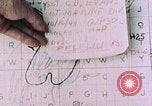
Chart illustrating progress of U.S. campaign against Peleliu, Palau Islands, during World War II.
View of situation map showing various actions by U.S. forces during the battle for Peleliu Island, Palau, from September 15th to October 15th, 1944. Key events are marked on the map in terms of D+days. View of tents on ground.
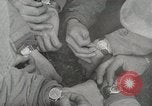
Scenes from the Battle of San Pietro, Italy, during World War II
Elements of the U.S. 36th Infantry Division engaging in the Battle of San Pietro, during World War 2. Opening scene shows U.S. infantrymen of the 141st Infantry Regiment synchronizing their watches on H-Hour, D-Day, the 15th of December, 1943. Next they move forward 400 yards from their positions and are immediately pinned down by heavy artillery fire from German defenders. Soldiers of the 2nd and 3rd Battalions of the 143rd Infantry Regiment advance 100 yards and hunker down at barbed wire barrier close to German defense line. They also come under heavy German artillery fire. American Sherman tanks enter the Town of San Pietro to find and destroy the German artillery interfering with the American advances. Views of U.S. tanks on the move. Narrator states that 16 tanks were dispatched along the road to San Pietro. Three reached the outskirts. German gunfire destroys two of these. Smoke rising from a struck tank. Views of pieces of destroyed tanks. Destroyed and abandoned American tanks. American infantrymen carrying a wounded on a litter past a knocked out Sherman tank. View of one (of four) tanks returning to the Regimental Bivouac area. Parachute flares illuminate the battlefield at night, where small American units succeed in penetrating German defenses, but are forced to move back again due to flanking German artillery and machine gun fire. Closeups of several wounded American infantry being moved on stretchers.
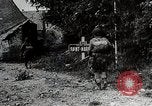
101st Airborne takes prisoners and trophies. Allied supplies and reinforcements arrive in Normandy in World War II
U.S. Army soldiers on road to Saint Marcouf, after invading Normandy in the D-Day invasion of France during World War 2. Paratroopers from the U.S. 101st Airborne Division take German prisoners. A U.S. soldier talks to small French boy and girl. The girl smiles. 101st Airborne troopers display a captured Nazi flag. Allied supplies and reinforcements coming ashore on the Normandy beachheads. German prisoners of war being escorted under guard and loaded aboard USS LCI(L) 584. Disabled USS LCI-30 and some dead U.S. soldiers on the beach.
Rabbi Chaplain Leon Rosenberg conducts services for Jewish Marines on Iwo Jima in World War II
Rabbi, Lieutenant Leon Rosenberg of the Chaplain Corps, conducts services on March 11 (D-day + 20) for Jewish Marines of the 4th Marine Division, on Iwo Jima, during World War 2. He stands in front of a makeshift altar containing a pair of candles and a cloth displaying the Star of David. He reads aloud from a small book. Marines are seated on the ground in a group. A truck in background drives away as a Marine photographer in background takes a picture of the seated marines. While Chaplain Rosenberg is reading, a jeep and another vehicle drive past in background. After break in sequence, the seated marines are seen with individual prayer books containing Hebrew script. They refer to the books during the service. In final sequence, the Chaplain continues to lead the service, with the marines now standing. (Note: Chaplain L. W. Rosenberg was the first Jewish chaplain to see actual combat with the Marines.. He went overseas with the Fourth Marine Division and was the, only Jewish chaplain to receive the Purple Heart, having been wounded on Tinian, 25 July 1944. Chaplain Rosenberg was in more Marine amphibious landings than any other chaplain. Among these were,assaults on Saipan, Tinian, and Iwo Jima.
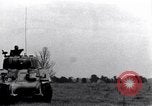
U.S. M-4 medium tanks crossing a field in St Lo, France, during World War II
U.S. M-4 medium tanks crossing a field in St Lo, France, about a month after D-Day in World War 2. Hedgerow clearing devices are seen on the M4 Sherman tanks. (These particular 'pronged' types of tank are designed to be rammed into the hedgerows, creating holes for demolition charges. Then, once the tank has reversed clear, TNT was packed into the holes and detonated.) Tank commanders are visible in the turret hatches. Trees in the background.

Secretary Henry Stimson, Generals Bradley and Patton visit a field hospital in Cherbourg Peninsula, France (WW2)
U.S. Secretary of War Stimson, General Omar Bradley, and U.S. General George S. Patton tour a field hospital in Normandy, France during World War II. Bradley poses outside a hospital tent with Secretary Stimson and an army doctor. Wounded soldiers in the tent. Signs on boards outside the tent. The United States Army generals visit a battlefield graveyard above Omaha Beach after D-Day. They drive down to Omaha Beach, still littered with equipment.. They look around. A flag on the beachhead. Soldiers stand on the field. Tents on the field. Soldiers work on the field.
CRITICALPAST.COM: About Us | Contact Us | FAQs - How to Order | License Agreement | My Account | My Lightboxes | Shopping Cart | Advanced Search | Featured Collections | Website Terms & Conditions | Privacy Policy ©2026 CriticalPast LLC.
License Agreement |
Terms & Conditions |
Privacy Policy
©2026 CriticalPast LLC.