


 Francais
 Deutsch
 Italiano

Refine Your Search
D-Day stock footage and images
- Showing 373 to 378 of 4874 results more
 Hide
Color Sound
U.S. Signal Corps officers and soldiers use mine detectors, modern radars, and meteorological equipment during World War II.
The role and contribution of the U.S. Army Signal Corps in combat and war. U.S. shuttle ships loaded with signal communication supplies for U.S. and Allied troops in the European Theater make their way in the Atlantic ocean. The Squier Laboratory at Camp Alfred Vail in Fort Monmouth, New Jersey. A technician works on signal communication equipment in the laboratory. U.S. soldiers use mine detectors in the European Theater during World War II. The mine detectors detect metallic, non-metallic mines, wooden box mines, and mines in glass containers. Artillery soldiers bury large microphones into the ground in advance zones. The microphones relay back information on enemy artillery. Soldiers receive the information on radio sets. U.S. aircraft on a training flight simulating real combat situation: The aircraft lost in heavy rain and rough weather, looking for the location of Boston. The pilot switches on a modern advanced radar. The radar waves pierce thick clouds, are reflected by Earth's surface and display an image on the scope. The image shows the clear location of Boston harbor directly under the aircraft. U.S. bombers attack over the Channel coast on D-Day (6 June, 1944). U.S. soldiers employ meteorological equipment for long range weather forecast in the European Theater during World War II. Soldiers release a hydrogen balloon into the sky. Another soldier uses an apparatus to take readings of atmospheric conditions behind enemy lines. An aircraft drops an automatic weather station called SCM-18-TI by parachute into enemy territory. The timed mechanism sends out weather data in codes. The interior of the automatic weather station lying open in a field.
U.S. Signal Corps employ the Eureka/Rebecca transponder system during the American airborne landings in Normandy, France.
The role and contribution of the U.S. Army Signal Corps in combat and war. Parachute drop-markers with radio signals guide an airborne operation in the European Theater. U.S. airborne troops board a U.S. Army Air Forces Douglas C-47 Skytrain or Dakota transport aircraft. A woman soldier greets the paratroopers as they prepare to board the aircraft. The paratroopers jump out and descend towards the ground. The paratroopers are furnished with markers for every dropping point. A paratrooper with a radio beacon hooked onto his belt. The beacon is the ground section of the Eureka/Rebecca transponder system. The paratrooper fixes the Eureka extension including the cable and the receiver transmitter. Animation depicts the working of the Eureka-Rebeca system. An aircraft unloads paratroopers over Normandy in France during World War II. Allied troops, landing crafts, landing ships arrive at Normandy on D-Day (6 June 1944). Soldiers wade through the water towards the shore and advance inland across the beach during Allied invasion of France.
Signal Corps weekly film reports sent to Photographic Center and used in training films for U.S. troops during World War II.
The role and contribution of the U.S. Army Signal Corps in combat and war. Amphibious landings of the first wave of Allied troops including Signal Corps Units in Normandy, France on D Day during World War 2. The Joint Assault Signal Companies (a Signal Corps Unit that accompanies the soldiers on every beach landing) go ashore in Normandy. Soldiers in landing crafts approach the beach. Landing crafts anchored along the shore line. A U.S. flag on the beach. Crafts approach the beach. U.S. Army Signal Corps combat photographers using motion picture cameras to film the battle that ensues on the beach and in the fields. Gun fire and explosions in the battlefield, filmed by combat cameraman. Allied aircraft in flight. Airmen load weekly film reports of the war in all Theaters made by Signal Corps officers from a van into an aircraft. The films are sent to the Photographic Center in New York. A soldier assembles the films. Technicians organize and arrange the films. They place the film reels onto racks. The film content is used to make training and orientation films for the U.S. troops. Troops watch the films in order to cut down the training period, and stay informed about the order of event in other Theaters of Operation. The films include 'Why We Fight' and 'The Fighting Men' series. Clips and recordings from these films.
U.S. 3rd Infantry Regiment soldiers lead a military funeral procession for General Jacob Devers at Fort Myer in Virginia.
United States Army 3rd Infantry Regiment also known as 'Old Guard' during the funeral of General Jacob Devers at Fort Myer in Virginia, United States. Members of the 3rd Infantry Regiment on horseback. A riderless horse with a riding boot placed in a backwards position in the stirrup. Officials lined up outside the Fort Myer Old Post Chapel as soldier pallbearers carry a flag draped casket out of the chapel. Pallbearers place the casket on the caisson carriage. Honor guard lined up. Soldiers of the 3rd Infantry Regiment march in the military funeral procession. Deavers was commander of the 6th Army Group in Europe during World War II. Following D-Day, Devers was the first U.S. military officer to reach the Rhine River.
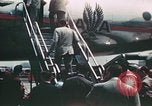
Former war correspondents reach London in an American Overseas aircraft from New York, United States.
An American Overseas Airlines aircraft leaves the United States from New York. It is on a multi-leg journey carrying 45 former War Correspondents back to Europe for celebrations commemorating the 5th anniversary of the D-Day Invasion of World War II. Former war correspondents board the aircraft. Aircraft in flight over a cloud cover. Officials get off the aircraft. A man refuels the aircraft. Officials again board the aircraft. Aircraft in flight over a cloud cover. Double decker buses on the streets of London. The former war correspondents talk and smile on the streets of London.
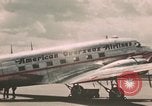
Former war correspondents tour Frankfurt, Germany five years after World War 2
A passenger airplane of the American Overseas Airlines in Frankfurt, Germany. It is on a multi-leg journey carrying 45 former War Correspondents back to Europe for celebrations commemorating the 5th anniversary of the D-Day Invasion of World War II. Views of Frankfurt from a moving vehicle, high atop a ridge, looking down at the city, and winery grape fields. Many Frankfurt buildings visible and the Main River running beside the city. Views of some buildings still destroyed from World War II, five years prior. Several African American U.S. Army soldiers beside cars greet the party of former war correspondents. The correspondents meet with a U.S. Army General -- possibly J. Lawton Collins or Thomas Handy. A correspondent looks out from a window at a war-damaged building in the background. A street car with the sign "Nied Hochst" arrives at a stop and civilians get into it. Exterior and interior views of the main train station, the Frankfurt Hauptbahnhof. Some cakes and pastries in a bakery. Correspondents meeting with a local Frankfurt official and his wife. Remains of a largely destroyed church, likely either Frankfurt Cathedral (Imperial Cathedral of Saint Bartholomew) (German: Kaiserdom Sankt Bartholomäus) or Katharinenkirche (the Church of St. Katherine). Views of the wrecked exterior and interior of the church. A West German flag draped over an interior balcony. Sign outside the church door indicates "Entrance to the Exhibition" (Eingang zur Ausstellung). A Germany girl selling trinkets at a market cart. German boys and girls in a market square and fair area, possibly Romerberg. Correspondents approach a booth selling cigars and cigarettes. More partially destroyed buildings in Frankfurt. Correspondents boarding a plane at Rhein Main Airbase. View of the airport terminal. Sign on a building reads 'Rhein Main Base Operations. Elev 358'. The correspondents boarding the American Overseas Airlines aircraft, and seated inside the aircraft. Aerial view of the German countryside below. Passengers sleep and relax aboard the airborne aircraft.
CRITICALPAST.COM: About Us | Contact Us | FAQs - How to Order | License Agreement | My Account | My Lightboxes | Shopping Cart | Advanced Search | Featured Collections | Website Terms & Conditions | Privacy Policy ©2026 CriticalPast LLC.
License Agreement |
Terms & Conditions |
Privacy Policy
©2026 CriticalPast LLC.