


 Francais
 Deutsch
 Italiano
Refine Your Search
D-Day stock footage and images
- Showing 4027 to 4032 of 4856 results more
more Hide
Hide
Soviet Union mobilizes to defend against German invasion in June, 1941, World War II
A film titled ' Our Russian front. It shows Soviet Russia's state of preparedness and national mobilization at the time of the German invasion (Operation Barbarossa) in 1941, during World War 2. Soviet troops on parade in Red Square, Moscow, carrying Tokarev SVT-40 semi-automatic assault rifles, with curved magazines and fixed bayonets. Glimpse of a Soviet heavy gun (possibly 152mm howitzer). A Soviet Navy gunboat speeding toward the camera. A formation of Polikarpov I-16 aircraft inflight overhead. Several views of soviet forces, including units composed entirely of women; Closeups of troops, some holding Russian RPD 7.62 cal m44 light machine guns. A Soviet T-26 speeding in Red Square with flag flying, during a parade. View from the rear of a line of Soviet Zvezda BT-7 light tanks being deployed along a dirt road. Russian civilians, most of them women, work digging hillside fortifications. Closeup of woman with small boy in her arms. Views of destroyed buildings and dead civilians in a Russian town Aerial view of bombs bursting on Russian city. Smoke rising from resulting fires. Several views of light flashes from artillery firing at night. American envoy, W. Averell Harriman, participant in the U.S.-British military mission to Moscow, broadcasts about Soviet determination to defend against the Nazi invasion, at all costs. He refers to Soviet mechanics assembling American aircraft (Provided under "Lend Lease"). Narrator identifies Harriman as Chairman of the Board of Union Pacific Railroad. View of Russian airplanes in formation, flying high above the State Museum building in Red Square, Moscow. An American Government aircraft (C-47 /DC-3) aircraft lands at Moscow Airport. View of the aircraft parked and surrounded by a large crowd of military and diplomatic attendees. Harriman steps from the plane. Next he is seen with British Lord Beaverbrook and Soviet diplomat, Andrey Yanuaryevich Vyshinsky. Another view of Russian aircraft flying over the State museum in Red Square. U.S. President Franklin D. Roosevelt (unseen) is heard in the background extolling the Russian efforts against the Nazis. Soviet Tupolev SB bombers in formation overhead. Flags waving Aerial view of a formation of Polikarpov I-16 aircraft in flight. A Komintern Artillery Tractor,carrying Soviet soldiers, tows a 152mm field howitzer. A formation of army vehicles carrying Russian troops along paths already formed in the dirt by prior tracked vehicles. Seen are Komintern Artillery Tractors and ordinary army trucks.
United States 101st Airborne Division soldiers put on field gear in Parrots Beak, Cambodia
United States 101st Airborne Division soldiers put on field gear in Parrot's Beak, Cambodia. They sit against heaps of sand at fire base. They board UH-1D helicopter and it takes off. Soldiers move across grassy field.
United States 101st Airborne Division soldiers look at captured weapons in Parrots Beak, Cambodia
United States 101st Airborne Division soldiers look at captured weapons as they stand near a UH-1D helicopter in Parrots Beak, Cambodia. Guns and other weapons put into wooden boxes and soldiers carry them away. Soldiers look at the guns.
Wartime nutrition public service film focuses on improving nutrition of American and British people. Also shows British war scenes.
Film on importance of good food and good eating habits during World War 2. Sweeping views of open farm land in the United States. Wheat harvesting by a harvester machine on a farm. Corn picked from stalks. Pigs in a pen. Cattle eat at a trough. Fish leaping on deck of a boat after being emptied from a net. Butcher weighs meat on a scale for a woman customer. Grocer puts meat, sugar, eggs, and other rationed items in a grocery bag. Scene changes to England, probably London, with smoking rubble on the ground from a blitz bombing run by German forces during World War 2. British firemen pour water on a blaze from fire hoses. A queue of British women and children citizens waits to receive food aid. Many of the British civilians look tired. A girl holds a large doll in her arms. A woman with a bandaged head holds a young girl child. Scene shows a British family at a table eating ration reduced portions of eggs, butter, and cheese. A British scientist holds a beaker and adds it to a large food preparation drum, adding vitamin enriched material to a food such as margarine, to aid with improving nutrition despite scarcity in the United Kingdom during World War 2. A box of butter is shown. Hand flips butter packet over to show label "Contains Vitamins A and D". British staples such as a wheat bread loaf and also beans, peas, and cereals are credited by the narrator as being "nerve conditioners, at a time when iron nerves are needed most." Footage of a British paratrooper in training jumping from a British aircraft. Next scene is in a steel mill as British men wearing protective glasses use shovels near a furnace. Scene of a British woman receiving cod liver oil and milk as a ration for a young child. Grocer at produce stand hangs sign saying "no tomatoes". But a victory garden sign behind shows someone pushing a shovel into the earth. People are shown working in victory gardens to grow fresh vegetables. All ages of older men and women and young children in England are shown working to tend victory gardens in plots large and small. Soldiers beneath a barrage balloon tend a garden with hoes. Scene in a community kitchen with a group of British citizens eating a meal. Next scene shows Americans in a restaurant and then in a diner ordering food at the diner counter. A woman orders and coffee is poured for her and two donuts are served. Narrator notes that the food nutrition choices made by many Americans are not good, and notes that malnutrition saps the strength of Americans. A woman secretary is seen typing and being frustrated and tired. A man welding lifts his helmet and rubs his head and face in exhaustion. A doctor and nurse examine and treat an eye of an American war worker. A U.S. Army recruitment or induction center is shown, with new recruits receiving medical examinations. Doctor uses a tongue depressor and examines a person's throat. A blood pressure machine takes a reading. An eye chart is shown. Doctor uses a stethoscope on a recruit's chest. Group of U.S. Army soldiers marching in formation. A group of new citizen recruits without uniforms marches.
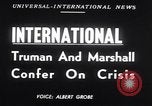
President Truman and State Secretary George Marshall meet to confer on China crisis.
Secretary of State George Marshall emerges from plane in heavy rain. President Truman greets Marshall at airport. They stand together for photos and shake hands. Truman and Marshall walking and talking together beside the White House in Washington, D.C. They are meeting to discuss American policy regarding Berlin and the China crisis.
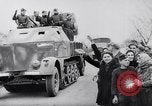
German troops enter Hungary and are warmly greeted by the local populace.
German troops enter Budapest ( reportedly after Hitler learned of secret Hungarian overtures towards the Allies) in World War 2. Locals watch and cheer the German troops. As German troops enter Budapest, they employ a number of different military vehicles. Among those seen are: Sdkfz.251/7 armored half-tracks; Ausf.D pioneer vehicle; Puma 234/2 8-wheeled armored cars, StuG III tank destroyers,and other military vehicles. Soldiers shake hands with civilians and school boys. Kids climb on military tanks and a BMW military motorcycle. Wehrmacht troops look over river with binoculars in the Buda Castle.
CRITICALPAST.COM: About Us | Contact Us | FAQs - How to Order | License Agreement | My Account | My Lightboxes | Shopping Cart | Advanced Search | Featured Collections | Website Terms & Conditions | Privacy Policy ©2026 CriticalPast LLC.
License Agreement |
Terms & Conditions |
Privacy Policy
©2026 CriticalPast LLC.