


 Francais
 Deutsch
 Italiano
Refine Your Search
D-Day stock footage and images
- Showing 4771 to 4776 of 4857 results more
more Hide
Hide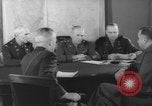
U.S. Army officers seated at a desk confer in an office in Washington DC.
U.S. Army officers seated in an office in Washington DC. The army officers in a conference. Brigadier General C.D. Young, Chief of Service of Supply Lieutenant General Brehon Somervell, Brigadier General W. A. Styler and Brigadier General L. Lutes seated at a desk. They discuss amongst themselves. A wall map in the background. Lt. General Lesley James McNair, Lt. Colonel F. L. Parks and Brigadier General Mark Wayne Clark seated at the desk. Lt. General McNair signing papers.
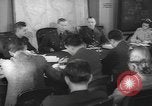
U.S. Army officers seated at a desk confer with reporters in an office in Washington DC.
A press conference in an army office in Washington DC. U.S. Army officers seated in the office along with reporters. Brigadier General A. D. Surles and Lieutenant Colonel Stanley J. Grogan seated at a desk. Men and women of the press confer with them. They note down the information given by the officers in their note books.
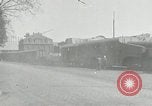
Assistant Secretary of the Navy Franklin Delano Roosevelt inspects a U.S. Navy railroad gun in France during World War I.
A railroad train carrying a U.S. Navy 14-inch railway gun, on a Mk I gun car, along with other cars containing associated personnel,supplies and equipment, arriving at a depot in France, during World 1. Most of the cars are marked "USN." In next scene, Assistant Secretary of the Navy, Franklin D. Roosevelt, stands in a field with two U.S. Navy Captains and U.S. Army Major General Henry T. Allen, along with two other Army officers. General Allen escorts Roosevelt to the railway gun train, where he climbs aboard the rear access door of the Mk I car. An American flag flies over the car. Camera pans along the car to where Roosevelt is seen standing beneath the 14-inch gun barrel. (World War I; World War 1; WWI; WW1)
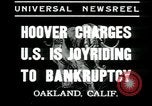
Former U.S. President Hoover speaks out against Franklin Roosevelt's New Deal and new taxation
Former U.S. President Herbert Clark Hoover addresses people in Oakland, California during the Great Depression. He speaks out in favor of a balanced budget and against the new spending and taxation proposals of the New Deal under President Franklin D. Roosevelt. He says, "The cost of the New Deal threatens to exceed that of the Great War...We have seen the creation of a most gigantic spending bureaucracy. That is not only a reduction of your standard of living, but of your freedom and your hopes. Here is where common sense cries out to be hear. The folly and waste must be cut out of this expenditure, and the federal government budget balanced, or we shall see one of three horsemen ravage this land: Taxation, or repudiation, or inflation...these issues transcend any group or individual. They represent the fate of the nation."
U.S. troops set up a field kitchen and mess in Eygelshoven, the Netherlands, during World War 2
View from hill, above, of U.S. Army troops, from the 3rd Battalion, 115th Regiment, 29th Division, who have set up a field kitchen and mess along the side of a road (Nieuwenhagerweg) in Eygelshoven, the Netherlands, during World War II. Closeup of the troops in a chow line, receiving food in their personal mess kits. Closeup of one soldier's mess kit with his ration. Closeups of smiling soldiers and views of some eating their meals. [Note: In the first 10 seconds, two churches can be seen in opposite corners of the background.The oldest, on the right, sheltered US soldiers. The other, on the left, was hit by German shelling around December 20, 1944. U.S. soldiers of the 562nd Anti-Aircraft Artillery Battalion, Automatic Weapons (Mobile), Battery D, patched the hole in the church roof.]
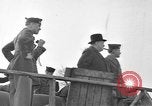
U.S. General Eisenhower and British Prime Minister Churchill inspect equipment, supplies and review a parachute jump in England.
U.S. 101st Airborne Division in England during World War 2.British Prime Minister Winston Churchill, U.S. Army General Dwight D Eisenhower, and Lieutenant General Omar Bradley, with other officials and officers, visit RAF Welford airfield in Berkshire County, England (then home to the 435th Troop Carrier Group). They are hosted by Brigadier General Maxwell Davenport Taylor, Commander of the 101st Airborne Division, together with members of his staff, including: Brigadier General Don F Pratt and Brigadier General Anthony C. McAuliffe. They tour various exhibits of engineers, artillery, anti aircraft and paratroop units. They inspect equipment, gliders, and supplies. From a reviewing stand, they observe a paratroop exercise involving formations of C-47 transport planes, from which large numbers of paratroopers jump, filling the skies with parachutes. Generals Eisenhower, Brigadier General Taylor and Prime Minister Churchill salute colors as they review troops. They walk among displays of troopers, equipment, and U.S. CG-4A gliders. Assisted by General Taylor, Prime Minister Churchill climbs aboard a British Horsa glider to examine it. He shakes hands and converses with Colonels of the 101st, including: Col.George S. Wear, commander, 327th Glider Infantry Regiment; Col. George V. H. Moseley, Jr., Commander, 502nd Parachute Infantry Regiment; Colonel Howard R.Johnson, commander, 501st Parachute Infantry Regiment; and Col. Thomas L. Sherburne, 101st Airborne Division's Artillery Commander.
CRITICALPAST.COM: About Us | Contact Us | FAQs - How to Order | License Agreement | My Account | My Lightboxes | Shopping Cart | Advanced Search | Featured Collections | Website Terms & Conditions | Privacy Policy ©2026 CriticalPast LLC.
License Agreement |
Terms & Conditions |
Privacy Policy
©2026 CriticalPast LLC.