


 Francais
 Deutsch
 Italiano
Refine Your Search
Dayton Ohio USA 1947 stock footage and images
- Showing 661 to 666 of 25558 results more
more Hide
Hide
U.S. Air Service promotional activities during the 1920s.
1924: A crowd gathered at Boston Harbor to welcome the first 'Round the world flyers. Dignitaries seated. Air Service Douglas World Cruiser biwing float planes land in the harbor. United States Army Air Service flyers, led by Lieutenant Lowell Smith, arrive in boat at harbor. The six intrepid Lieutenants: Harding, Nelson, L.P. Arnold, Wade, Ogden and Smith, pose with General Patrick, Chief of the Air Service , along with several young women. View of the Barling Bomber at Wright Field in Ohio. Crew members: Lieutenants Harris and Muir Fairchild together with designer Walter Barling and engineer Culver, pose together and then climb aboard the airplane. The aircraft commander stands in open cockpit and orders flight engineer to start the 6 Liberty engines. The Barling Bomber taxis out and takes off. Commander waves from open front cockpit as aircraft climbs after takeoff. Views of the Barling Bomber in flight. President Calvin Coolidge stands, awaiting the arrival of the Pan American Goodwill flyers, at Bolling Field, Washington, DC. Crew of the Loening OA-1A amphibian, "New York": Major Herbert Dargue, and Lieutenant Ennis Whitehead, are greeted as they climb down from their aircraft. President Coolidge, presents all of the flyers with Distinguished Service Cross Certificates.
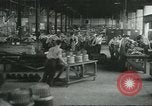
Workers returning to oil heater plants, rolling mills, Douglas Aircraft Plant, and Atlas brewing company in the United States
Renewed manufacturing activity throughout the nation recalls thousands of workers as the American industry forges onward and shows some signs of improvement during the great depression. Bloomington, Illinois: Workers manufacture oil heaters. They work on various machines and equipment. Middleton, Ohio: 2400 men at work in one of the big rolling mill companies. The workers arrive at the steel mill. Steel processing. Santa Monica, California: Men and women report for work at the Douglas Aircraft Plant. They work on a tight schedule for the new type Army torpedo and bombing planes. Men work on various parts of the aircraft. Chicago, Illinois: The Atlas Brewing Company, a huge brewery and bottling works where the production has been speeded to almost 30,000 bottles of beer an hour to meet a surge of demand following the passing of the Volstead Act allowing 3.2 beer (3.2% alchohol), near the end of prohibition in America. Beer Bottles move on conveyor belts. The bottles are filled, packed in crates and readied for transportation.
Governor Dewey being elected as the Presidential candidate at Republican party convention in Chicago, Illinois.
Republican national convention of 1944 in Chicago, Illinois. A banner in support of Governor Bricker of Ohio as a Republican Vice Presidential candidate. Pictures of Governor Thomas Dewey for the Presidential nomination. Representative Joseph Martin, Chairman of the Convention. Statesmen eat and discuss around a table before the convention. Wendell Willkie at desk. Cars outside the convention hall as people arrive. Delegates from various states across United States arrive at the convention. Newsmen at typewriters as they send out news about the convention. Cameramen record the proceedings at the convention. National Chairman Harrison E. Spangler opens the convention and invites Governor Earl Warren of California for delivering a keynote. Governor Thomas E. Dewey of New York at desk as he is elected as the Republican Presidential candidate.

Workers return to work in various plants like furniture, clock company, electrical appliances in the United States.
A large number of men and women shown returning to work in the United States during the Great Depression. Film aims to boost morale during Depression. A large number of workers enter an electrotype company factory in Cincinnati, Ohio. Men work on various machines as they manufacture advertising mats and cuts for use in newspapers and magazines. Mats and cuts being packed in wooden crates. Men at a furniture plant in Portland, Oregon. Men work on wooden planks as they make furniture for homes. Workers at an electrical and house heating appliances plant weld parts of appliances. Men construct oil burners at a plant in Pittsfield, Massachusetts. In La Salle, Illinois a large number of men and women workers enter a building with a sign "Big Ben Western Clock Company." Men and women manufacture clocks inside the plant.
Bofors gun being manufactured and thousand pound bomb being tested in the United States.
Weapons being manufactured and tested in the United States during World War II. Women manufacture Bofors anti aircraft gun at a plant in Akron, Ohio. Men and women work on various parts of the Bofors gun. Bofors gun lined up at the plant. A one thousand pound bomb being tested at Aberdeen Proving Grounds in Maryland. Men push the bomb on a trolley. Bomb being loaded under the wing of an aircraft. Aircraft in flight. A bomb isdropped and it impacts causing billows of smoke to rise up. Another bomb being released and it hits the ground. Billows of smoke rise up.

Static tests of jet engine of U.S. buzz bombs and fly-bys at Dearborn, Michigan during World War II.
Testing of U.S. buzz bombs at Dearborn, Michigan. U.S. buzz bombs, duplicates of German V-1 bombs, being produced and fuselage is assembled at Toledo, Ohio. Jet engines are assembled at Dearborn, Michigan. Raymond Blough and Henry Ford II watch the operations. A static test of jet engine of U.S. buzz bombs. Fly-bys of U.S. buzz bombs.
CRITICALPAST.COM: About Us | Contact Us | FAQs - How to Order | License Agreement | My Account | My Lightboxes | Shopping Cart | Advanced Search | Featured Collections | Website Terms & Conditions | Privacy Policy ©2026 CriticalPast LLC.
License Agreement |
Terms & Conditions |
Privacy Policy
©2026 CriticalPast LLC.