


 Francais
 Deutsch
 Italiano

Refine Your Search
Dayton Ohio USA 1947 stock footage and images
- Showing 8797 to 8802 of 25588 results more
 Hide
Color Sound
A U.S. Army Air Service Martin transport aircraft takes off and in flight in the United States.
An early cargo and transport aircraft of the United States Army Air Service in the United States. A U.S. Army Air Service Martin Transport airplane on a field. Exteriors of the aircraft. Interiors of the airplane with two men seated. They look out from the aircraft. Airplane propellers start to rotate. The motors warm up. The engine starts and the aircraft takes off. The aircraft lands after a flight.
A U.S. Army Air Service DH-4 Honeymoon Express takes off and in flight in the United States.
Early transport aircraft of the United States Army Air Service in the United States. U.S. Army Air Service DH-4 Honeymoon Express on a field as an engine starts and the propellers begin to rotate. A pilot in the cockpit. Passengers in the compartment wave. Specifications of the aircraft. The airplane taxis and takes off. The aircraft in flight. It flies at a speed of 118 miles per hour. The aircraft comes in for a landing and lands on a field.
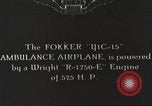
U.S. Army Air service Fokker YIC-15 ambulance plane takes of from a field in the United States.
Early cargo and transport aircraft of United States Army Air Service in the United States. U.S. Army Air Service Fokker YIC-15 Ambulance airplane on a field. Propellers of the aircraft rotate as the engine starts. Men carry a litter patient and place the litter into the plane. Interiors of the aircraft has a cabinet with medicines. Mounting litters and padding on the side to absorb shocks. Aircraft warms up. Aircraft taxis.
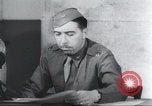
U.S. B-17 crews of 8th Air Force are debriefed by intelligence officer upon return from a mission, during World War II.
U.S. 8th Air Force B-17 crew is debriefed by an intelligence officer immediately after returning from a bombing mission during World War 2. In response to his questions, the crew members describe being hit by enemy fire, damage to their aircraft, and attacks by German Fw-190 and Me-109 fighter aircraft. A gunner tells of shooting down a German plane that flew underneath their B-17. Narrator Richard Cordon seated at a desk speaks to camera in a public service announcement, and appeals to capable American mechanics and men under 50 who are handy with tools to volunteer for service with the Army Air Forces. He reads a notice of the U.S. Army Air Forces dated October 1, 1942, inviting civilian mechanics to service with the Army Air Force. Views of mechanics performing various maintenance duties on parked B-17 bomber aircraft. Mechanics work on a B-17 aircraft with name "Baby Doll" on it. A mechanic works on a propeller of B-17 aircraft with nose art and name "Birmingham Blitzkrieg." A mechanic evaluates a machine gun in side door of a B-17 aircraft named "Shoot, You're Faded." Close-up view of notice from the U.S. Army on its letterhead, appealing for mechanics up to 50 years of age.
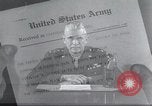
U.S Army Lieutenant General Brehon Somervell urges all Americans to contribute to war effort during World War II.
U.S Army Lieutenant General Brehon Somervell gives radio address to all Americans early during World War 2. He cites the early defeats being suffered by America and its allies in the struggle against the Axis Powers worldwide. He emphasizes the importance of Americans devoting all their efforts to work for the war effort, and exhorts everyone to avoid anything in their civilian life and pursuits that might impede the Nation's war efforts. He states that if things go unchanged, it will be too late to save ourselves and America and civilization. He notes there is no room for any interest groups whose interests and actions might weaken America's war efforts. He appeals to all Americans to back up their fighting men.

A map gives a comparison of various endurance flight across the Atlantic from 1909 to 1921.
Various endurance flights and their comparison. A map of the United States as it depicts the comparison of various endurance flights from 1909 to 1921. Map compares various flights like the 1910 flight by Glenn Curtis, trans continental flight in 1919 by O.C. Read, non stop trans Atlantic flight by Captain John Olcock. 1st transcontinental flight by R.C. Towler in 1912.
CRITICALPAST.COM: About Us | Contact Us | FAQs - How to Order | License Agreement | My Account | My Lightboxes | Shopping Cart | Advanced Search | Featured Collections | Website Terms & Conditions | Privacy Policy ©2026 CriticalPast LLC.
License Agreement |
Terms & Conditions |
Privacy Policy
©2026 CriticalPast LLC.