


 Francais
 Deutsch
 Italiano

Refine Your Search
Dayton Ohio USA 1947 stock footage and images
- Showing 9325 to 9330 of 25588 results more
 Hide
Color Sound

Joint Congressional Hearing on Iran-Contra affair. Committee counsel John Nields questions Lt. Col. Oliver North
U.S. Marine Lieutenant Colonel Oliver North testifies before a Joint Congressional Committee formed to investigate the Iran-Contra matter. Chief Counsel for the Committee, John Nields, questions Lt. Col. Oliver North about newspaper publicity. Mr. Nields asks him about his discussions with Robert McFarlane. He also asks whether Lt. Col. shredded some documents on 21st of January and if they contained anything that could be damaging to the President. North's counsel, Brendan Sullivan, objects. North and his prosecutor whisper. Mr. Nields asks North about political damage to the President.
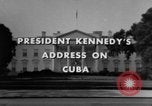
President John F. Kennedy addresses the nation about the missiles in Cuba from his office in the White House, Washington DC.
U.S. President John F. Kennedy addresses the nation during Cuban Missile Crisis. Exterior of the White House. President Kennedy in his office. He speaks about the series of offensive missiles found in Cuba and the range of these missiles. He names the cities that could be covered by medium range missiles and intermediate range missiles and thus are a danger to the western hemisphere. He also talks about Jet bombers capable of nuclear bombing. He refers to the constitution and the charter of the United States. He also discusses his talk with Soviet officials and their refusal to remove the weapons. President Kennedy condemns the nuclear weapons and expresses his concern about the Communist buildup in Cuba as it is dangerous to the United States. He talks about Americans policy to be patient and restrained. He warns that any nuclear attack from Cuba would be regarded as Soviet attack. He talks about an emergency meeting of the UN Security Council for withdrawal of all offensive arms from Cuba under supervision of the United Nations. Kennedy addresses Cuban people and says that they had been betrayed by their leaders. He asks all citizens to be patient

Technician demonstrate attaching of Razon tail to bomb in United States.
A film titled 'Razon' by the Strategic Services, United States. Dropping of a 1000lb 'Razon' bomb or VB3. Man attaches the bomb's Razon tail. The tail Contains a Radio receiver fed by an antenna. Power supply is a 24 volt battery. A technician with a automatic Gyro stabilizer, the primary unit. He inspects the control rudders and elevators. He attaches a 600,000 candle power flare to the tail cover. The bomb is rocked during inspection. A control stick and transmitter used to check the rudders and elevators. The completed bomb with Nose arming tail arming. Technicians wheel the bomb on a carrier. (World War II period).

Bomber make manipulation with the help of Norden sight and control stick for accurate dropping of Razon bomb in United States.
A film by Strategic Services, United States. Carrier of the Razon bomb on an air strip. The carrier contains an antenna, transmitter unit and control stick. Bomber controls Norden sight from the carrier. Animated diagram shows mirror of Norden sight. Bomber makes a modification called crab. View through Norden sight. Bomber makes manipulations, he moves the stick to control and pint point accurate dropping of bomb through radio control. Diagram shows image of target dropping in relation to bomber. (World War II period).

Demonstration of targets covered by uncontrolled and Razon bombs in United States.
A film by the Office of Strategic Services (OSS), United States. Demonstrates the accuracy and effectiveness of Razon control bomb drop. Two bombs dropped from plane, one Razon another uncontrolled bomb. Razon bomb drops on target and uncontrolled way left from center. Bomber controls the Razon and it drops slightly off the target lacking in accurate range. Diagram shows coverage of target in the radius of 500 feet. It shows the dropping of 11 Razons. Maximum distance from target of uncontrolled bomb is 1560 feet and 360 feet is of Razon. Diagram of enemy battleship and Razon covering the target. (World War II period).
Views of Japan and its militarism from 1937 through 1943 . Construction of B-29 bombers in the United States
Volcanic eruption and creation of island of Japan. Glimpse of map of Japan. Gardens and rivers. Two men demonstrate samurai sword techniques. Japanese soldiers advance through smoke carrying rising sun flag. Chinese suffering under Japanese military occupation. Two executed with rifles. Japanese soldiers waving weapons and red ball flags. A DC-3 aircraft flying over a Japanese Pagoda. Vies of Old Japan. Farmers at work. One manually turning a water pump with his feet. A man using a pole to propel a boat. Modern methods adopted in Japan for terraced farming. Japanese building railroads. Japanese modern locomotive on South Manchurian Railway. in 1934. A Japanese twin engine bomber taking off. The Japanese ocean liner, Asama Maru, in the 1930s. Glimpse of numerous ships in Tokyo harbor. Western style architecture in modern Tokyo buildings. Neon lights on the Grand Palace Hotel and other establishments in Tokyo. Industrial smoke stacks. Women at work in a silk factory. Finished product stamped "Made in Japan."Steel ingots being made in a Japanese steel mill using scrap iron imported from the U.S.A. Chinese victims of 2nd Sino-Japanese War. Japanese troops on parade. Dead American Marines on shore of Tarawa Atoll in the Pacific in World War 2, killed in battle. Japanese high ranking officers reviewing troops on parade. Japanese warships underway. Troops parading beneath the Imperial Palace in Tokyo. American B-25 bombers on flight deck of the USS Hornet, headed to bomb Tokyo.A crew of Doolittle's Raiders standing by their plane. B-25 taking off from the Hornet. Formation of B-25s in flight. View from bomber of smoke rising from bombing of Tokyo below. Brigadier General Jimmie Doolittle pledging to repeat bombing of Tokyo. Supply train entering a Boeing Company defense plant. United States war production workers being scrutinized as they enter the facility and punching in at a time clock. Poster in the plant picturing a B-29 bomber aircraft on a message in German describing it as an instrument for a "Destruction Battle against the Luftwaffe." Bold letters, above, in English read: "They're Promised-Let's Deliver 'em!" And, below, the words: "B-29, Super Bombers." Slabs of aluminum sheets fill a factory room. Overhead traveling cranes move them. Workers in airplane manufacturing and assembly plant use heat and brakes to shape the aluminum sheets. Multiple views of the aluminum being machined and stamped to specifications. Wings being fabricated. Relatively unskilled labor using jigs to perform the work. Woman war worker operating an overhead crane moving a wing in the plant. Views of plane parts moving across the ceiling via cranes. Women workers driving rivets into wings. Men and women employees working inside fuel fuel compartments of wings. A floor full of engine nacelles. A floor full of 2200 HP radial engines. A skeleton nose section being fabricated. Midsections and bomb bays being assembled. Workers crawling through the airframe during aircraft assembly. A woman working on a connecting tunnel. Sub-assemblies made by contractors arriving at the plant. More views of Boeing employees including young, old, men, and women, at work in the plant.
CRITICALPAST.COM: About Us | Contact Us | FAQs - How to Order | License Agreement | My Account | My Lightboxes | Shopping Cart | Advanced Search | Featured Collections | Website Terms & Conditions | Privacy Policy ©2026 CriticalPast LLC.
License Agreement |
Terms & Conditions |
Privacy Policy
©2026 CriticalPast LLC.