


 Francais
 Deutsch
 Italiano
Refine Your Search
Dayton Ohio USA 1947 stock footage and images
- Showing 91 to 96 of 25558 results more
more Hide
Hide
Aviation history; historic early flight scenes; first hand accounts from persons who knew and worked with the Wright brothers.
Views of traffic on a city street around the turn of the 20th century. A mix of horse and buggies and motorcars and bicycles. People waiting for a trolley car. Reenactment of persons using an early telephone and of early filmmakers at work with camera on motion picture film. The Wright brothers home at 7 Hawthorne Street, West Dayton, Ohio. The Wrights' former housekeeper, Carrie Grumbach, recalls December 17, 1903, a telegram arriving about the Wright brothers successful first powered flight. Glimpse of Wright brothers machine shop. Charlie Taylor, who had worked in their shop, speaks of being pleased at their accomplishment. View of the Wrights flying gliders at Kitty Hawk, North Carolina. Charlie Taylor describing how he machined and built the motor for the Wright brothers airplane. Glimpse of that motor or a facsimile. Men positioning the Wright brothers airplane for launching, and French citizens gathered to watch a demonstration of their airplane in France. French aviation pioneer, Henri Farman with two other men in his Voisin-Farman I airplane. They begin takeoff. Closeup of Brazilian aviation pioneer, Alberto Santos-Dumont. Other early aircraft in flight. A Wright Flyer passing over the Fort Myer drill ground in Virginia. An Army balloon in the background. Retired United States Air Force Brigadier General, Frank P. Lahm, walks across the tarmac on an airport and speaks for interviewer (unseen). He speaks about the difficulty the Wright brothers had in convincing the U.S. Army of the value of their airplane. He tells that in December, 1907, Wilbur Wright was finally granted an interview with the Board of Ordnance and Fortifications, which led to a contract, in 1908, with the Signal Corps. Moving imagesof Orville Wright and assistants bringing a Wright Flyer to Fort Myer, Virginia, to conduct flight trials for the Army. Views of the airplane being flown all around the area, watched by spectators. (This footage is a mix of 1909 footage where the aircraft shows two half-rounds of canvas in the front elevator, and 1908 footage, taking off and flying, where the aircraft has a single half-round of canvas in the front elevator.) After landing on the 9th of September, 1908, then, Lieutenant Lahm, accepts Orville Wright's offer to fly with him. Lahm climbs aboard the airplane, sits next to Orville Wright, and they are seen taking off and flying about for six minutes and forty seconds. (Lahm is the first. military officer to ever fly in an airplane.) The next scene shows the wreck of a Wright Flyer, in which Army Lieutenant Thomas Selfridge was killed and Orville Wright injured, on September 17, 1908.
Technicians in WADC buildings and in MIT facilities; and supersonic propeller undergoing test on large test stand at WADC.
Technicians and members in the laboratories and offices of WADC, Dayton, Ohio, United States. Aerial view of approach to Wright Air Development Center (Wright-Patterson Air Force Base), includuing view of Wright Memorial on Wright Brothers Hill. Low altituide aerial view of Aero Medical Laboratory, wind tunnel area, static structural tent building and the main flight line area. Hand holding book entitled, "Wright Air Development Center" (WADC). Hands open book-on first page is: "Mission of WADC". Interior, laboratory research building at Massachusetts Institute of Technology (MIT), airmen push rack down test area and into vault. Exterior view in Cambridge Massachusetts of the MIT Great Dome and Building 10 seen from Killian Court, with text engraving seen on building frieze: Massachusetts Institute of Technology. Two members of the Institute walk down steps of Building 10. Two technicians working in office building. Supersonic propeller undergoing test on large test stand. Superimposed over this picture are the words: Research And Development. Supersonic propeller undergoing tests. Two technicians at control panel of the test stand. USAF B-50 Superfortress aircraft in flight. Engine starting on B-50 in flight-plane equipped with special deicing equipment. B-50 in flight showing special test and research instruments and operator.
Captain James Green being airlifted from his crash site by a Sikorsky YR-4 helicopter in Shingbwiyang, Burma during World War 2
Men carry injured U.S. Army Air Force Jungle Rescue Pilot Captain James Green from hospital tent to completed MEDEVAC landing zone in Shingbwiyang, Burma during World War II. Green had been injured in a crash of his helicopter. Dr. Underwood talks on hand radio as men sight an incoming Sikorsky YR-4 helicopter. Engineer sets off smoke flare. Helicopter lands and men hold it. Men carry Captain Green on litter to the helicopter and he shakes hands with Pilot Lieutenant Raymond Murdock. Dr. Underwood gives Green an injection in his arm. Men put Captain Green in the helicopter and it takes off. Men cheer and shake hands with Dr. Underwood. This is an early example of one of the first helicopter MEDEVAC (Medical Evacuation) flights in a combat zone. Prior to this MEDEVAC flight, this particular helicopter, a Sikorsky YR-4, had been dismantled at Wright Field in Dayton, Ohio on January 17, 1945, loaded on a C-54 transport, and flown to the North Burma theater of operations. It was reassembled and flown by Capt. Frank Peterson, USAAF, on January 26, 1945 to evacuate wounded weather observer Private Howard Ross from a 4,700 foot mountain ridge in the Naga hills of Burma.
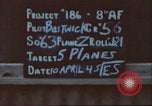
P-47 of the U.S. 8th AF, 63rd Fighter Squadron strafes German aircraft on the ground, near the end of World War II in Europe
U.S. 8th Air Force fighter aircraft operate unopposed over Germany in final days of World War 2. Gun camera footage from P-47M, of the 56th Fighter Group, 63rd Fighter Squadron, tail number 44-21112, UN-Z, "Ungly Duckling," flown by Major George E. Bostwick, of Dayton, Ohio. He strafes and destroys 5 German aircraft on the ground.
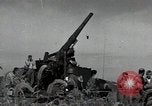
U.S. 24th Infantry Soldiers firing from tank.
Soldiers of U.S. 24th infantry regiment. Soldiers on and around a tank. Soldiers fire the tank. A tank marked with USA 9132569 can be seen in water. Soldiers sitting on the tank. 1947.
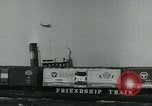
The Marshall Plan being launched to assist recovery of Europe after World War II
Rail cars on the November, 1947 "Friendship Train," at a sea port in the U.S.A. Behind it is seen the funnel of the SS Exiria, of the American Export Lines. The camera moves around to show the Exiria, displaying a large American flag and words,"Friendship Food Ship," on her hull. A steam locomotive on train in France, delivering relief supplies, displays crossed American and French flags on it. Trucks on road in France, displaying French and American flags and pictures of the Freedom Train on their sides, with words:"Ravitaillement, offert spontanment au peuple de France à partir de peuple Americain." (Refueling, spontaneously offered to the people of France from American people.) The SS Exiria docked in an Italian port. A catholic priest and several nuns with a group of boys, standing on the pier, wave American flags. Another group of American girls enthusiastically wave American flags. A large crowd waves several large Italian flags. President Harry S. Truman, at his desk on the White House, Washington, DC, signs the Economic Recovery Act of 1948 (AKA Marshall Plan). Secretary of State Marshall speaking in support of the legislation before Congress. Senator Arthur H. Vandenberg, of Michigan, speaking in support of the bill.
CRITICALPAST.COM: About Us | Contact Us | FAQs - How to Order | License Agreement | My Account | My Lightboxes | Shopping Cart | Advanced Search | Featured Collections | Website Terms & Conditions | Privacy Policy ©2026 CriticalPast LLC.
License Agreement |
Terms & Conditions |
Privacy Policy
©2026 CriticalPast LLC.