


 Francais
 Deutsch
 Italiano

Refine Your Search
Dayton Ohio USA 1947 stock footage and images
- Showing 10327 to 10332 of 25587 results more
 Hide
Color Sound
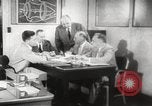
General Electric producing the first American jet airplane engine. Bell Aircraft building first U.S. jet powered airplane.
General Electric Company engineers work on designs for America's first jet aircraft engine during World War 2. In the company's plant, at Lynn, Massachusetts, machinists make parts for the engine and others assemble it. Company executives conversing about the enterprise. On April 18, 1942, the first engine produced is rolled into a test cell for operational testing. Engineers pull down the door to the test cell displaying the words: "Fort Knox." Engineers at control panel of the test cell. View into the test cell. GE Project manager, Donald F. Warner, actuates toggle switch to "on" position, and the engine ignites. Flame seen in rear of the engine. Complete change of location. View of Bell Aircraft company buildings. Bell engineers working on design of an airplane designated, XP-59A (Airacomet) to be powered by the new General Electric jet engine (later designated J-31 by the military). Views of the Bell engineering and production activities at secret facilities in Buffalo, New York. Two Bell workers expressing reservations about airplanes without propellers. A main intersection street scene in Schenectady, New York. Pedestrians walking and shopping. An F.W. Woolworth store on the corner. Copy of the Schenectady Gazette Newspaper, with headline about 500 planes raiding Berlin. A man buying a copy of the paper.
First flight of Bell YP-59A aircraft. GE develops J-33 jet engine. First flight of Lockheed P-80 jet fighter.
Official films of the flight of Bell YP-59A Airacomet jet-powered airplane, October 1, 1942. Workers at the General Electric plant in Lynn, Massachusetts, producing versions of increasingly more powerful jet engines: the I-16 with 1600 pounds of thrust and the J-33, with 4000 pounds of thrust. First flight, January 8, 1944, of a Lockheed P-80 shooting star fighter jet powered by the J-33 engine. Formation of P-80 fighter planes in flight. (World War 2 period.)
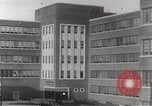
Lockheed P-80 Shooting Star; Douglas D-558 skystreak; Republic F-84; Northrop flying wing and XFD-1 Navy Phantom jet aircraft.
General Electric company sharing its J-33 jet engine design with other manufacturers such as Allison engine manufacturer who also build them for Lockheed P-80 shooting star airplanes. Animated illustrations of the J-33 centrifigal compresser contrasted to the axial flow compressor of the J-35 engine. View of straight wing Republic F-84 thunderbolt powered by the J-35 engine. View of Douglas Skystreak airplane. View of Northrop Flying wing airplane powered by 8 J-35 engines. McDonnell Douglas FH-1 phantom jet airplane operating on an aircraft carrier. Classroom where General Electric personnel are being trained to service and support organizations using GE jet aircraft engines.
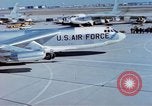
USAF B-52H in flight carrying GAM-77 cruise missile under its wing during a test flight in the United States.
Progress report of United States Air Force B-52G and B-52H in the United States. United States Air Force B-52H aircraft taxis and takes off from the runway. The aircraft carries GAM-77 cruise missile under its wing during flight. The GAM-77 cruise missile releases from the B-52H aircraft.

USAF B-52G in flight carrying GAM-87 ballistic missile under its wing during a test flight in the United States.
Progress report of United States Air Force B-52G and B-52H in the United States. GAM-87 missile mounted under the wing of United States Air Force B-52G aircraft. The Boeing crew loads the ballistic missile under the wing of the B-52G aircraft. The aircraft in flight with the ballistic missile.

M61 Gatling gun being fired from USAF B-52G during firing test in the United States.
Progress report of United States Air Force B-52G and B-52H in the United States. M61 Gatling gun being lowered from beneath aircraft mockup. The M61 Gatling gun displayed on a table. Two engineers check M-61 mockup. Dual radar antennas move back and forth. A sign reads 'Danger, Live Ammunition Being Discharged'. The Gatling gun fires on target board in front during a firing test. The USAF B-52G aircraft in flight.
CRITICALPAST.COM: About Us | Contact Us | FAQs - How to Order | License Agreement | My Account | My Lightboxes | Shopping Cart | Advanced Search | Featured Collections | Website Terms & Conditions | Privacy Policy ©2026 CriticalPast LLC.
License Agreement |
Terms & Conditions |
Privacy Policy
©2026 CriticalPast LLC.