


 Francais
 Deutsch
 Italiano
Refine Your Search
Dayton Ohio USA 1947 stock footage and images
- Showing 1129 to 1134 of 25558 results more
more Hide
Hide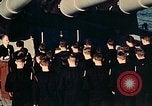
A chaplain addresses sailors during church services held aboard a ship underway at sea in the United States.
A film on the life of sailors aboard U.S. Navy ships in the United States. Church services aboard a ship on a Sunday morning. A navy chaplain addresses sailors during a sermon. The chaplain talks to a patient in bed. He meets and gives guidance to other sailors. Cooks prepare dinner in a kitchen aboard the ship. A cook takes a roasted turkey from a table. The sailors seated at a table eat Sunday dinner. A sailor eating a roasted turkey leg.
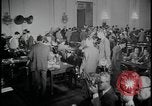
Film executive Jack L. Warner testifies at a House Un-American Activities Committee (HUAC) hearing.
Canadian-American film executive Jack L. Warner testifies in a House of Un-American Activities Committee (HUAC) hearing. Jack E. Warner, accompanied by attorney Paul V. McNutt, is sworn in as a witness. The President of the Motion Pictures Association of America (MPAA), Eric Johnston, is seen. Committee chief investigator Robert E. Stripling questions Attorney Paul V. McNutt. Attorney Paul V. McNutt answers the Committee’s inquiries. Jack L. Warner attempts to read a statement, but the Committee interrupts, as they tell him “it was the same statement you have read out”, and instead asks Warner to hand over the statement. Jack L. Warner reads from a statement, “Here I am before this committee to help as much as I can in facilitating this work. I am happy to speak openly and honestly in an inquiry which for its purpose the reaffirmation of American ideals and democratic processes”. Members of the committee J. Parnell Thomas, Chairman Richard B. Vail, John S. Wood and Richard Nixon sit as Jack L. Warner testifies. View of Committee chief investigator Robert E. Stripling listening during hearing. View of Attorney Paul V. McNutt while his client, Jack L. Warner testifies.
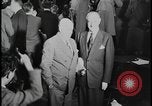
Film executive Jack L. Warner reads his testimony before a hearing of the House Un-American Activities Committee (HUAC)
Hollywood executive Jack L. Warner reads his statement at a House Un-American Activities Committee (HUAC) hearing. Behind Jack L. Warner are film executives. With microphones on his table, Jack L. Warner reads his statement repeatedly, starts again when he finds his delivery unsatisfactory. “We can’t fight dictatorship by following dictatorial methods nor can we defend freedom by curtailing liberty. We can attack with a free press and a free screen”.
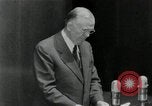
U.S. Secretary of State, George Marshall addresses the General Assembly of the United Nations
In a speech to the General Assembly of the United Nations, U.S. Secretary of State, George Marshall, refers to repeated vetoes by a permanent member of the Security Council. He discusses the post-war state of the world and the many matters yet to be resolved, including the independence of Austria, the Palestine issue, the matter of Korea, still divided along the 38th parallel, and status of nations in Eastern Europe, etc.
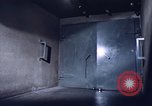
Controls at Offutt Air Force Base, Nebraska and operations of Looking Glass Air Borne Command Force.
Offutt Air Force Base, near Omaha in Sarpy County, Nebraska. Radars and systems at Air Force Base. Office at three story below ground level. SAC (Strategic Air Command) officers cover cartons with a sheet. Ammunition stored. Looking Glass Air Borne Command Force center. Telephone, communication equipment and control systems used to keep track of things. SAC officers run, they get on trucks and go to air craft. Aircraft takes off. Pilot in plane. Rocket takes off. SAC headquarter.
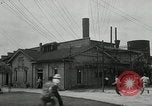
Takeover and censorship of the press during reenactment of Nazi martial law in Anderson South Carolina.
Group of armed men storms the newspaper publishing facility in Anderson South Carolina during a reenactment of martial law measures practiced in Nazi Germany. Press workers are escorted away. Man throws large power switch and lights go out. New edition of the "Anderson Daily Mail" newspaper is seen rolling off the presses, under guard by armed men. Newspaper headline is "Clemsonia Captures Anderson". Numerous articles are blacked-out and labeled "censored." Article is seen entitled "It Can Happen Here. In Fact it Did."
CRITICALPAST.COM: About Us | Contact Us | FAQs - How to Order | License Agreement | My Account | My Lightboxes | Shopping Cart | Advanced Search | Featured Collections | Website Terms & Conditions | Privacy Policy ©2026 CriticalPast LLC.
License Agreement |
Terms & Conditions |
Privacy Policy
©2026 CriticalPast LLC.