


 Francais
 Deutsch
 Italiano
Refine Your Search
Dayton Ohio USA 1947 stock footage and images
- Showing 13945 to 13950 of 25558 results more
more Hide
Hide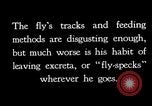
Fly specks on a menu card are found to contain tuberculosis bacillus in the U.S.
Experiments on fly specks show the fly as a disease carrier in the United States. A fly moves on a menu card. A cup and a serving of sugar cubes on a dining table. The fly sits on sugar cubes. Experiments are performed which show that these fly specks frequently contain disease germs in an active and virulent state. After incubation the fly specks show living germs of typhoid and spinal meningitis. Tuberculosis bacillus seen.
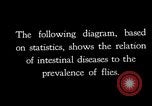
Charts illustrate incidence of flies to intestinal diseases and typhoid fever and their breeding places in the U.S.
Animated diagrams show the fly as a disease carrier in the United States. Animated diagram based on statistics shows the relation of intestinal diseases to the prevalence of flies and depicts deaths from typhoid. Views of eggs of fly. They develop into hairless whitish larvae. While feeding on the manure in which they live the larvae gradually change into pupae. At the termination of the pupa stage the fly comes out of the pupa case.
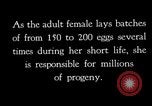
Methods to combat disease carrying fly by using formalin are shown in the U.S.
A data shows that the fly is responsible for millions of progeny in the United States. The data depicts that as an adult female fly lays batches of 150 to 200 eggs several times during her short life, she is responsible for millions of progeny. To terminate the young flies: a woman pours formalin into a plate and places it in a window. The flies are poisoned and are terminated.

Methods to combat disease carrying fly by cleaning and screening in the U.S.
Methods to protect human beings from disease-carrying flies in the United States. Food suppliers at a shop - those protect merchandise from the flies. They keep their merchandise in glass shelves. A man screens his house with his child. A diagram shows exterminated fly.
Vice President Lyndon B. Johnson becomes the 36th President of the United States after assassination of John F. Kennedy.
Features President Johnson assuming his new responsibilities as the President in an atmosphere of grief in the U.S. United States civilians walk in a long queue line and entering the U.S. Capitol Building to view the casket of President John F. Kennedy, days after his assassination death. The U.S. flag draped coffin of assassinated President John F. Kennedy (35th President of the United States) is seen in the center of the dome room. People cry and express grief, and comfort each other. Point of view shot of mourners exiting the U.S. Capitol building and looking out over the National Mall, with the Washington Monument visible in the distance. Night time exterior view of the White House. Scenes changes to show a man, possibly Indian, laying bricks at a construction site. A teacher in a college talking to a student in a courtyard. Women seated selling and buying goods at an outdoor market in Asia. A farmer driving a red tractor in the United States and tilling the soil of a farm field. A lit up room in the White House. Lyndon B. Johnson, former Vice President of the U.S. (now the 36th President of the United States) sits with documents at his desk and works in the White House. Close up side view of President Johnson as he works. Flashbacks: Views of President Johnson surrounded by large crowds, including a group of children, and being greeted during his trip to Asia, Europe, Africa and South Africa. LBJ signs promoting Lyndon Johnson at a Democratic Convention. Brief excerpts of Johnson speaking about Civil Rights and about space exploration, and about military readiness. President Johnson entering the House of Representatives chamber in the U.S Capitol five days after he became President of the United States to make his first speech to Congress as President. Lawmakers assembled give him a standing ovation as he enters.
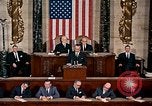
President Lyndon B. Johnson addresses congress and speaks about the pursuit of President Kennedy's policies in the U.S.
U.S. President Lyndon B.Johnson takes new responsibilities as the President in an atmosphere of grief in the U.S. The House of Representatives chamber. President Lyndon B. Johnson speaks, addressing lawmakers five days after the assassination death of President John F. Kennedy. Excerpts from President Johnson's speech, including his opening statement, "All I have I would have given gladly, not to be standing here today. The greatest leader of our time has been struck down by the foulest deed of our time. No words are sad enough to express our sense of loss. No words are strong enough to express our determination to continue the forward thrust of America that he began." He expresses his dedication to the pursuit of the policies of former President John F. Kennedy, including space exploration, Peace Corps, education, jobs, care for the elderly, and civil rights. He stresses his experience and qualifications for the Presidency. Elevated exterior view of the U.S. Capitol, with the Washington Monument in the foreground. Brief scene of marchers during the March on Washington for Jobs and Freedom. A United States missile launching, side view of U.S. Navy sailors marching in a parade. Two Asian boys enjoying a drink from cups.
CRITICALPAST.COM: About Us | Contact Us | FAQs - How to Order | License Agreement | My Account | My Lightboxes | Shopping Cart | Advanced Search | Featured Collections | Website Terms & Conditions | Privacy Policy ©2026 CriticalPast LLC.
License Agreement |
Terms & Conditions |
Privacy Policy
©2026 CriticalPast LLC.