


 Francais
 Deutsch
 Italiano
Refine Your Search
Dayton Ohio USA 1947 stock footage and images
- Showing 14707 to 14712 of 25558 results more
more Hide
Hide
A political broadcast in the U.S. prior to the 1968 Presidential Election promotes Richard Nixon.
A political broadcast based on unity in the United States promotes Republican nominee Richard Nixon prior to the 1968 Presidential Election. Still images show a young couple, a group of old-aged people and boys at school and promotes unity among American people. Images of American citizens and crowd. Still images of Richard Nixon.
A political broadcast shows Richard Nixon shaking hands with people during a campaign prior to U.S. Presidential Election.
A political broadcast promotes Republican nominee Richard Nixon prior to the 1968 Presidential Election in the United States. Still images show Richard Nixon shaking hands with people during an election campaign. A sign reads 'NIXON'S THE ONE'.
Ronald Ziegler reads a statement outlining events surrounding Nixon's 'Saturday Night Massacre'
White House Press Secretary Ronald Ziegler in a press room at the White House in Washington DC, United States reads a statement outlining dismissals of officials (known as Saturday Night Massacre) made by U.S. President Richard Nixon on October 20th , 1973. He says that President Nixon has taken action in which he has fired special prosecutor Archibald Cox in the Watergate Case. It was because of his refusal to comply with instructions given to him through U.S. Attorney General Elliot Richardson. He was not to seek to invoke the judicial process any further to compel production of recordings, notes, or memorandum regarding private Presidential conversations. He says that office of the Watergate Special Prosecution Forces has been abolished and its function will be transferred back to the Department of Justice. Ziegler says that President Nixon sought to avoid a constitutional confrontation by the action he announced on Friday October 19th, 1973 to give the courts the information from the tapes which the President had considered privileged. Further he says that President Nixon's action was accepted by responsible leaders in the Congress and in the country. But special prosecutor Cox's refusal to follow the President's instructions at a time of serious world crisis made it necessary for the President to discharge him. Ziegler says that before taking any action the President met with Richardson to instruct him to dismiss Cox, but Richardson refused to do so. After Richardson submitted his resignation, the President directed Deputy Attorney General William Ruckelshaus to dismiss Cox. When Ruckelshaus refused to carry out President's directive, he also was discharged. President Nixon then directed acting Attorney General Robert Bork to carry out the instructions and Bork fired Cox.
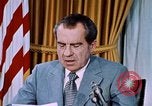
President Richard Nixon gives an energy crisis statement from the Oval Office of the White House in Washington DC.
U.S. President Richard Nixon addresses the nation from the Oval Office of the White House in Washington DC, United States. President Nixon says that lack of energy supplies would bring temporary shortages in fuel supplies and some increase in fuel prices. He says that if energy resources were properly developed they could fulfill American energy requirements for centuries. He says that his administration was going to end quantitative controls on oil imports and establish a national energy office in the United States. He talks about increasing the ability of the United States to prevent oil spills. The President proposes that the Congress should remove government regulations which discouraged the growth of domestic natural gas industry. Secondly, the Congress should help to establish research and ground work for developing new forms of energy for a long range future (alternate sources of energy). Thirdly, the Congress should permit the licensing of new deep water ports to open the way for long delayed Alaska oil pipeline.
President Richard Nixon speaks on the occasion of a photo opportunity with the BSA in Washington DC, United States.
Clip shows opening slate and contains audio only. No visual images. U.S. President Richard Nixon at a photo opportunity with the Boy Scouts of America (BSA) in Washington DC, United States on 21st February, 1974. A boy scout speaks about the activities of the boy scouts in the recent years. President Richard Nixon is presented with a collection of coins. President Nixon speaks during the occasion. He speaks about character building, boy scouts joining the armed forces and progress of the boy scouts. He thanks the boy scouts for the honor and for the invitation to their Jamboree and regrets that he cannot attend, but says he is glad he does not have to go on a 50 mile hike. He invites them on a tour of the White House.
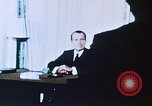
From the Oval Office in the White House, President Nixon talks to Apollo 11 astronauts after their landing on the moon.
Telephone conversation between U.S. President Richard Nixon and the astronauts of Apollo 11, while they are on the moon, July 20th, 1969. President Nixon seated at a desk in the Oval Office of the White House in Washington DC, United States. Technicians setting up video cameras. Nixon talks over a phone. Men setting up a monitor screen. Flickering moving images of the astronauts beside the Lunar Lander, on the surface of the moon. A camera focuses in on a document titled: DRAFT 'Talk to men on the moon' on the desk. The opening sentence reads: "This is an epic day in the history of man." A split image on the screen shows President Nixon talking and the astronauts on the moon. President Nixon talking to an astronaut on a phone at his desk in the Oval Office. Picture of "Earthrise" as seen from the moon, on wall in the Oval Office. NASA Astronaut, Frank Borman,who commanded the Apollo 8 mission,in 1968, comes before the cameras in the White House and makes speaks on behalf of NASA astronauts involved in the Apollo missions.
CRITICALPAST.COM: About Us | Contact Us | FAQs - How to Order | License Agreement | My Account | My Lightboxes | Shopping Cart | Advanced Search | Featured Collections | Website Terms & Conditions | Privacy Policy ©2026 CriticalPast LLC.
License Agreement |
Terms & Conditions |
Privacy Policy
©2026 CriticalPast LLC.