


 Francais
 Deutsch
 Italiano
Refine Your Search
Dayton Ohio USA 1947 stock footage and images
- Showing 14989 to 14994 of 25559 results more
more Hide
Hide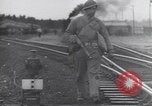
Troops board trains with war equipment and other supplies en route to ports of embarkation from the United States during World War II.
Plans underway in the United States in 1944 for participation in the invasion of France during World War 2 by Allied forces. A U.S. Army sentry of the Army Service Forces (ASF) patrols a rail line, where military men and equpment are being transported abroad., during World War 2. ASF soldiers drive DUKWs (amphibious vehicles) up a ramp for loading into railroad box cars. A long line of DUKWs being driven for loading. Many men load 55 gallon drums of petroleum products into rail cars. An M3 Stuart light tank being driven on an open rail car. Soldiers loading motorcycles on a train. An Army M3 Half-track Amored Personnel Carrier (APC) driving onto a railroad train. (Narrator notes that it requires 75 trains to transport a single Armored Division by rail.) Men loading a 105 mm Howitzer Motor Carriage M7 (Called Priest, by the British) onto a flat rail car and securing it in place with wooden supports. Army personnel that would participate in an invasion are shown. Paratroopers with their packs. Women's Army Corps (WACs) fill their duffel bags with clothing and other items, and are then seen climbing aboard an open stake truck. An Army band plays and marches giving troops a sendoff at a train station. U.S. soldiers board passenger railroad trains, carrying their field packs and weapons. A steam locomotive pulling a troop train. A train load of Sherman M4 medium tanks and other equipment, including a caterpillar tractor, is seen underway. Unidentified tanks being fastened to rail flat car. Many Army trucks and heavy equipment on train passing a town train station. Military equipment moving on trains over bridges. Two ladies under hair dryers at a salon, discussing boys in service going overseas. United States Army troops bound for the war front are seen boarding railroad trains and also changing trains, monitored by Army military police (MPs) at night. Soldiers inside a moving train car occupy themselves by playing cards; shooting craps; An African American porter watches a game. An Army chaplain talking with some of the soldiers. A soldier reading a magazine. His seat partner keeps falling asleep against him. American civilians at a newsstand. Newspaper headline reads: "London expects invasion of Europe at any hour."
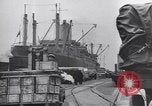
War materiel is loaded on ships to support the Allied invasion of Europe in World War II
A ship being loaded at a U.S. port of embarkation with war materiel to support the Allied invasion of Europe in World War 2. A group of Army dock workers enters the port building. A sign on the front office reads: "U.S. Army Transport Service." Steel structural items and large steel boiler are loaded aboard the ship. Men steady supplies lowered on deck in nets. Men place boxes in the ship's hold. A 2x4 Army truck being lowered into the ship.Tanks and artillery pieces, covered with canvas on the ship deck. A 155mm long tom gun being loaded on the ship More views of equipment and supplies being loaded aboard ship. The covered fuselage of a P-38 Lightning fighter plane being lowered onto the deck. Two civilian men in a wash room talk about upcoming invasion. Troops in full field gear coming aboard the transport ship. Men looking out the port holes of the ship. An invasion convoy getting underway. Soldier on deck, silhouetted against the sky. View of the Pentagon Building in Virginia. Army Service Forces officers meeting in Pentagon. Officers walking in the Pentagon halls. One exchanges salutes with a guard as he leaves the building.

U.S. recruits being classified for assignments and being informed about the progress of World War II and why they fight.
New U.S. army recruits seated at benches in the classification center, taking notes, as an instructor at a blackboard tells them how to fill out their classification questionnaires, during World War 2. View of machines processing the questionnaires. Hollerith 88 column punch cards being sorted by machine. Newspaper article about the Air Force efforts to improve classification and assignments of new airmen. A recruit being counseled. An Airmen in barracks, filling out a post card form to complain about his assignment. Servicemen working with sewing machines and at long cobbler's benches repairing shoes. U.S. soldiers in pith helmets, laying communications cable from a truck. A soldier recording information about a shipment of supplies. Soldiers filling 5-gallon "jerry cans" with fuel from a hose. Others serving at a communications center in woods. A soldier fastening a cable to a tank. Soldier standing on a truck. Large group of soldiers gathered to listen to a lecture about explosives. Army draftsmen at their work tables. Soldiers using information and training materials.(Narrator states these materials are often ignored.) An army newsmap for Monday, August 31, 1942 posted on an Army office wall. A sergeant points to July, 1943, on a current calendar next to it, illustrating that the newsmap is long out-of-date. View of another news map and narrator notes they are produced weekly. An officer speaking to an auditorium of soldiers. A soldier arranging his personal gear. Infantry on field maneuvers, firing rifles as they advance across a field. Soldiers firing a Browning water-cooled machine gun; a mortar; and a 105mm M101A1 howitzer. The sergeant using a newsmap to brief his staff about the progress of the war. Opening frames of a War Department Film Bulletin, and soldiers in a theater, watching the film. Opening frames of the film,"Why We Fight," that goes on to show animated map of the German advance across Europe in World War 2. Scenes of German forces on the move, towing artillery, riding on tanks, and entering towns as they invade countries of Europe. Women and children running in streets under bombardment, and civilians fleeing from their homes during aerial bombing. A Bombed out city and civilian corpses lying on the ground. Women in Poland, identifying their dead and grieving over them. German Heinkel He 111 aircraft dropping bombs. Norwegians evacuating the city in trucks, and other vehicles and on foot, during the German invasion. A squadron of German Messerschmitt Bf-109 aircraft in flight. German Ju-87, Stuka dive bombers diving on targets. Civilians rushing to a bomb shelter, and other refugees boarding a truck to evacuate. More He-111 bombers dropping bombs. A Ju-52 trimotor transport (type used to transport German paratroopers). Buildings ablaze in a town. Large formations of German aircraft of various types flying overhead. Building destroyed and burning from bombing. Ju-87s flying close past the camera.
U.S. Signal corps communications in war and in peace time in the United States.
A training film on the wartime and peacetime activities of the U.S. Signal Corps. U.S. Signal Corps recruits disembark on a beach from landing barges during World War 2. The soldiers set up communications equipment and operate a EE-8 field telephone, and morse code keyer to transmit range observations. U.S. Navy sailor sends signal lamp blinker signals from a U.S. Navy ship offshore. The signal corps soldiers lay telephone wires by aircraft and truck. The telegraph and telephone poles are erected. The Chief Signal Officer seated at his desk. Exterior view of the Pentagon, and then interior views inside the Pentagon at the Pentagon signal center. Soldiers working in the signal center of the Pentagon in Arlington, Virginia. Tape machines dispense paper tapes with encoded communications. Sign "Traffic Control Army Command and Administration System" written on a board in the center. The transmission system of the message.
Dwight D Eisenhower visits U.S. Secretary of War, James Vincent Forrestal in the Pentagon, Virginia.
Retired 5-star General, Dwight David Eisenhower (now President of Columbia University in New York) enters the office of the U.S. Secretary of War, James V. Forrestal, in the Pentagon. The two men shake hands and begin conversing. (Note: The War department was renamed the Department of Defense when President Truman signed the National Security Bill on August 10, 1949.)
The production of war films and other work in the Signal Corps Photographic Center in the United States (WW2)
Soldiers of the U.S. Signal Corps in the European Theater during World War II. Signal Corps cameramen of Army Pictorial Service photograph and film an amphibious landing. The soldiers wade ashore. U.S. soldiers advance on a battlefield, firing rifles. Camera man present. Street fighting on the war front. The wall of a building leans and crashes to the ground as a U.S. Army camera man captures moving image footage on camera. U.S. soldier rips a Nazi German eagle symbol from a building and it crashes to the street. A U.S. Army Air Corps B-17 aircraft in flight , seen from beside and close up from below and beside. View of exterior of Signal Corps Photographic Center building in New York. Men working inside the Signal Corps Photographic Center in the United States. Soldiers at film cutting machines at work, and view of film canisters in storage. The production of films in the center including a segment from "Why We Fight" and one from "The Fighting Men" pictures. Several war related films, and training and orientation films are produced. The foreign version of the films are also made so that they can be seen by other countries. Scene of an American soldier speaking Japanese in a U.S. military created film. Bing Crosby singing "Accentuate the Positive" during a filmed segment for the American G.I. audience at a USO show. Elevated view of war material and equipment stacked in a massive warehouse building, with Signal Corps workers moving about in the building. Men working and placing more equipment in the building. 'MacArthur's Headquarters' written on a wooden shipping crate. Boxes of war materiel being loaded into trucks, railroad train cars, and ships for transport to the war front in World War 2. Views of various kinds of Signal Corps communication equipment, radios, transmitters, cameras, vacuum tubes and other electronic equipment that was innovated during World War II. A moisture-proof switchboard is tested in the field. A U.S. Army Signal Corps soldier holding a phone during the switchboard testing.
CRITICALPAST.COM: About Us | Contact Us | FAQs - How to Order | License Agreement | My Account | My Lightboxes | Shopping Cart | Advanced Search | Featured Collections | Website Terms & Conditions | Privacy Policy ©2026 CriticalPast LLC.
License Agreement |
Terms & Conditions |
Privacy Policy
©2026 CriticalPast LLC.