


 Francais
 Deutsch
 Italiano
Refine Your Search
Dayton Ohio USA 1947 stock footage and images
- Showing 15985 to 15990 of 25559 results more
more Hide
Hide
Animated diagrams show how energy is stored and discharged in Edison storage batteries
How Edison batteries function. The are also known as nickel-iron battery or NiFe batteries. An animated diagram shows how nickel iron alkaline storage batteries such as Edison batteries store and generate energy. The diagram shows the battery, generator, switch, motor, and a light bulb. An early nickel-iron Edison battery in wooden box. A later version of the nickel-iron battery invented by Thomas A. Edison in 1909. Pie chart showing the market share of Edison batteries over other portable batteries in 1926. Photograph of German-born American mathematician and electrical engineer Dr. Charles Proteus Steinmetz, "The Wizard of Schenectady". Slate bearing a commentary on from Dr. Steinmetz claiming "complete reversibility" of the Edison battery reaction. Diagram shows the reversible cycle of a portable battery. Animation in the diagram shows how energy is stored in the battery- the oxygen contained in the negative plate is forced to the positive plate by the charging current. The animation demonstrates the discharge of the battery. Plates from used Edison batteries show little decay after years of use.
The rugged durability and characteristics of Edison Batteries under testing and in use.
A diagram compares the payload capacity between vehicles powered by lead battery versus Edison battery. A WW1 era United States battleship sailing in an ocean. Steel beams of a skyscraper under construction. Vibration testing of Edison battery to check durability under use. A man operating an electric motorized cart carrying packages crosses a train track and loses one of the packages. Animation demonstrates the benefits of the Edison Battery, noting that it can be overcharged, overcharged, and even reverse charged. Photo of Edison battery array in a control room. A ‘Mrs. Wagner’s Pies- The Wagner Pastry Co.’ Edison battery electric delivery van is started and drives in the midst of a blizzard, thus demonstrating battery resistance to freezing conditions. This is probably near Newark, New Jersey, headquarters for the company.
Ambassador Henry F. Grady is interviewed about the nationalization of Iran's oil industry.
United States Ambassador to Iran Henry F. Grady gives an interview for Longines Chronoscope on CBS Television. Advertisement for Swiss watchmaker Longines-Wittnauer watch company. Longines Chronoscope moderation Frank Knight introduces himself, with Frazier Hunt and William Bradford Huie the panelists for the interview. Former Ambassador to Iran Mr. Henry F. Grady is introduced to the audience. The panelists and Mr. Grady discuss about the nationalization of the Iranian oil industry. Mr. Grady talks about the control of private companies, mainly American and British, of the Iranian oil industry before the nationalization. “I don’t think Russia could get any of the oil” Ambassador Grady said when asked about the possibility of Soviet takeover of the Iranian oil industry. William Bradford Huie asks Grady about Premier Mohammad Mosaddegh, the leader behind the nationalization movement. Ambassador Grady briefly gives his opinion about a possible settlement between foreign companies and Iran until he is interrupted by Huie. Frank Knight introduces the panelists and guests again before advertising Longines watches to the audience. Longines clock gears and mechanism moving. Display of international gold medal awards won by Longines. Longines wristwatches for men and women on display.
The United States and Japan sign the 1960 U.S. – Japan Security Treaty in Washington DC.
The U.S. – Japan Security Treaty (Treaty of Mutual Cooperation and Security between the United States and Japan) is signed in Washington DC, United States. View of the White House in Washington DC. President Dwight D. Eisenhower escorts Japanese Prime Minister Nobusuke Kishi to the East Room of the White House. Photographers taking photos of Eisenhower and Kishi. President Eisenhower speaks to the media. “This treaty represents the fulfillment of the goal set by Prime Minister Kishi and myself in June of 1957 to establish an indestructible partnership between our two countries in which our relations would be based on complete equality and mutual understanding. The treaty likewise reflects the closeness and breadth of our relations in the political and economic as well as security fields.” President Eisenhower said. Prime Minister Kishi signs the Treaty of Mutual Cooperation and Security Between Japan and the United States. Japanese official stands behind Prime Minister Kishi. United States Secretary of State Christian Herter signs the same treaty. President Eisenhower and Prime Minister Kishi shake hands after the signing of the 1960 U.S. – Japan Security Treaty.
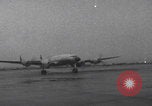
President Kwame Nkrumah of Ghana meets President Kennedy during to the United States
Ghanaian President Kwame Nkrumah arrives at Washington National Airport for an official visit with U.S. President John F. Kennedy. President Kwame Nkrumah climbs down air stair from Military Air Transport Lockheed Constellation as an attendant holds an umbrella behind him. President Kennedy talks with the Ghanaian president at bottom of stairs while Clement Conger (wearing glasses), assistant chief of protocol, stands over his shoulder. At frame left, in dark hat, Chief of Protocol Angier Biddle Duke listens in. Photographers taking pictures of Kennedy and Kwame Nkrumah while the two leaders walk to the hangar of the airport. United States military and government officials meet Presidents Kennedy and Kwame Nkrumah inside hanger.
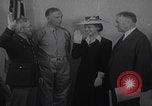
Oveta Culp Hobby is sworn in as Director of the United States Women’s Army Auxiliary Corps (WW2)
Oveta Culp Hobby is sworn into the Army with the rank of Director of the United States Women’s Army Auxiliary Corps during World War II. The organization would later be called the Women's Army Corps (WAC). Major General Myron C. Kramer administers oath of office to Oveta Culp Hobby. General George C. Marshall stands between Kramer and Hobby as he witnesses the ceremony. United States Secretary of War Henry Stimson also witnesses the event. Hobby stands with her arm raised under oath. Hobby shakes hands with Stimson, Marshall, and Kramer after the oath taking. Oveta Culp Hobby makes short statement, noting that, "This new corps is the 1942 expression of the patriotism and courage that the women of America have always demonstrated in every national crisis." Hobby continues, “In a total war, there is a total responsibility of all citizens regardless of sex, race, or creed. Every woman must do her part. The Women’s Army Auxiliary Corps offers an opportunity for every woman eligible under the law to do her part.”
CRITICALPAST.COM: About Us | Contact Us | FAQs - How to Order | License Agreement | My Account | My Lightboxes | Shopping Cart | Advanced Search | Featured Collections | Website Terms & Conditions | Privacy Policy ©2026 CriticalPast LLC.
License Agreement |
Terms & Conditions |
Privacy Policy
©2026 CriticalPast LLC.