


 Francais
 Deutsch
 Italiano
Refine Your Search
Dayton Ohio USA 1947 stock footage and images
- Showing 17155 to 17160 of 25559 results more
more Hide
Hide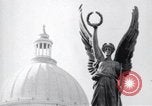
Racial segregation and unrest of 1957 in Arkansas; Reporter interviews the Governor of Arkansas, Orval Faubus.
Reporter interviews the Governor of Arkansas, Orval Faubus about racial segregation of 1957 during his term. The Governor says that he is always ready to accept changes, but he conveys support for segregation by equating it to an "old building" or a "fine painting" and saying that it is "not good to tear down such a building or destroy such a painting simply because it is old." He continues saying, "These things are not good because they are old; many of them have grown old because they are good. And the experiences of many people have proved them to be good." Montage shows buildings, courthouse and justice statues, and public protests, with police arrests of African American marchers and demonstrators during the civil rights movement. Police beat some protestors. Jim Crow era signs segregating whites only versus colored waiting room facilities. Signs read "Colored Waiting Room" and "White Waiting Room." Local Arkansas officials and police beating back protestors with clubs and batons, and police seizing African American protestors and making arrests. U.S. troops in jeeps and trucks arriving and deploying in Arkansas. Included are scenes with signs of Jim Crow segregation practices, with separate entrances for white versus colored patrons at an Intra-state bus depot.
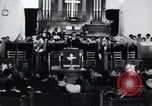
AME church service in Little rock, Arkansas; recognition for Little Rock Nine; scenes after 1957 church bombing in Montgomery
A service at the AME Church in Little Rock, Arkansas. Pastor addresses the African American congregation that includes several of the original "Little Rock Nine." They receive life membership in the National Association for the Advancement of Colored People (NAACP). Bombing damage done to the First Baptist Church (347 N Ripley St, Montgomery, AL 36104, United States) in Montgomery, Alabama is shown. African American women leave the Little Rock AME church after the service. (During Civil rights movement.)
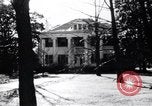
Old woman speaks about integration of public facilities for Blacks and Whites.
Elderly woman gives an interview in her palatial home. She says that every public facility should be integrated including library, hospitals and schools. She speaks for the civil rights of African Americans and the importance of integration based on her Christian faith. She was on the board of the Public Library when it was integrated 10 years prior.
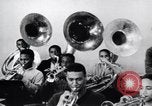
An African American high school band and chorus performs the Battle Hymn of the Republic.
Shows a director conducting African American youth of a high school band in Arkansas playing and singing the Battle Hymn of the Republic. Young men and women singers sing in the choir and an orchestra of various instruments plays the hymn.
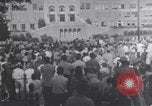
Protests against admission of black students at Little Rock Central High School, Arkansas; later work and teaching by Ernest Green.
Shows crowd gathered outside the Little Rock Central High School in Arkansas, in 1957, protesting admission of African American students during civil rights movement. Shows "Little Rock Nine" in station wagon being escorted to the school by armed Federal troops. Ernie Green reflects on the experience of the troop escort. Views of Ernest Greene at Michigan State University in a library and Professor Greene teaching in a classroom. Green is seen on a building site working to encourage black apprenticeships in the building trades. Ernest Green seated in an office.
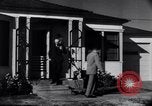
British worker and his American counterpart in labor exchange program visit the Lockheed aircraft plant in Los Angeles, Calfornia
A British guest on labor exchange program visit to the U.S. during World War 2. He leaves the home of his counterpart American host in Los Angeles, California. They leave in the American's car and drive a considerable distance to the Lockheed Aircraft Company facility. View of Honor Roll listing 15, 174 Lockheed affiliated members of the U.S. Armed Forces. The British-American pair walk past a Lockheed Ventura airplane under construction. View of a room filled with P-38 Lightning fighter planes completing final construction, outside the plant. A film clip of the maiden flight of the Lockheed Constellation aircraft (Later designated C-121 by the Army Air Corps) is inserted at this point. It shows the Constellation taking off from the factory airstrip in 1943, and climbing without raising its landing gear. View of aircraft fuselage under construction, where the British worker is inquiring about the manner of its assembly. Next he is seen observing a turntable press operation being run by men and women workers. View of workers using pneumatic hand tools to remove wrinkles from edges of pressed products. A woman punch operator is seen with safety straps on her hands that pull them away each time the punch comes down. Another woman worker demonstrates an electric spot welder. (The observing visitors are required to wear safety goggles in case sparks are created by the process.) Closeup of the aircraft part being spot welded. More workers operating similar machines in the plant, including an African American man and woman. Workers placing a large sheet of aluminum into a machine that fabricates wings for the P-38 fighter plane. Closeup of the British worker and his American counterpart on a balcony overlooking the production line for the Lightning aircraft. View across the production line floor. The two look into the factory first aid station available to workers and also see the transportation section where worker carpools can be formed. Employees are seen obtaining ration books and driver licenses from government clerks working in the plant itself. Employees are seen eating outdoors under foliage camouflage and others gather at an indoor eating site. Next, a section of a B-17 flying fortress wing, is seen moving out of a manufacturing jig. New components are immediately placed into the empty jig for construction. View of final installation area for B-17s, An overhead crane moves a finished wing, including engines, to be mated with its fuselage. Glimpse of numerous B-17s being assembled. A finished B-17 bomber being towed out of the factory.
CRITICALPAST.COM: About Us | Contact Us | FAQs - How to Order | License Agreement | My Account | My Lightboxes | Shopping Cart | Advanced Search | Featured Collections | Website Terms & Conditions | Privacy Policy ©2026 CriticalPast LLC.
License Agreement |
Terms & Conditions |
Privacy Policy
©2026 CriticalPast LLC.