


 Francais
 Deutsch
 Italiano
Refine Your Search
Dayton Ohio USA 1947 stock footage and images
- Showing 19303 to 19308 of 25559 results more
more Hide
Hide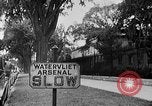
Artillery piled up at Watervliet arsenal in Watervliet, New York.
Manufacturing of ordnance in United States by war production workers early in World War 2. A sign outside a building reads 'Watervliet Arsenal: drive slow' Men at work inside the arsenal. Artillery hoisted in a sling lowered to be piled up inside the arsenal. Artillery lowered and piled up. Pile of artillery.
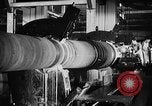
Artillery processed on various machines by war production workers at Watervliet arsenal in Watervliet, New York.
Manufacturing of war materiel and ordnance in United States early in World War 2. Gun barrels worked on as they undergo various processes during manufacturing by war production workers. Men work on drill, presses and lathes in factory. Artillery and gun barrels shaped on machines. Fiery flare seen as artillery is processed. Man operates a lathe and barrels roll on the lathe. Final machined dimensions checked with large hand-held gauge.
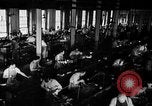
Weapons processed on various machines at Watervliet arsenal in Watervliet, New York.
Manufacturing of ordnance in United States. Men work building war materiel in Watervliet arsenal, New York. Men work on machine gun manufacture and assembly. Assembling aircraft machine guns by war production workers early during World War 2.
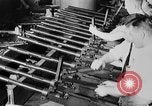
Machine Gun manufacturing at Watervliet arsenal in Watervliet, New York.
Manufacturing of ordnance war materiel in United States. War production workers checking guns by placing test cartridges in machine guns. Stacking two types of completed machine guns at the factory early during World War 2.
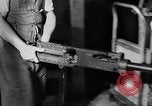
Test firing of newly built machine guns at Watervliet arsenal in Watervliet, New York.
Manufacturing of ordnance war materiel in United States early in World War 2. Man carries a machine gun and fixes it on a stand with its barrel protruding to the other side of the wall. Cartridge belts. Men pick up belts and feed them into guns. War production workers test fire the guns and used up cartridges pile up in a container by the side of the gun. Smoke rises as guns are fired for testing at conclusion of machine gun production process.
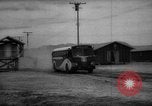
Japanese Americans at relocation center in United States during World War II.
Relocation of Nisei people in United States during World War 2. Japanese Americans arrive at the Manzanar relocation center (internment camp). Family members exit a bus. A young boy looking unsure as he observes the camp. New internees undergo medical examination. They participate in Americanization classes. They train themselves in self government. Block leaders are presented citations at a meeting. Japanese-American children internees are looked after in day care centers as men and women go to work. Young boys and girls seated at a table. Internees at Manzanar working in an experimental laboratory house for extracting rubber from guayule shrubs to increase rubber production during the war. Japanese American internees working in cultivating the guayule shrub. View of a project at the Parker camp where internees were working to irrigate desert land. View of sugar beet fields where internees could work. View of Manzanar war relocation center with mountains behind. War time propaganda narrator promotes the relocation centers as "setting a standard for the rest of the world in the treatment of people who may have loyalties to an enemy nation. We are protecting ourselves without violating the principles of Christian decency."
CRITICALPAST.COM: About Us | Contact Us | FAQs - How to Order | License Agreement | My Account | My Lightboxes | Shopping Cart | Advanced Search | Featured Collections | Website Terms & Conditions | Privacy Policy ©2026 CriticalPast LLC.
License Agreement |
Terms & Conditions |
Privacy Policy
©2026 CriticalPast LLC.