


 Francais
 Deutsch
 Italiano

Refine Your Search
Dayton Ohio USA 1947 stock footage and images
- Showing 205 to 210 of 25589 results more
 Hide
Color Sound

Towing operations of phoenix units, a Lobnitz pier head and a whale unit constructed by the Seabees in Normandy, France.
Creation of an artificial harbor and bridges by the Seabees ("Operation Mulberry") in Normandy, France during World War II. U.S. Navy Captain Augustus Dayton Clark, in charge of the Operation Mulberry landing operations at Omaha beach, is seen in discussion with Commander E.T Collier from the 108th Naval Construction Battalion (Seabees). Towing operations are shown: Tugs used for towing phoenix units. The tugs take a whale unit in tow. A tug takes a phoenix unit in tow and another with a whale unit in tow. Lobnitz spuds in tow. A formation of Allied fighter aircraft in flight overhead protecting the convoy. Seabees crew and gun crew on phoenix unit. 40mm anti aircraft gun on the phoenix unit. View at H-2 hours before D-Day of skies overhead with transport aircraft towing gliders with troops on board for the D-Day landing operation.
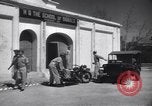
A U.S. officer instructs Pakistani soldiers about the use of American signal equipment and Pakistanis train in T-33A jets
Unites States soldiers in Pakistan. Soldiers outside a building with a sign that reads "Headquarters, School of Signals. Established 1947". An American officer teaches the use of American signal equipment to Pakistani soldiers. The flag of Pakistan flying in breeze on a flagpole. Line of T-33A jet aircraft lined up on runway. Pakistani pilot gets into the cockpit of a USAF T-33A jet trainer aircraft. Three T-33A training aircraft take off simultaneously from the airfield, in formation.
Improvement of miners, condition of mines and factories and civilians of war affected countries of Europe, by Marshall Plan.
Film titled 'Me and Mr. Marshall' depicts developments of coal mines in Germany and aid to other European nations affected by World War II. German coal miners dig deep in a coal mine soon after the end of World War 2. Volunteers awarded at a ceremony. Volunteers board a train and proceed for work at coal mines. Volunteers eat food, give their shoe size, under go training on mine machinery. Miners on lift move underground. Miners at end of the day walk out tired and blackened by coal dust, from a mine. Miners take hot showers after work and get clean clothing hung high on ropes. Salary given to workers for a day's work. Headlines of German newspapers about Marshall Plan. General George C. Marshall speaks his plans at a meeting in Washington DC, America. Aerial views of ruined buildings and factories, wrecked harbor, refugees in tenements in Europe after World War II. Buildings, monuments and bridges in London and Eiffel Tower and other buildings and civilians on roads in Paris, and view of Kremlin in Moscow, Soviet Union. Map shows countries under Marshall recovery plan. View of meeting in progress of Conference for European Economic Cooperation in July 1947, in the Grand Dining Room of the French Foreign Office. Meetings of leaders of nations adopting Marshall plan. Ruins of industries of Germany. Ruins on the ground after war in London, with Big Ben in the far distance. Workers at a factory. Miners take a horse inside a coal mine. Empty coal cars at a German coal mine. Men push coal cars full with mined coal out from mine, on rails. Views of buyers in suits at a German trade show and conference, promoting German products and industries to potential buyers in other countries, a few years after the end of World War 2. U.S. Congress and President Harry Truman in Washington DC approve the Marshall Plan and provide monetary aid to other European countries. Scenes in Germany as it recovers economically after the war: Workers in a factory. Harbor, fruit and vegetable market; customers in a bakery; coal cars and machinery at a coal mine under normal operation under the plan.

Cardinal Mindszenty in Hungary. In New York: American Legionnaires Parade. Communists parade. Catholics protest against Russia
Views of St. Stephen’s Cathedral, Budapest, Hungary. Cardinal József Mindszenty and retinue enter St. Stephen's Cathedral (Budapest, Szent István tér 1, 1051 Hungary). Dark interior of cathedral. Cardinal Mindszenty, priests, and sacristans leaving the cathedral. Cardinal in procession during festival. Cardinal Mindszenty blesses the crowd outside St. Stephen’s Cathedral. Several graves in woods, marked with wooden crosses. Hungarian Communist Leader Mathius Rakosi speaks. Photograph of Cardinal during his trial in Hungary. Comparison of Cardinal Mindszenty's signatures made in 1947 with that ostensibly signed to his confession in 1949. Massed American flags carried by members of the American Legion, in May Day loyalty Parade passing Central Park, in New York City. Small parade of Communists Sympathizers in New York. People carry banners reading: "Against KKK; Against War Bases in Africa; Against Universal Military Training; The Soviet Union Wants Peace; Return to Roosevelt's Peace Policy." One man carries a sign "Hail the State of Israel." Roman Catholic priests lead 'Procession of protests' against Communist Russia at the New York Polo grounds.

Damaged fortifications and structures behind Reich Chancellery in Berlin,Germany, including Hitler Fuhrerbunker.
Bomb damage in Berlin, Germany in the area of the so-called Fuhrer Bunker, shortly after the end of World War II in Europe. Bomb damaged buildings, air raid shelters, and fortifications of the Führer Headquarters (Führerhauptquartiere). View of the Reich Chancellery Garden area (Garten Reichskanzlei) and exterior of the Adolf Hitler Fuhrerbunker at the back of the Reich Chancellery. Heaps of debris in front of the bomb damaged buildings. Tail of an exploded mortar shell on the ground. View of a wrecked truck. Pock marks by shells seen on buildings used as fortifications and shelters. More Mortar tails partially embedded in the ground. (Note: The buildings in this area were demolished in 1947 by the Soviets.)

Hanging of a Nazi war criminal in Landsberg, Germany after end of World War II
Hanging of a Nazi war criminal in Landsberg, Germany after end of World War 2. . American Military officers stand and converse near the gallows. The condemned man, attended by guards and a priest, comes out of a building. They climb the stairs of the scaffold for hanging. An American Field Grade Officer speaks of charges against the condemned man. Soldiers stand near the gallows and watch the hanging. The hooded, condemned man is dropped through a trap by the executioner, Johann Reichhardt, who wears the traditional German executioners’ attire of black coat, white shirt and, black bow tie and black hat. (Reichardt who is clearly seen standing on the platform, was a principal executioner for the Third Reich. But he was subsequently employed by the Occupation Authorities from November 1945, through May, 1946. to help execute Nazi war criminals at Landsberg am Lech by hanging. He was subsequently arrested in 1947, interned, and tried in a tribunal at Munich, where he was sentenced to strict punishment measures.) A military doctor uses a stethoscope to confirm death of the hanging man.
CRITICALPAST.COM: About Us | Contact Us | FAQs - How to Order | License Agreement | My Account | My Lightboxes | Shopping Cart | Advanced Search | Featured Collections | Website Terms & Conditions | Privacy Policy ©2026 CriticalPast LLC.
License Agreement |
Terms & Conditions |
Privacy Policy
©2026 CriticalPast LLC.