


 Francais
 Deutsch
 Italiano

Refine Your Search
Dayton Ohio USA 1947 stock footage and images
- Showing 22621 to 22626 of 25587 results more
 Hide
Color Sound
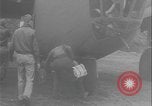
U.S. Army Air Force bombers raid Japanese-held Kiska Island in the Aleutian Islands, Alaska, 1942, during World War 2
U.S. Army Air Force (USAAF) soldiers wearing flight suits board bomber aircraft from a newly established U.S. position in the Aleutian Islands, 1942, during WW2. A soldier pokes his head out a window in the cockpit of one of the aircraft. Bomber aircraft take off from a runway constructed from marston mat (pierced steel planking), mountains in the background. Scenes of the bomber aircraft in the sky, taken from an on-board camera. Close up shots of gunners at their positions. The bombers fly over the foggy islands toward the Japanese base on Kiska Island. A Japanese warship appears in the water far below, one of the U.S. gunners strafes the deck of the ship. Close up of machine gun firing at the boat. Now over Kiska, bomb bays open and American bombs are unloaded. Smoke and explosions far below. A second load of bombs drops toward the Japanese base in slow motion. Wide shot of the target, now covered in streaks of smoke. Shot of the American bomber aircraft in the sky, turning to head back to base.
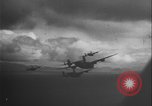
U.S. Army Air Force B-24 bombers return from a raid on Japanese-held Kiska Island in the Aleutian Islands, 1942, during World War 2
U.S. Army Air Force B-24 bombers fly back to base after bombing the Japanese base at Kiska Island, Aleutian Islands, Alaska, in 1942, during WW2. Narrator details the events of the successful mission. Close ups of the B-24 Liberators as they fly over water. Vast mountains of the Aleutian Islands in the background. The aircraft land back at the newly established U.S. base in the Andreanofs of the Aleutian Islands. Close ups of the bombers, now on the ground. U.S. soldiers exit the aircraft, inspect damage taken from Japanese fire on the fuselage. A group of U.S. pilots and crew walk across the airfield. Soldiers circle around and chat. Ending scene of soldier standing with cloudy Aleutian mountain rising in the background.
Creation of dust storms and how to prevent soil erosion caused by dust storms, 1939
View of house on barren land. Destroyed fences and mounds of dirt. Dust storm covers the sky during Dust Bowl period in America. View of windmill and houses before the wall of dust. Illustrated map of the United States outlines the areas affected by dust storms, ranging from the panhandle of Texas to the Dakotas. Graphic shows side view of soil including top soil and sub-soil. Crops are pictured growing from the top soil, then dying. Narrator explains that sun and wind then strip away the top soil. Animation shows top soil crumbling to dust and being swept into the air. Measures to protect top soil are pictured, beginning with planting "arid-land plants" such as grasses to protect soil from the sun and wind. Illustration depicts Lister Furrows: the cutting of deep ridges at right angles to the direction of the wind, acting as a wind break. For future protection, an illustration of shelter belts of trees acting as wind breaks. Scene of house and barren ground in dust storm. Motor cars drive amid dust storm. Scenes of buffalo and cattle being herded. Man stands with cow in dry, barren farmland. Farmers tend to dry, unhealthy crops. Motor car and carriage drive on barren ground. Idealistic scene of healthy land with good grass for cattle grazing and large barn in the background. Final image of a wall of dust.
1929 Master Farmer awards and historical recreation of the Oklahoma land run of 1893
Historical dramatization of the 1893 Oklahoma land run, from a 1929 United States Department of Agriculture (USDA) film. A man on his horse looks at his watch. When the time strikes noon, the man blows a trumpet and fires a blank from his pistol, signaling the beginning of the land rush. A line of horses, wagons, and carriages take off. A large swarm of people on horses ride furiously. A line of horse-drawn carriages and buggies on open plains. More scenes of dozens of horses and people riding at speed. A man loses his hat and trips off the side of his wagon. A man jumps off his horse and quickly hammers a small stake and flag into the ground, staking his claim. Close up as the man, meant to be "Joe Tripp," as he ties the reins of his horse to his leg and prepares to sleep on the ground, without a shelter. Scene changes to "Bill Taylor," another figure in the historical recreation, who is uprooting a thicket in order to make good farming land. The historical recreation ends. Both men have received gold medals labeling them "Master Farmers." Joe Tripp wearing his medal. Two horses pull a wagon towards a large barn and house. Close up of the medal worn by Bill Taylor, who climbs into a wagon pulled by two horses. Behind him is a barn labeled "Riverside Farm W. S. Taylor." 37 men, including Joe Tripp and Bill Taylor, all honored as Master Farmers, stand and pose for a photograph. The men talk with one another, then take off and raise their hats for the picture. Panning shot shows all faces. Note says that Master Farmer medals are awarded by "public spirited agencies" in many states. Secretary of Agriculture, William Marion Jardine, pins a medal on one of the farmers. Scene changes to a farmer harvesting using a grain cradle, then a large combine harvester.
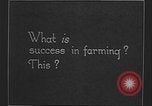
Oklahoma Master Farmer Ed Hearn's farming successes, 1929
From a United States Department of Agriculture (USDA) film. Title card presents the question "what is success in farming?" Various examples attempt to answer the question: A farmer handing a stack of bills to banker. Woman splits wood with an axe, small ramshackle house behind her. Man sits on the banks of water, fishing while smoking a pipe. Herd of cattle with large barn and house in the background, grain silos. Motor car pulls up to doorway of a luxurious house, man dressed in a suit enters the car and it drives off. Now, portrayed as a better answer compared to the previous, scenes of Ed Hearn's farming practices. Hearn has been recognized and awarded as an Oklahoma "Master Farmer." Hearn speaks with another man. Scene of Hearn driving a wagon pulled by a team of horses, which the film notes was what he began with. Now he has 550 acres. Hearn practices crop rotation and terracing to preserve soil quality. Various crops swaying in the wind. Wide shots of Hearn's farmland. Hearn's herd of shorthorn cattle graze in a field. View of Hearn's two-story house. Hearn's two daughters, both noted as being in college. Close up of Hearn smiling and talking with a man. Title card says "That's one story of success."
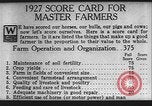
Farming practices of Will Barnett, named Oklahoma Master Farmer
United States Department of Agriculture film. A 1927 scorecard depicts the breakdown of points for assessing a farmer and his operations. Zoom on "maintenance of soil fertility." Scene shows deep machine plowing of soil, practiced by Will Barnett. Barnett uses manure from his farm to keep his soil healthy. Barnett drives a cart pulled by two horses, spreading manure on his land. Barnett's hogs in a pen. Barnett walks down a line of hogs, barn in the background. Barnett's wife's white leghorn chickens, moving about on the ground by their coop. Barnett weighing a bag of cotton, hoists it into the back of a truck amid a cotton field. Shot of the Barnett house and pumpkin patch.
CRITICALPAST.COM: About Us | Contact Us | FAQs - How to Order | License Agreement | My Account | My Lightboxes | Shopping Cart | Advanced Search | Featured Collections | Website Terms & Conditions | Privacy Policy ©2026 CriticalPast LLC.
License Agreement |
Terms & Conditions |
Privacy Policy
©2026 CriticalPast LLC.