


 Francais
 Deutsch
 Italiano
Refine Your Search
Dayton Ohio USA 1947 stock footage and images
- Showing 3097 to 3102 of 25604 results more
more Hide
Hide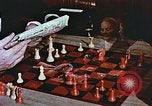
Animation of generation of electricity by atomic and other modes in United States,1957.
Men playing chess and billiards. They are discussing the use of electricity generated by atomic power plant. A player hits the billiard ball and cleans the ferrule of the cue stick. Animation of a table spoon full of uranium atoms and comparison of that potential energy to the work of millions of people or hundreds of thousands of tons of coal. Cartoon animation showing a boy scout making fire, that makes steam to turn a pinwheel (turbine), then a magnet is attached to the pinwheel, and invisible lines of magnetic force cut across the lines in a coil, generating electricity (shown as a lit lightbulb)o. Animation of a moving train and lighted buildings. Animation to compare the generation of power by steam, boilers and atomic reactors. Electric supply lines reaching a house.
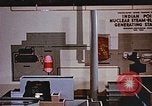
Various power plants and different uses of isotopes in United States,1957.
Men discussing design of Model of 275000KW Indian Point Nuclear power plant to be built in New York. Nuclear power plants in Detroit,Chicago and New England planned in next 10 years. Animation of a map of U.S. shows new nuclear power plants to be built. Narrator indicates that by 1975 atomic plants (nuclear power) may provide a substantial portion of the U.S. electricity. Views of electric power supply lines and towers. Cans of isotopes in a factory. A reaction studied by scientist. Exterior of White Plains Hospital building; inside doctors at a radio lab. Iodine isotopes are mixed in water and a patient drinks it. Doctor analyzes the isotopes by a tracer placed near the Thyroid gland of the patient. The doctor looks at the scale. Doctor examines another patient. The patient is given radiation therapy to control malignant tumors of cancer, via a cobalt therapy machine, at New York Memorial Center.
Examining effect of radiation on cancerous cells. New England Deaconess Hospital, Boston, Massachusetts, United States.
Doctors operate on a cancer patient at the New England Deaconess Hospital, in Boston. Cancerous tissue excised from patient's body during surgery is saved to test behavior of the cells when exposed to radiation. The tissues are cultivated and then.examined under microscopes fitted with a movie camera. Cells divide. Radioactive material in a pack with warning, 'Hazard' written on it. A doctor exposes cancerous tissue to the radioactive material. Cancer cells die after exposure. Exterior view of the White Plains Hospital building in White Plains New York. A child runs to a woman in front of the hospital building. She picks up the child and both smile.
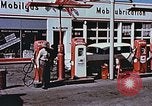
Use of radioisotopes in engine and tire manufacturing in United States
A 1957 Ford Fairlane convertible automobile with top down, pulls into a "Mobil gas" station, and an attendant comes out to serve the driver. He opens the hood revealing the engine which is dominated by a large air filter on its top. Next, the scene shifts to a V8 engine mounted on a test stand in an automotive laboratory . The engine parts have been irradiated so that the slightest wear will be detected in engine oil. Oil drained from engine is collected and passed to atomic scintillation counter. A graph showing wearing metals of the engine. Scene shifts back to the convertible in the gas station, where the little girl leans over to watch the service station attendant check the pressure on one of the white wall tires. This introduces the discussion and views of radioactive applications in tire manufacture. Nylon fabric woven into tires at a factory is shown being precisely measured using atomic radiation technology. Thickness of nylon tire fabric is graphed continuously as it passes measurement station in automated production process. And rubber being applied is constantly monitored. If out of specification, lights alert the operator to intervene and reset controls. Final scene shows the woman and girl, from the opening scene. driving their Ford Fairlane convertible in a residential town or suburban neighborhood.

Use of radioactive chemicals in experiments leading to use of fluoride in dentistry.
Testing procedures that led to advent of fluoride treatment in dentistry for prevention of cavities. A boy brushing his teeth. In a laboratory, teeth that had been made radioactive at the Oak Ridge National Laboratory, Tennessee, are subjected to mechanical brushing with stannous fluoride. A technician places a tooth in a Petri dish. He drops acid (akin to that produced by the human mouth which causes tooth decay) over the tooth, via a pipette. A woman technician using a Geiger counter, measures the amount of radioactive tooth dissolved by the acid. Experiment showed that the stannous fluoride reduced damage to the tooth caused by the acid.

Use of radioactivity to explore oil and new fuels in United States, and other uses of atomic energy.
A man with a briefcase gets off a airplane and sets his brief case down. A plastic sheet production factory and rolls of colored plastic being created with the aid of a "Atom Ray" thickness gauge used in manufacturing. An oil drilling site. Drilling core samples of rock are extracted from the bottom of the hole. They are collected and sent to laboratory in a van. The core samples are irradiated in a particle accelerator or atom smasher and the response of different elements in the samples is observed, providing information about their composition. Activity is recorded on paper and a needle moves over a graph during particle acceleration. Engineer shows an experimental well logging device that contains a radiation source for use deep in the hole to determine nature of the strata without having to remove a core. Geologists examine a graph. Engineers subject oil samples to bombardment by neutrons in a nuclear reactor. Test apparatus is lowered down in a water pool. It is anchored to a movable rack and water is filled in the pool. The test apparatus is moved into position beside the atomic reactor uranium core. The core goes critical and irradiates the test sample with neutrons. Control equipment is switched on. Red sign illuminates with message "Reactor on." The core glows. An engineer looks to observe the test apparatus. Another engineer operates control equipment in front of a General Electric Reactor Control panel. Summary of role of radioactivity in ordinary life, in medicine, food production, manufacturing, transportation, and the home. Exterior of a a nuclear reactor is shown beside power transmission equipment. A man in a hospital room receiving treatment from cobalt machine radiotherapy or radiation therapy. (External beam radiotherapy, or EBRT machine, also called a teletherapy machine). Several cows on a farm walking beside grain silos with a farm house nearby. A man applying stain or varnish to wood with a brush. A rack of automobile whitewall tires in a warehouse. A woman or housewife in a 1950s kitchen pouring coffee for a another woman. A van passes by a suburban house on a street in a 1950s American town and a mail man or post man delivers to the house. Scenes of a main street or downtown area busy with pedestrian and street traffic in White Plains, New York. Light post on pedestal in front of a municipal building with People's National Bank and Trust Company Building in background, at 31 Mamaroneck Ave, White Plains, New York. Elevated, wide view of city of White Plains, New York. AT&T Telecommunications Tower and Switching Center (then in the Bell Telephone system network), at 400 Hamilton Avenue, seen rising above all other buildings.
CRITICALPAST.COM: About Us | Contact Us | FAQs - How to Order | License Agreement | My Account | My Lightboxes | Shopping Cart | Advanced Search | Featured Collections | Website Terms & Conditions | Privacy Policy ©2026 CriticalPast LLC.
License Agreement |
Terms & Conditions |
Privacy Policy
©2026 CriticalPast LLC.