


 Francais
 Deutsch
 Italiano
Refine Your Search
Dayton Ohio USA 1947 stock footage and images
- Showing 3739 to 3744 of 25603 results more
more Hide
Hide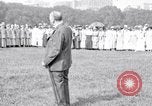
U.S. Navy Secretary Daniels, bids farewell to Navy female Yeomen(F) and female Marinettes of the U.S. Navy as they end their active duty after World War I
U.S. Navy Secretary Josephus Daniels stands in the center of a grassy field surrounded by contingents of women Navy Yeomen and Marine "Marinettes." He bids them farewell, as they are being officially released from active duty in accordance with the Naval Appropriations Act of 1919. Next, he dons his hat and steps forward to commence a final review of the women in formation. Among those accompanying him are: Assistant Navy Secretary, Franklin D. Roosevelt, Admiral William Sims (now President of the Naval War College), and Major General George Barnett, Commandant of the Marine Corps. They walk past a formation of Yeomen(F) commanded by a male Petty Officer sailor, and continue toward a contingent of women marines. Camera focuses,next, on Yeomen(F) marching in review. During the review, Assistant Secretary Roosevelt is seen speaking to Admiral Sims. Civilian spectators stand in the background. Next, the women marines march in review. The final scene shows Daniels and Roosevelt conversing as they pose with women Marinettes, a young Navy Admiral, and and a Yeomen(F) color guard. All relax and disburse as the ceremony ends.

U.S. 65th Congress opening its First Session in Washington DC; women's suffrage leaders gather.
Glimpse of the U.S. Capitol dome. Members of Congress and associated staff and other persons are seen gathering in front of the U.S. Capitol in Washington, DC , on April 2, 1917, for the first session of the 65th U.S. Congress of the United States (following a special session in March). Many people sit on the steps and others gather in clusters. Scene shifts to Jeannette Rankin, Republican representative from Montana, and the first woman elected to Congress. She and a man are trying to unfold a large American flag before the camera. Soon two more men help and they hold the flag spread out as Representative Rankin poses in front of it. Next, James Beauchamp "Champ" Clark, Democratic representative from Missouri (who would be elected Speaker of the House) shakes hands with James Robert Mann, Republican representative from Illinois, who served as House Minority Leader from 1911-1919. Elsewhere in Washington, Jeannette Rankin stands with suffragist Carrie Catt (sometimes also called a suffragette), in the back of an open car in front of the Washington D.C. headquarters of the National Woman's Suffrage Association. Rankin holds a bouquet of flowers. An American flag is displayed nearby. Next the car is seen pulling away, causing Rankin to fall back and sit, from where she was standing, in the back seat. Two more cars full of women follow. A cordon of police officers begins to move a crowd back, and two mounted policemen direct people away from the Capitol buildings. (Note: In this first session of the 65th Congress, on April 2, 1917, President Woodrow Wilson asked Congress to declare war on Germany.)
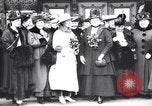
America's first elected woman member of Congress, Jeannette Rankin, in Chicago with women suffragists in 1917
Jeannette Rankin, Republican member of Congress from Montana, and first woman representative elected in the United States, is seen standing with women's suffrage movement activists in Chicago, Illinois, just before America's entry into World War 1. The leading slate mentions her forthcoming participation in a special session of Congress (referring to the Joint Session of Congress on April 2, when President Wilson will ask for a declaration of war against Germany). Rankin holds a bouquet of flowers and stands with another woman wearing a large corsage of flowers. A dozen women suffragists stand behind them (also sometimes called suffragettes). The building behind seems to be a hotel, containing several mirrored doors. Several men passersby walk past the camera while it photographing the group. Jeannette Rankin moves forward and another woman helps her to step into a vehicle (unseen).
Passenger views tractor on a field from railorad train window in United States
Passenger views tractor on a field from Amtrak train window in United States. A man drives the tractor. A house in the background.
Passenger views hill in an area from a passenger railroad train window in United States.
Passenger views hill in an area from window of a moving Amtrak train in the United States. Greenery on the hill. Waterfall is seen cascading down. Trees in the area. Man and a woman sit inside the train and look outside the window.

Train moves through a snowy, mountainous area in the United States.
Views from moving passenger train as it moves through a mountainous, snowy area in the United States, alongside a river (possibly in Colorado). Passengers view trees and electricity towers covered with snow from the moving train. A river along side the snow covered mountains and the train tracks. The train passes through a tunnel. It moves beside the river.
CRITICALPAST.COM: About Us | Contact Us | FAQs - How to Order | License Agreement | My Account | My Lightboxes | Shopping Cart | Advanced Search | Featured Collections | Website Terms & Conditions | Privacy Policy ©2026 CriticalPast LLC.
License Agreement |
Terms & Conditions |
Privacy Policy
©2026 CriticalPast LLC.