


 Francais
 Deutsch
 Italiano
Refine Your Search
Dayton Ohio USA 1947 stock footage and images
- Showing 3919 to 3924 of 25603 results more
more Hide
Hide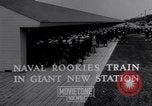
United States blue jackets training at new Naval Training Station in United States.
United States blue jackets training at new Naval Training Station in United States. Sailors at a boat in the sea. Sailors stand on the station in uniforms. They eat food in the dining hall. A swimming pool in the hall. Sailors swim. Sailors exercise in the meditation hall
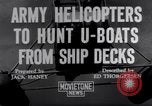
Sikorsky YR-4 helicopter takes off for submarine search at sea in United States.
Sikorsky YR-4 helicopter takes off for submarine search at sea in United States. It lands on the deck of a moving tanker and takes off. Soldiers stand on the ship deck. Helicopter in flight. (World War II period).
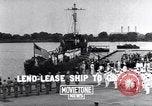
President Roosevelt presents the Crowell crest to the Hellenic Navy at Washington Navy Yards.
President Roosevelt presents the Crowell crest to the Hellenic Navy at Washington Navy Yards. Greek ambassadors respond. Greek sailors board the boat. Flag on the boat.
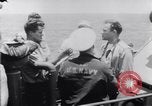
U.S. Navy Task Group led by USS Guadalcanal (CVE-60) tows captured German submarine (U-505) to Bermuda
A Task Group of the U.S. Atlantic Fleet captures and tows a German Submarine (U-505) to Bermuda. Views of captured German crew members being rescued. Destroyer USS Pillsbury passing a line to the U.S. boarding party aboard the U-505, which then collides with the Pillsbury, damaging her hull, and must be cut loose. Because a destroyer appears unable to tow the sea laden submarine, the USS Guadalcanal (CVE-60) does so herself. Views of captured German crew members exercising and bathing on deck of the Guadalcanal. View of the U-505 flying the American flag and entering harbor in Bermuda, on June 19, 1944..
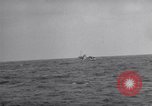
U.S. Coast Guard Cutter, Campbell, makes temporary repairs, at sea, after collision with German submarine U-606 in World War II
Canadian corvette HMCS Dauphin (K 157) seen from the U.S. Coast Guard Cutter George W Campbell, as the Campbell makes temporary repairs at sea, following collision with German submarine U-606, during World War 2. Crew of the Campbell lowering heavy canvas over the side to staunch flow of water into her engine room from the collision. Crew members look over her side as others place the canvas into position. Coastguardsmen swarm over the canvas as they nail it fast to the deck. Crew members run lines up over the ship's side to secure the repair tight against the hull. Crew tilt a fabricated cofferdam and lower it overboard, where it is then seen floating next to the ship. Two crewmen in rubber gear stand on the raft and use poles to stuff material into the gashed hull. Ship's crew runs to starboard to tilt the port hull up for repair crew.Then they run to the port side. Officers make final check on a diver in rubber suit, who then descends side of the ship on a rope ladder. Another diver, sans suit, descends the ladder. Divers back on deck after completing work. Officer on the Campbell hailing a merchantman on a megaphone as she comes abeam, underway. The HMCS Dauphin providing protection for the Campbell. Crew of Campbell securing the cofferdam in place. All hands pulling on lines with block and tackle to tighten the repairs in place.
United States Navy training film on 'Disorientation Crashes' in United States.
United States Navy training film on 'Disorientation Crashes'. Animated film describes disorientation and how instruments solve the problem when flying.
CRITICALPAST.COM: About Us | Contact Us | FAQs - How to Order | License Agreement | My Account | My Lightboxes | Shopping Cart | Advanced Search | Featured Collections | Website Terms & Conditions | Privacy Policy ©2026 CriticalPast LLC.
License Agreement |
Terms & Conditions |
Privacy Policy
©2026 CriticalPast LLC.